


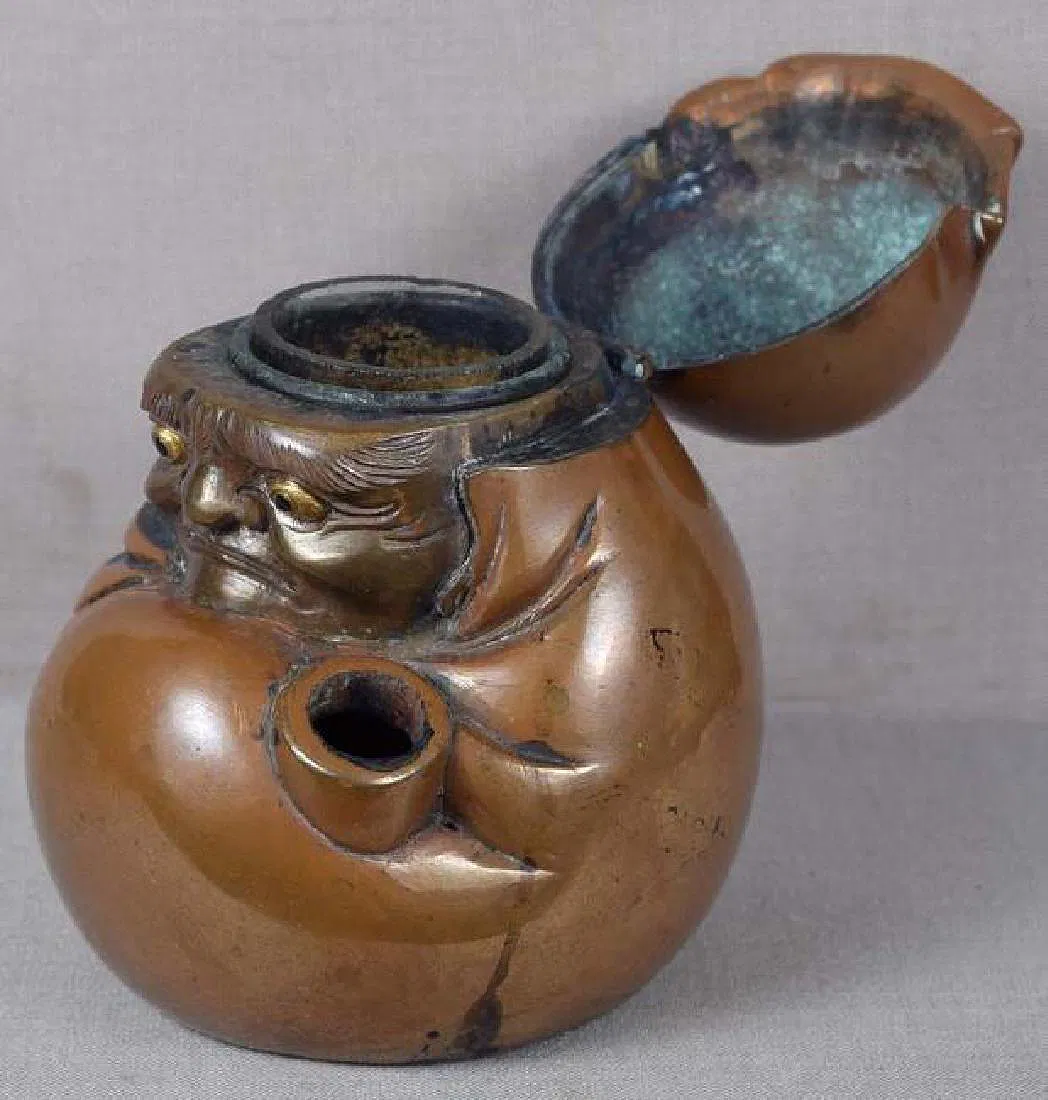


Zen Patriarch Daruma Figure
| Categories | Far East / Oriental, Figural - Mythology; Literature; Religion; Fictional |
| Type | Religion |
| Material | Bronze |
| Markings | Unmarked |
| Manufacturer | Undetermined |
| Origin | Japan |
| Date or Era | circa 1890 |
| Measuring | 3 3/16” high |
This 19th-century Japanese bronze inkwell combines spiritual symbolism with functional desk art. It depicts Daruma (Bodhidharma), the legendary 5th-century monk credited with bringing Zen Buddhism to China and Japan.
The Figure of Daruma: Symbolism and Legend
The inkwell’s rounded, ovoid shape is not merely a stylistic choice; it is deeply rooted in Zen hagiography. According to legend, Daruma spent nine years in a cave facing a wall in a state of intense meditation (zazen).
- The “Limbless” Form: It is said that because he sat motionless for nearly a decade, his arms and legs eventually atrophied and withered away. This gave rise to the traditional Japanese “Daruma doll” shape seen here—a weighted, limbless figure that represents the proverb: “Fall seven times, stand up eight.”
- The Gaze: His expression is one of intense concentration. The eyes are skillfully inlaid with gold and black lacquer, giving him a piercing, “ever-watchful” quality. This reflects the story that Daruma once cut off his own eyelids to prevent himself from falling asleep during meditation.
Artistry and Craftsmanship
This piece is an excellent example of late Edo or Meiji-period metalwork, characterized by its “crisp” execution and attention to texture.
- Drapery: The monastic robe and cape feature a beautiful, fluid movement that contrasts with the solid, heavy nature of the bronze. The lines of the fabric sweep across the body, leading the eye to the figure’s face.
- The Face: The facial features—particularly the famously bushy eyebrows and stern, downturned mouth—are rendered with high-relief detail, capturing the Patriarch’s fierce determination.
- Patina: The metal possesses a rich, warm coppery patina, developed through age and careful handling, which highlights the contours of the casting.
Functional Details
While it serves as a sculpture, the piece is designed for the scholar’s desk:
- The Mechanism: The top of Daruma’s head is hinged, flipping back to reveal a removable glass inkwell housed within a protective brass liner.
- The Pen Rest: On the front left, the robe forms a circular opening designed to hold a calligraphy brush or pen, making the piece a self-contained writing station.
Specifications at a Glance
| Feature | Description |
| Origin | Japan, 19th Century |
| Material | Bronze with gold and black lacquer accents |
| Height | 3 3/16 inches |
| Components | Hinged lid, brass liner, glass inkwell |
| Subject | Zen Patriarch Daruma (Bodhidharma) |
This inkwell is more than a utility; it is a “memento” of perseverance. Having such a fierce, focused figure on a desk was likely intended to inspire the writer to match Daruma’s legendary discipline.
Dating the Inkwell
Based on the craftsmanship and functional features of this piece, one can confidently narrow the date of manufacture to the 1880s or 1890s, during the mid-to-late Meiji Period.
Several specific details act as “temporal anchors” that place it squarely in this window:
- The Post-Samurai Bronze “Golden Age” (1876–1900)
In 1876, the Japanese government issued the Haitōrei Edict, which forbade samurai from wearing swords in public. This suddenly left thousands of master metalworkers (who previously made intricate sword fittings and armor) without a market. To survive, these artisans pivoted to creating high-end decorative objects for the Western “Japonisme” export market and the new Japanese bureaucracy. This inkwell’s “superb face” and “crisp work” are direct results of these master sword-smithing techniques being applied to desk art.
- The Transition to Liquid Ink
The presence of a glass inkwell and brass liner is a major dating clue.
- Pre-1880: Traditional Japanese writing relied on the yatate (portable case) or the suzuri (inkstone) for grinding solid sumi sticks.
- 1880s-1890s: As Japan modernized its education and government systems, Western-style steel nib pens and bottled liquid ink were introduced. Stationary desk inkwells with glass reservoirs became the height of fashion for the “modern” Japanese scholar.
- Material and Technical Hallmarks
- The Eyes: The use of gold and black lacquer for the eyes was a favorite technique of the Meiji period to give bronzes a “lifelike” or “living” quality (iki-ningyo).
- The Patina: The “beautiful coppery patina” is often associated with the high-copper alloys (such as shibuichi or sentoku) that Meiji masters used to achieve a wider range of colors than standard brass or dark bronze.
- Height & Scale: At 3 3/16 inches, this falls perfectly into the category of “scholar’s table” or “cabinet bronzes” (known as okimono) that were popular at international expositions (like the 1893 Chicago World’s Fair) where such items were sold as luxury souvenirs.
Summary of Provenance Markers
| Feature | Historical Context |
| Glass/Brass Liner | Adoption of Western liquid ink (Post-1880). |
| Hinged Head | Western desk-accessory influence integrated with Japanese figure. |
| Lacquered Eyes | Late 19th-century focus on realistic, “fierce” detail. |
| Daruma Theme | Resilience and focus; a popular “good luck” gift for the modern era. |
This piece likely originated from a high-quality workshop in Tokyo or Yokohama, centers that specialized in these refined “desk sets” for collectors and diplomats during the peak of Japan’s 19th-century opening to the world.
Estimated value: $200
Content disclaimer. The information posted is the owner’s best knowledge and may not have been vetted by the SOIC. We welcome comments, corrections, and additions, working to make our website information comprehensive and accurate.
Join the Society of Inkwell Collectors (SOIC) – it’s free!
Founded in 1981 as a non-profit organization,
we are documenting inkwells (and accessories).
We’re here to help and inform!