


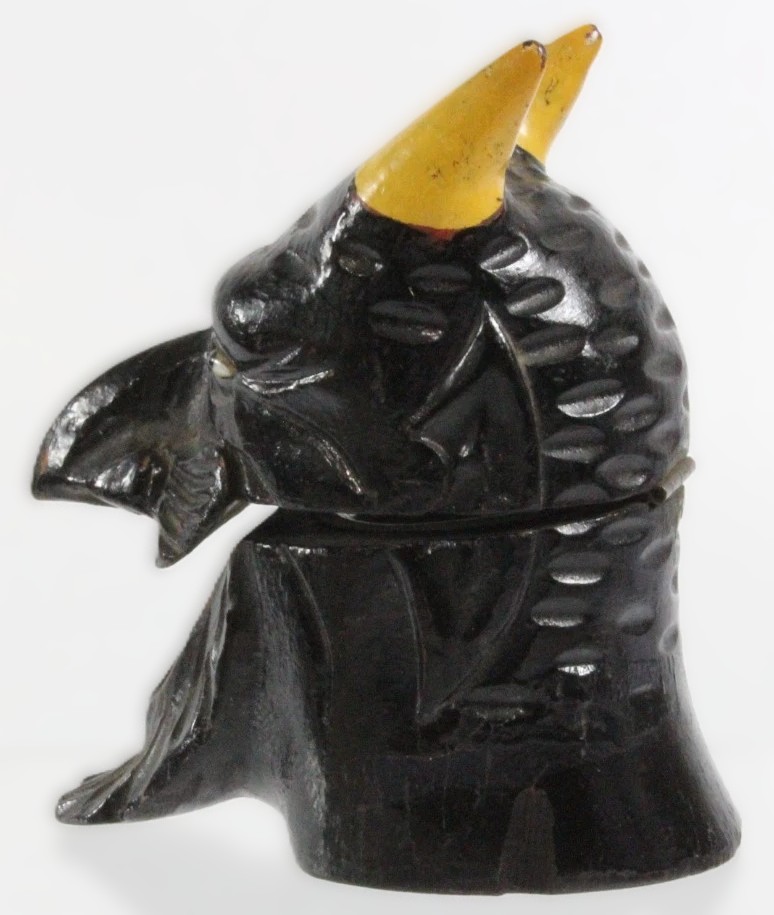
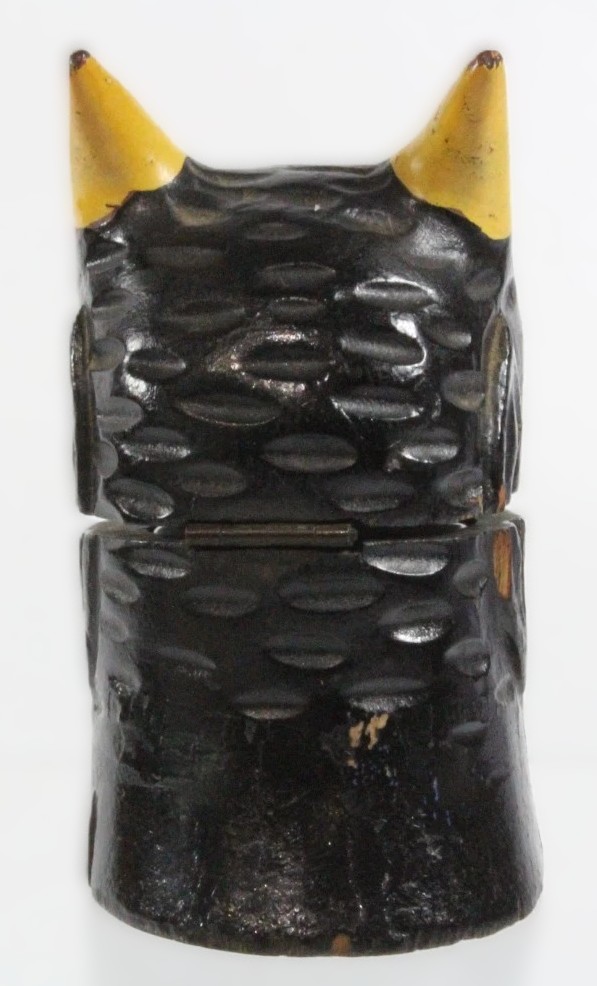


Mephistopheles Carved Figural Inkwell
| Categories | Figural - Mythology; Literature; Religion; Fictional |
| Type | Devil |
| Material | Wood |
| Markings | Unmarked |
| Manufacturer | Black Forest |
| Origin | Switzerland |
| Date or Era | circa 1890 |
| Measuring | 3 ⅜” high |
This piece is a classic example of 19th-century “Black Forest” carving, specifically representing Mephistopheles, the sophisticated devil from Johann Wolfgang von Goethe’s Faust.
While often categorized broadly as a “novelty” or “grotesque,” these objects were high-status desk accessories intended to showcase the owner’s literary taste and appreciation for the Gothic.
Detailed Description
- Material: The piece is hand-carved, likely from Linden (lime) or Walnut wood, which were the preferred materials for artisans in the Alpine regions. The surface is stained or painted black to enhance the “diabolical” aesthetic.
- Features: The glass eyes (with their fixed, translucent stare) are a hallmark of high-quality Black Forest work. The yellow-painted horns and tongue provide a theatrical contrast, reminiscent of the “Red Devil” imagery popular in Victorian theater and early opera.
- Mechanism: The head is hinged at the back of the neck, a standard design for figural inkwells of this period. The white ceramic (porcelain) liner is present.
In the 1800s, Mephistopheles was a global pop-culture icon due to the popularity of Faust and Gounod’s opera of the same name. Having his head on your desk suggested you were a man of letters who understood the “Faustian bargain.”
Origins: Where and When
- Region: Most likely produced in Brienz, Switzerland, or the surrounding Bavarian/Austrian Alps. This region (commonly called “The Black Forest” in the antiques trade, even though Brienz is in Switzerland) dominated the market for carved wood novelties from 1850 to 1920.
- Date: Circa 1880–1900. This was the height of the Victorian obsession with “grotesques”—humorous or frightening figures that broke the monotony of traditional decor.
The Source of Fascination
The fascination with “diabolical” desk items stemmed from the Gothic Revival and the Romantic movement. Victorians were captivated by the “Grotesque”—the idea that the ugly or the demonic could be artistically compelling.
Additionally, an inkwell shaped like a devil carried a subtle, witty subtext: the “devil in the ink.” It suggested that the act of writing was powerful, perhaps even dangerous, and that the person wielding the pen was a master of their own “deal” with the world.
Johann Wolfgang von Goethe’s Faust is far more than a simple “deal with the devil” story; it is a sprawling, two-part epic that explores the limits of human ambition, morality, and the search for meaning.
The Central Wager
The story begins not on Earth, but with a “Prologue in Heaven.” Mephistopheles makes a bet with God, claiming he can lure God’s favorite scholar, Faust, away from his righteous path.
On Earth, the elderly Heinrich Faust is in despair. Despite mastering philosophy, law, medicine, and theology, he feels he knows nothing of true value. When Mephistopheles appears (initially disguised as a black poodle), they strike a unique bargain:
- The Deal: Mephistopheles will serve Faust on Earth, granting him every possible experience and pleasure.
- The Condition: If Faust ever finds a moment so beautiful and satisfying that he asks it to linger—saying, “Stay, thou art so fair!” (Verweile doch, du bist so schön!)—then he will die at that instant, and his soul will belong to Mephistopheles in the afterlife.
Part I: The “Little World”
This part is a domestic tragedy. Mephistopheles restores Faust’s youth and helps him seduce Gretchen, an innocent, pious young woman.
- The Downward Spiral: With Mephistopheles’ cynical guidance, Faust’s “love” leads to a series of horrors: Gretchen’s mother is accidentally poisoned, her brother is killed in a duel with Faust, and Gretchen herself drowns her illegitimate child in a fit of madness.
- The Ending: Faust tries to rescue Gretchen from prison, but she refuses to flee with the help of a demon. As she dies, a voice from Heaven declares, “She is saved,” highlighting that her soul is redeemed by her repentance, while Faust and Mephistopheles flee.
Part II: The “Great World”
Published decades later, Part II is highly allegorical and covers politics, history, and classical mythology.
- The Imperial Court: Faust and Mephistopheles go to the court of the emperor, where Mephistopheles invents paper money to save the empire from bankruptcy.
- Classical Beauty: Faust becomes obsessed with Helen of Troy (representing the ideal of classical beauty). Through time-travel and magic, he marries her, and they have a son named Euphorion, though both eventually vanish.
- The Final Project: In his old age, Faust embarks on a massive engineering project to reclaim land from the sea for a new civilization.
Mephistopheles: The “Spirit of Negation”
Mephistopheles is one of literature’s most complex antagonists. He famously describes himself as:
“Part of that power which always wills evil and yet always works good.”
His Role as a Foil
- The Cynic: He is the ultimate skeptic. While Faust is a “striver” who wants to touch the divine, Mephistopheles believes everything is ultimately meaningless and destined for destruction.
- The Intellectual Devil: He doesn’t use brute force; he uses wit, irony, and the exploitation of human ego. He provides the “how” for Faust’s desires without ever bothering with the “should.”
- The Paradox: By constantly challenging and tempting Faust, Mephistopheles drives Faust to keep striving. In the end, it is this “unending striving” that allows angels to rescue Faust’s soul from Mephistopheles’ clutches, effectively making the devil the accidental tool of Faust’s salvation.
Sold for $225 in March 2026
Content disclaimer. The information posted is the owner’s best knowledge and may not have been vetted by the SOIC. We welcome comments, corrections, and additions, working to make our website information comprehensive and accurate.
Join the Society of Inkwell Collectors (SOIC) – it’s free!
Founded in 1981 as a non-profit organization,
we are documenting inkwells (and accessories).
We’re here to help and inform!