





Combination Inkwell and Pocket Watch
| Categories | Dual Purpose Inkstands |
| Type | Clock |
| Material | Silver, Stoneware |
| Markings | See Narrative |
| Manufacturer | John Grinsell & Co |
| Origin | England |
| Date or Era | circa 1904 |
| Measuring | 2 ⅜” x 2 ⅜” x 2 ⅞” high |
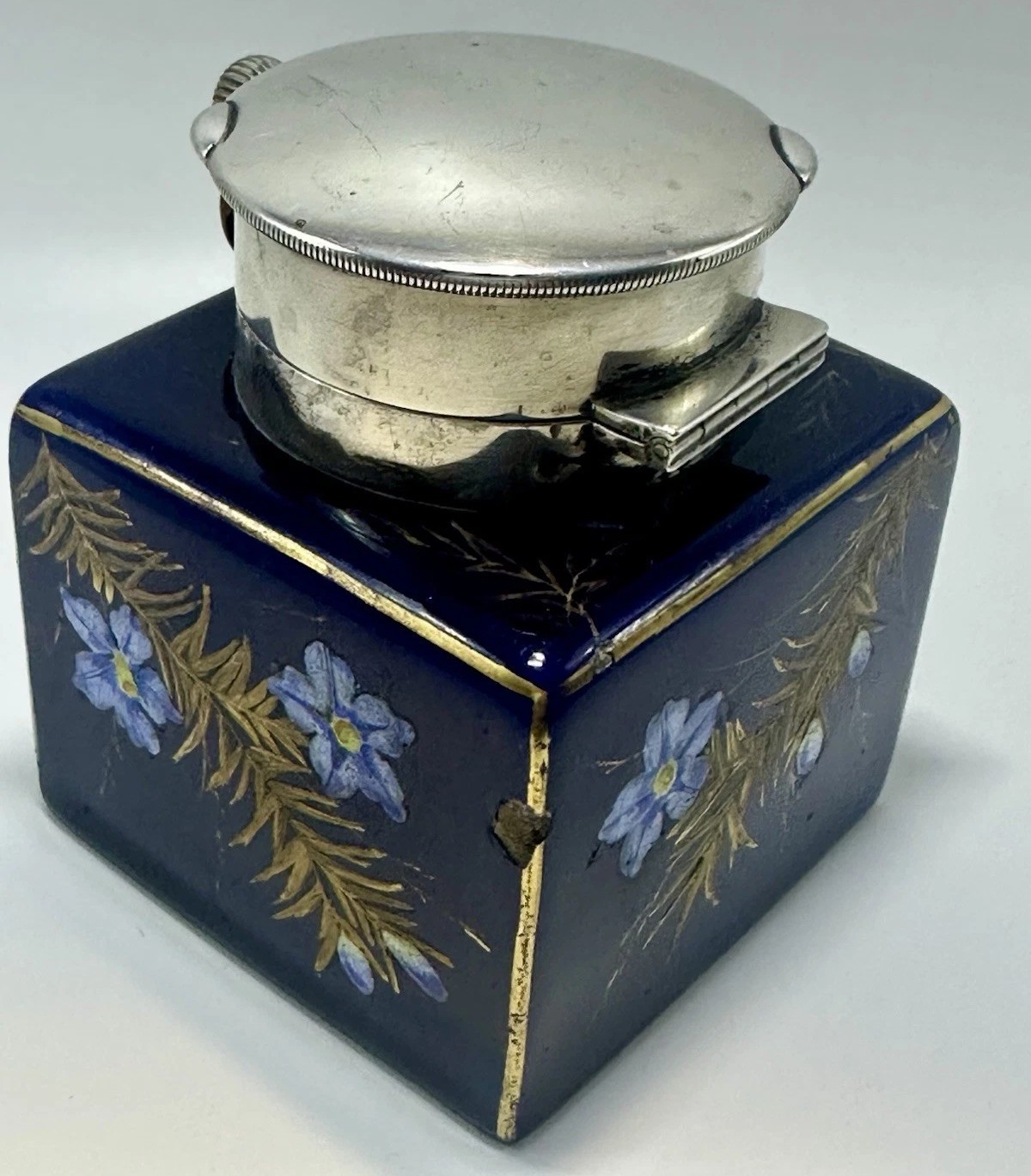
This is a remarkable Edwardian sterling silver and cobalt blue ceramic combination inkwell, featuring an integrated pocket watch.
General Description
This “combination” desk accessory was a luxury item produced during the Edwardian era (1901–1910). It served as both a functional inkwell and a desk clock. The square (cuboid) ceramic base is finished in a deep cobalt blue glaze, embellished with hand-painted gold gilt depicting evergreen/pine branches and blue forget-me-not flowers.
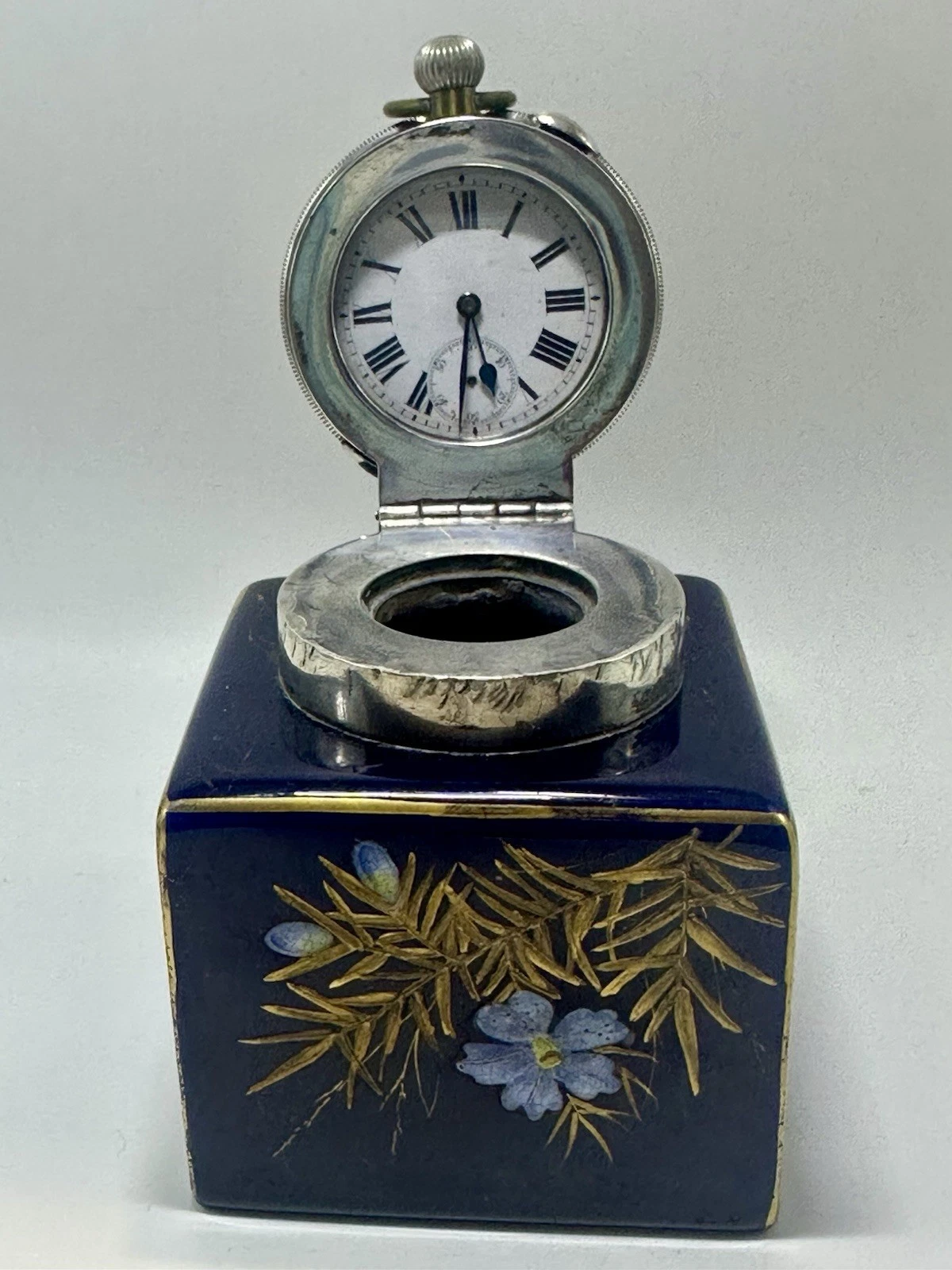
The silver mount consists of a cylindrical collar with a hinged lid that opens to reveal a top-wind pocket watch embedded in the underside of the lid. When the lid is propped open, the watch face is positioned for easy viewing by the writer.
Hallmarks & Identification
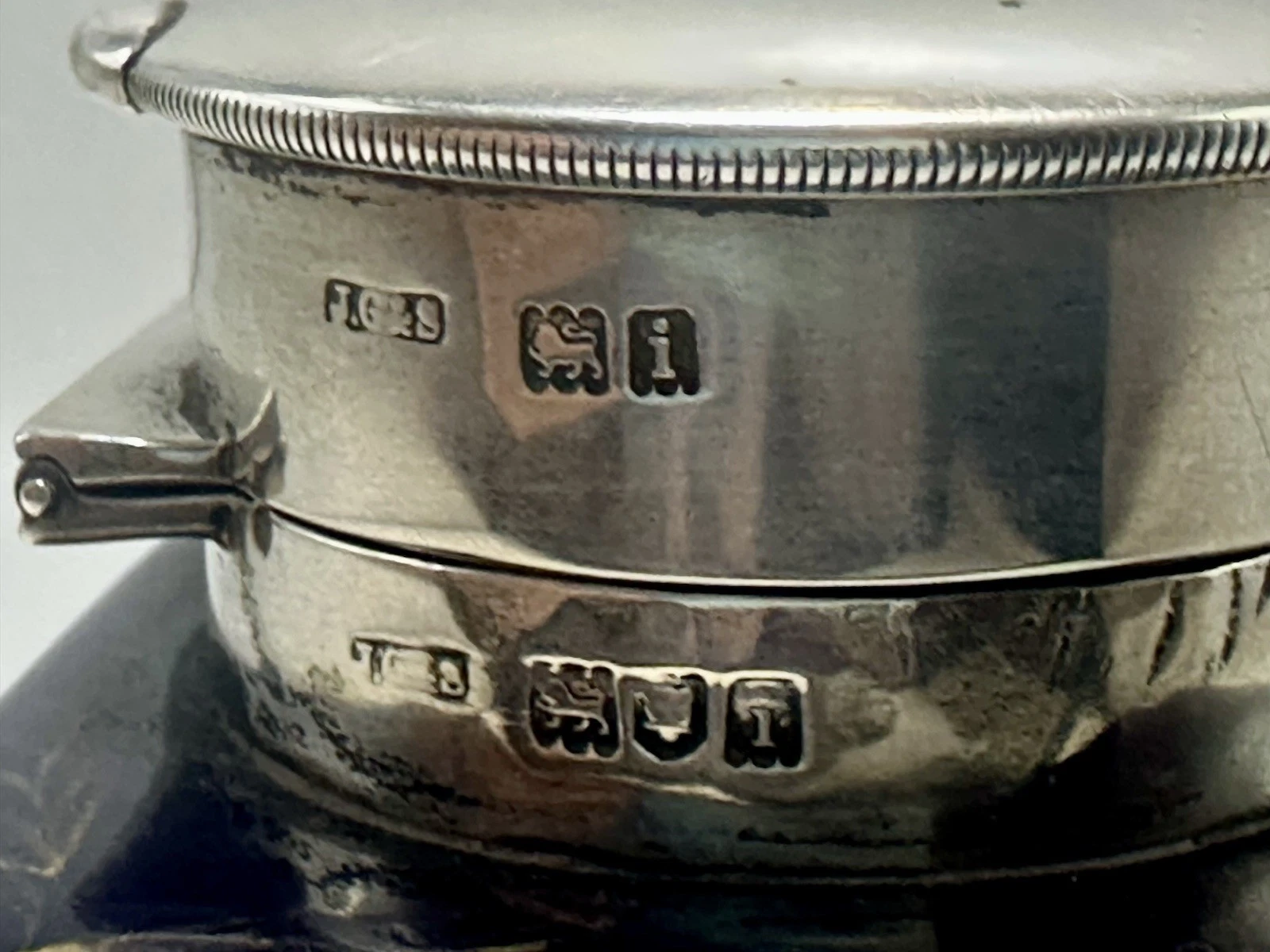
- Maker: J G & S – This stands for John Grinsell & Sons. They were a prestigious firm founded in Birmingham (Victoria Works) with significant showrooms in London. They were renowned for high-quality “mounted” items—combining silver with glass, ceramics, or leather.
- City Mark: Leopard’s Head – This confirms the silver was assayed in London.
- Purity Mark: Lion Passant – Denotes .925 Sterling Silver.
- Date Letter: “i” – Specifically for the year 1904.
- Watch Movement: The watch is a standard high-quality Swiss or English lever movement of the period. The “S” and “F” (Slow/Fast) are the regulator marks used to adjust the timing.
Ceramic & Pattern
The ceramic base is most likely Doulton Burslem (Royal Doulton). John Grinsell & Sons had a long-standing partnership with the Doulton factory, frequently mounting silver onto their stoneware and porcelain.
- The Glaze: This deep “Cobalt Blue” was a hallmark of Doulton’s high-end decorative wares at the turn of the century.
- The Pattern: The combination of pine needles (and sometimes cones) with forget-me-nots is a classic Aesthetic Movement motif, often influenced by “Japonisme” (Japanese art styles). Forget-me-nots were highly symbolic in this period, representing lasting memory and friendship.
Unusual Features
- Removable Watch: The pocket watch is designed to be removable. This allowed the owner to use it as a standard pocket watch or to wind/set it more easily.
- Integrated Winding: The silver collar features a small “U” shaped notch or a specific crown access point which allows the watch to be wound while seated in the lid.
- “Traveling” Heritage: While this is a desk piece, the “watch-in-lid” design was originally popularized for traveling inkwells, ensuring that a gentleman or lady had both time and ink in a single, compact unit.
Historical Context
By 1904, John Grinsell & Sons was at the peak of its popularity, specializing in these “novelty” combinations (clock-inkwells, barometer-inkwells, and even inkwell-stamp boxes). A piece like this would have been a high-end gift or a luxury purchase from a London jeweler.
Sold for $200 in March 2026
Content disclaimer. The information posted is the owner’s best knowledge and may not have been vetted by the SOIC. We welcome comments, corrections, and additions, working to make our website information comprehensive and accurate.
Join the Society of Inkwell Collectors (SOIC) – it’s free!
Founded in 1981 as a non-profit organization,
we are documenting inkwells (and accessories).
We’re here to help and inform!