


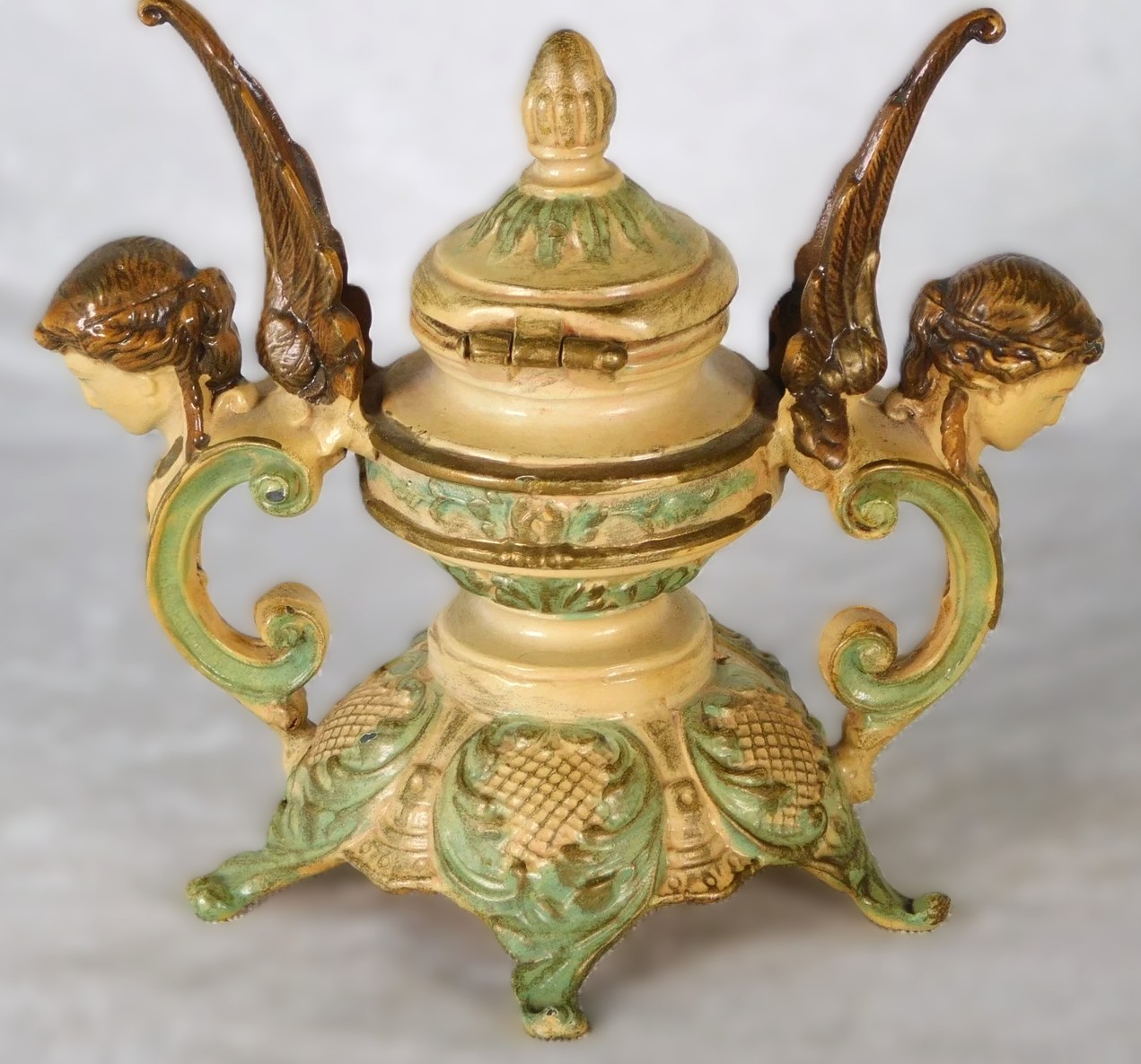


Cold-Painted Spelter Inkstand with Female Busts
| Categories | Art Nouveau |
| Material | Spelter |
| Markings | Unmarked |
| Manufacturer | Undetermined |
| Origin | France |
| Date or Era | circa 1900 |
| Measuring | 6” x 4 ⅜” x 5 ¼” high |
This is a nice example of a French Art Nouveau cold-painted spelter (régule) inkstand, dating to the Belle Époque period, circa 1890–1910.
Description
The inkstand is cast from spelter (a zinc-based alloy often called “pot metal” or régule in French) and has been cold-painted. This technique involves applying layers of unfired enamel or paint to the metal, a popular method for creating colorful, affordable decorative items that mimicked expensive polychrome bronze or ceramics.
- Color Palette: It features a classic late 19th-century “ivory” or cream base, accented with soft green (simulating a verdigris patina) and highlights of gold gilt.
- Design: The central inkwell has a hinged lid topped with an ornate finial. The base is flared and heavily decorated with Art Nouveau foliate scrolls and a cross-hatched lattice pattern.
- The Handles: The most distinctive feature is the pair of handles, which take the form of winged female busts.
Who are the winged women?
In the context of French Art Nouveau and Beaux-Arts design, these winged women are allegorical figures. They are not traditional biblical angels but are instead representations of Fame (La Renommée) or Victory (La Victoire / Nike).
- Symbolism: Figures of Fame were a favorite motif in the Belle Époque, symbolizing inspiration, success, and the “lifting up” of the arts. They are often depicted with tall, vertical wings and serene, classical faces.
- Caryatid Form: These specific figures are designed as winged caryatids (female figures used as structural supports), where their busts transition into the scrollwork of the handles. If you look closely at the chest of the figures, there is a small medallion or heart-shaped pendant, which was a common decorative detail for “Fame” busts of this era.
Origin and Age
- Where was it made? Almost certainly France, likely in one of the major Paris foundries such as Fabrication Française Paris or the workshops of the Moreau brothers (Louis or Hippolyte), who were famous for producing highly ornate spelter statues and desk accessories.
- How old is it? It is roughly 125 years old. This style of polychrome spelter peaked in popularity around the 1900 Paris Exposition Universelle, where many such “souvenir” inkstands and desk sets were produced for the international market.
Sold for $110 in March 2026
Content disclaimer. The information posted is the owner’s best knowledge and may not have been vetted by the SOIC. We welcome comments, corrections, and additions, working to make our website information comprehensive and accurate.
Join the Society of Inkwell Collectors (SOIC) – it’s free!
Founded in 1981 as a non-profit organization,
we are documenting inkwells (and accessories).
We’re here to help and inform!