





Johnston’s Spotless Inkstand to Banker’s Automatic No. 300
| Categories | Glass - Non-figural |
| Material | Glass |
| Markings | See Narrative |
| Manufacturer | Cushman & Denison Mfg Co. |
| Origin | United States |
| Date or Era | circa 1900 |
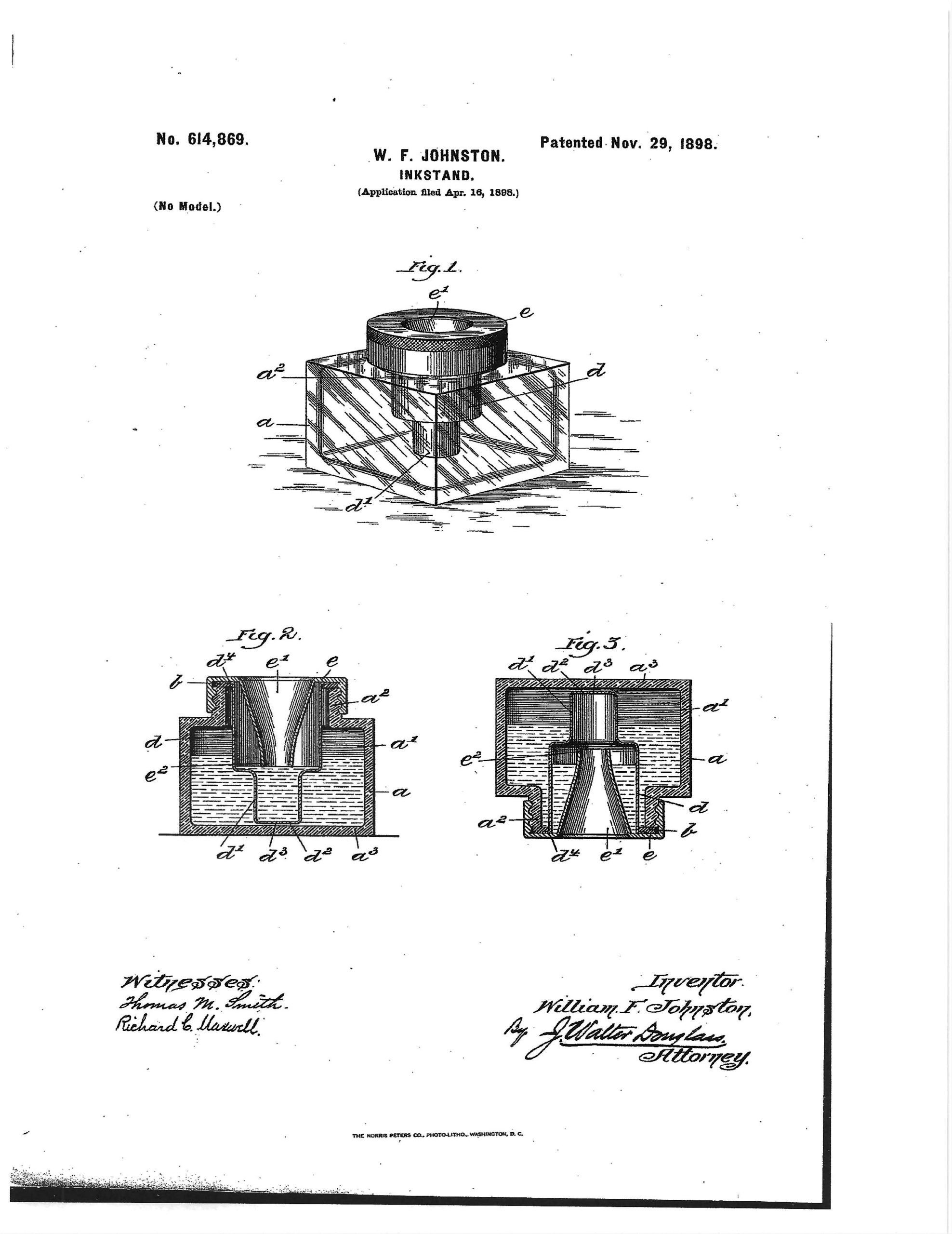
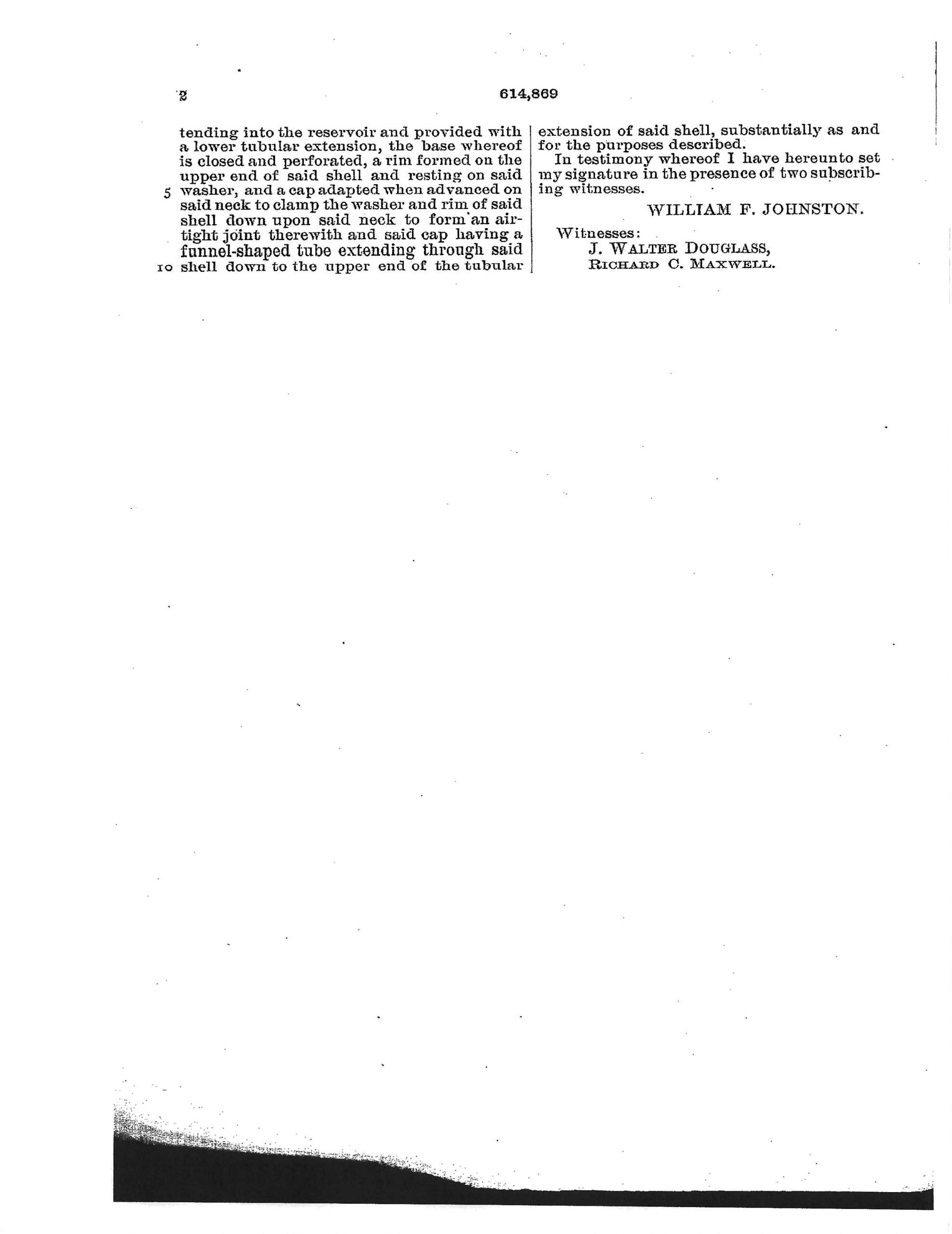
| Patent | No. 614,869 Patented Nov. 29, 1898 |
- Summary of the Johnston Patent (No. 614,869)
William F. Johnston’s invention was a solution to two messy problems of the 19th-century desk: evaporation and accidental spills. The patent describes a sophisticated “atmospheric” inkwell that relies on air pressure to keep ink available but contained.
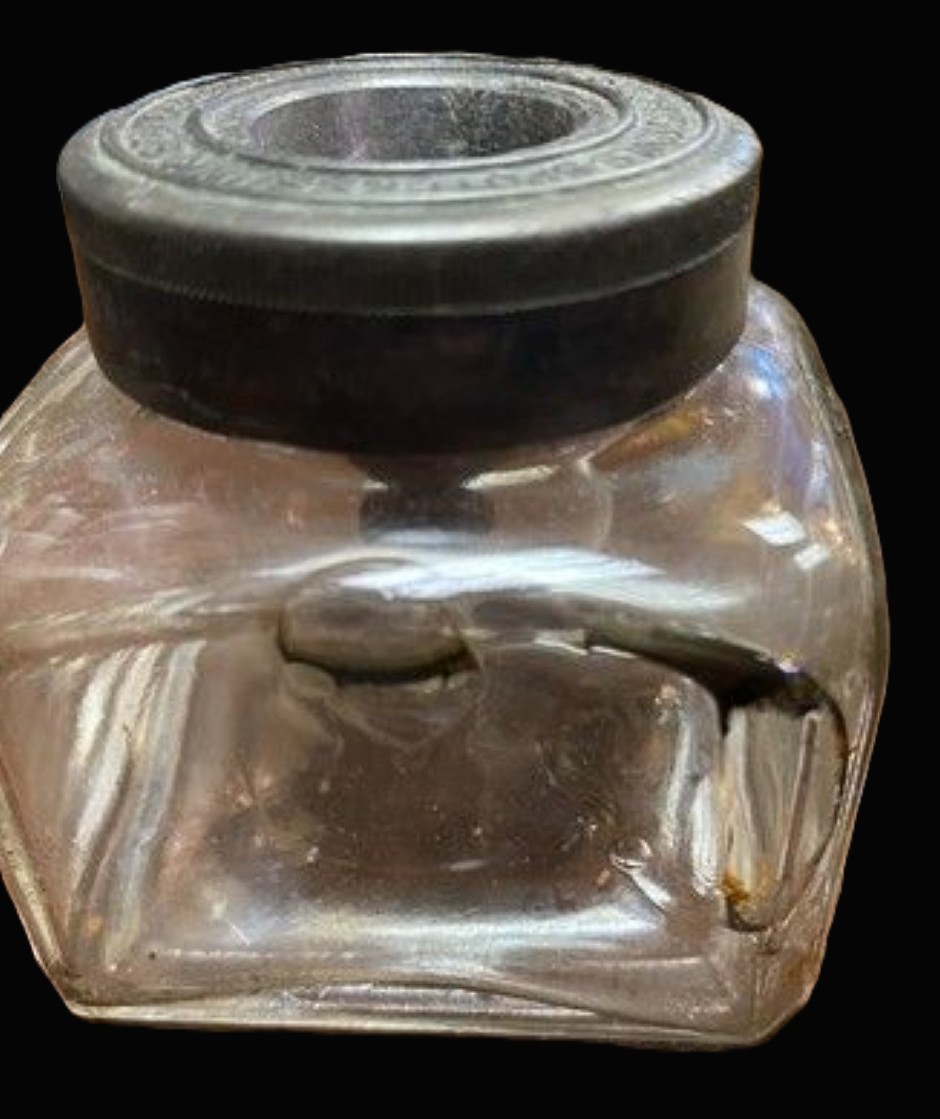
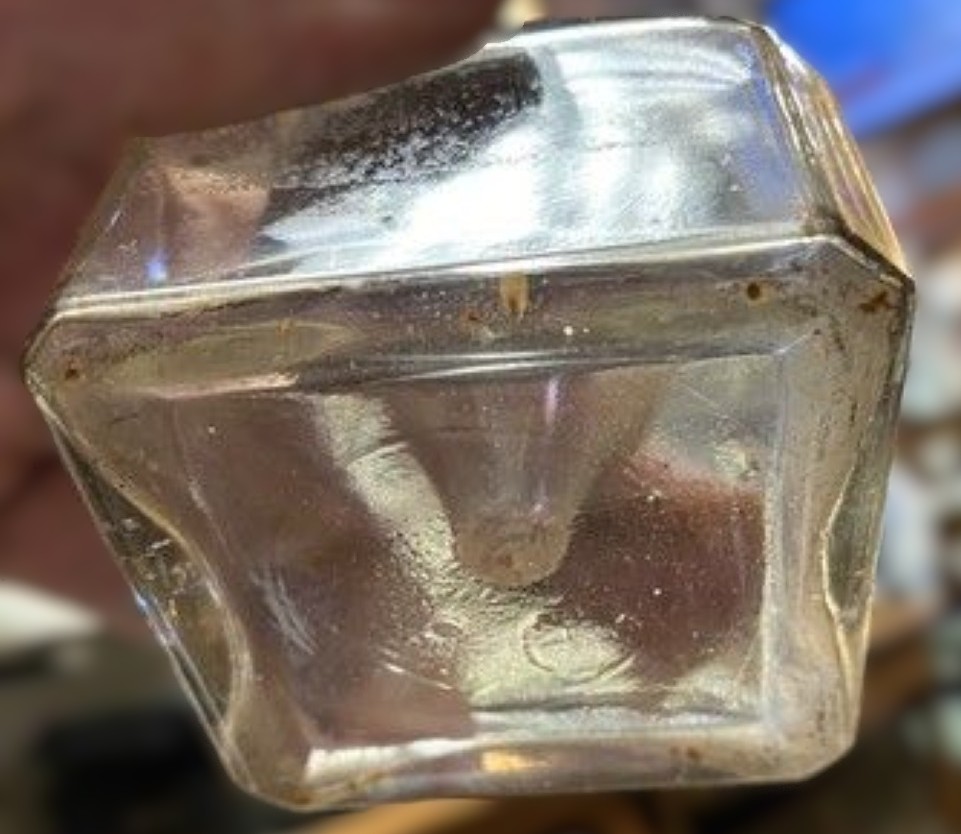
- The Internal Shell: Unlike standard wells, this has a removable inner cup. A tiny perforation at the bottom allows ink to “percolate” from the main reservoir into the center.
- The Atmospheric Seal: As the ink rises in the inner shell, it eventually touches the bottom of the funnel-shaped cap. This creates an air-tight seal. Because no more air can enter the main reservoir, the ink stops flowing into the center, preventing it from overflowing.
- The “Spotless” Feature: Because of this vacuum seal, the patent highlights that the inkstand can be completely inverted (turned upside down) without leaking, as shown in Figure 3 of the patent drawing.
- Maintenance: The design allows for easy cleaning by unscrewing the cap and removing the inner shell, a significant upgrade over “closed” safety inkwells of the era.
The story of this inkwell is a classic American tale of late-Victorian ingenuity meeting 20th-century industrial marketing. It traces a 10-year journey from a “Spotless” basement invention to an “Automatic” essential in the halls of Wall Street.
- The Inventor’s Vision (1898)
The journey begins with William F. Johnston, a Philadelphia inventor who set out to solve the greatest office frustration of the 1890s: the messy ink spill. On April 16, 1898, he filed a patent for a revolutionary “Atmospheric” inkstand.
The “Spotless” Design
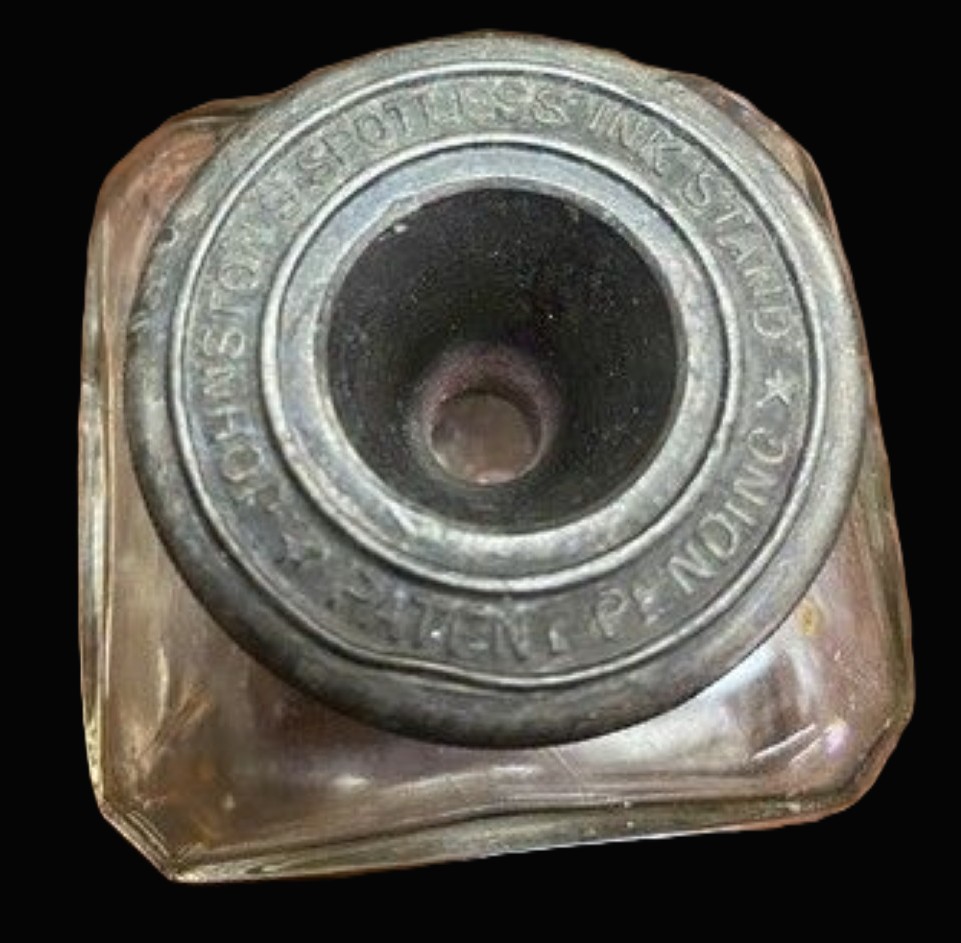
Johnston’s early production models, labeled “Johnston’s Spotless Ink Stand,” were defined by their functionality over form. These first versions featured:
- The Atmospheric Seal: A complex interior where a funnel-shaped cap trapped a pocket of air. This regulated the ink level so that it would “percolate” into the center only as needed.
- Gravity Defiance: Johnston’s primary selling point was that the inkwell could be turned upside down without leaking, thanks to the vacuum seal created between the inner shell and the funnel.
- Industrial Utility: It was “Spotless” because it kept the user’s fingers and desk clean—a rare feat in the era of dip pens.
- The Marketing Pivot (c. 1899–1904)
While Johnston had the “brain,” he lacked the distribution network to reach every desk in America. Enter W.L. Mason & Co. of Keene, New Hampshire.
Mason was already a titan in the pen industry (famed for their “Bankers’ Pens”). They recognized that Johnston’s “Spotless” name sounded like a household cleaning product. To appeal to their high-end clientele, they rebranded the invention as the “Bankers’ Automatic.”
The Branding Strategy: They kept Johnston’s mechanics but renamed it “Automatic” to suggest a self-regulating, high-tech piece of equipment, and “Bankers” to denote prestige and reliability.
During this era, the inkwells were stamped with the Mason name, and early marketing graphics (like the one seen on the “No. 300” box) were created to establish the brand’s new identity.
III. The Corporate Final Form (c. 1905+)
By the early 1900s, Cushman & Denison Mfg. Co. of New York—the “Goliath” of office supplies—sought to consolidate the market. They acquired the rights to the design and fully integrated it into their massive catalog as the Bankers’ Automatic No. 300.
- Industrial Refinement: The glass was transitioned into a heavy, sharp-beveled block, providing the “Executive” look preferred in law firms and banks.
- The “Hybrid” Box: The box is a perfect historical snapshot. It features the Cushman & Denison name on the cardboard, but the illustration on the side still shows the older L. Mason lid. This suggests it was manufactured during the transitional period when C&D was using up Mason’s old marketing plates.
- The Final Lid: The cap is finally stamped with “Cushman & Denison Mfg. Co.,” marking the end of the “Spotless” and “Mason” independent eras.
Summary of the Journey
| Phase | Identification | Key Achievement |
| The Invention | Johnston’s Spotless | Created the spill-proof “Atmospheric” vacuum seal. |
| The Branding | W.L. Mason & Co. | Positioned the product for the banking and professional elite. |
| The Empire | Cushman & Denison | Mass-produced the “No. 300” as a global office standard. |
This evolution shows that while the glass became heavier and the name changed from a simple “Spotless” to a prestigious “Bankers’ Automatic,” the mechanical heart remained exactly as William Johnston envisioned it in Philadelphia in 1898.
Banker’s Automatic sold for $34 in February 2026
Content disclaimer. The information posted is the owner’s best knowledge and may not have been vetted by the SOIC. We welcome comments, corrections, and additions, working to make our website information comprehensive and accurate.
Join the Society of Inkwell Collectors (SOIC) – it’s free!
Founded in 1981 as a non-profit organization,
we are documenting inkwells (and accessories).
We’re here to help and inform!