

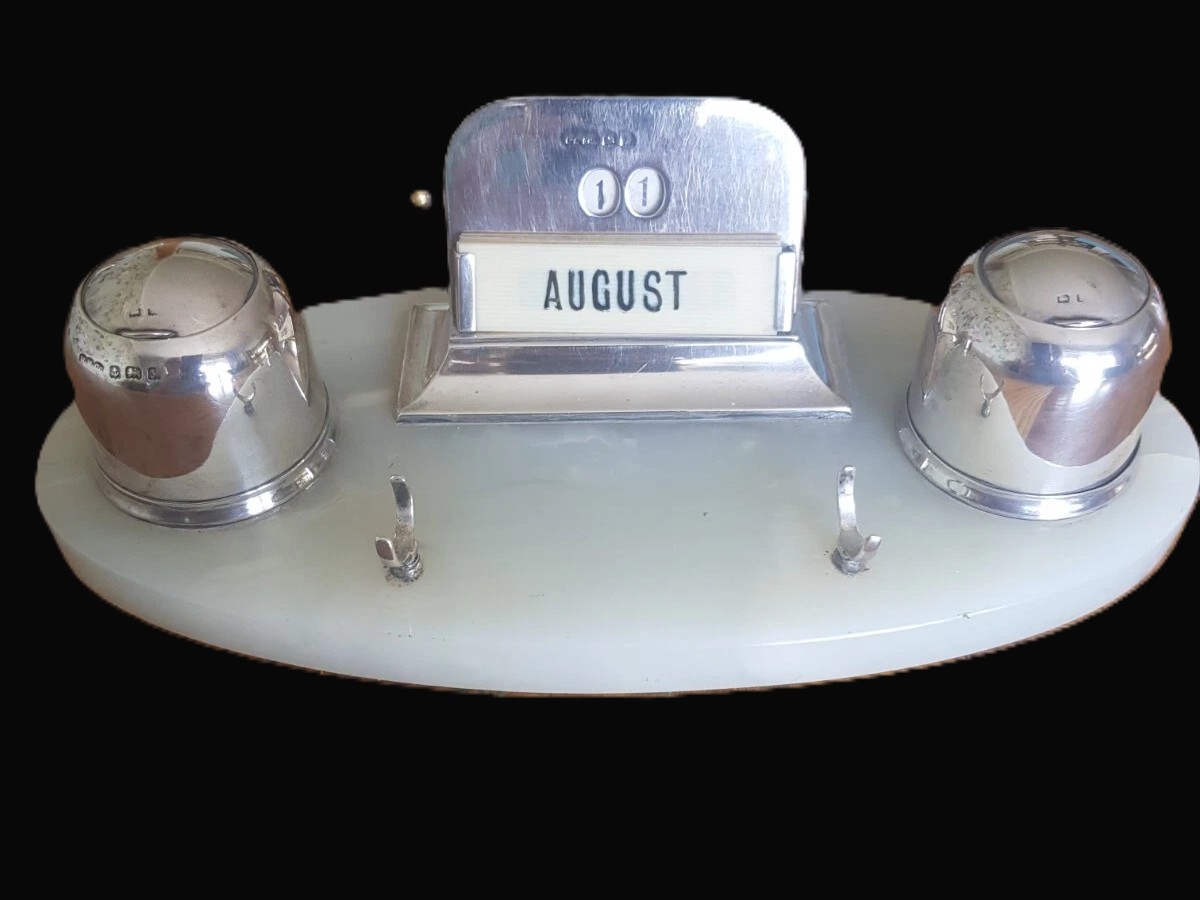

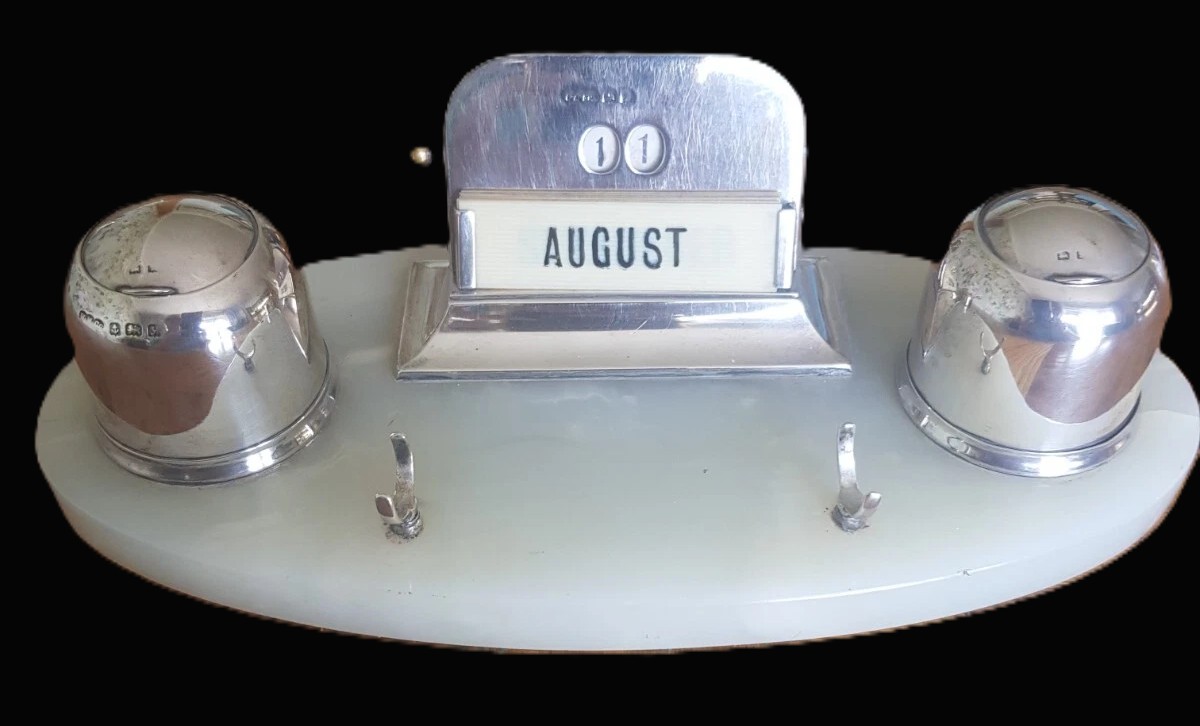
Art Deco Silver & White Onyx Perpetual Calendar Inkstand
| Categories | Art Deco, Dual Purpose Inkstands |
| Type | Calendar |
| Material | Onyx, Silver |
| Markings | See Narrative |
| Manufacturer | Wilmot Manufacturing Co. |
| Origin | England |
| Date or Era | circa 1923 |
| Measuring | 8 ¾” x 4 ⅛” (base) |
The Design & Base
The centerpiece of this set is an oval base made from solid white onyx. The stone features subtle natural veining and a polished finish that provides a luxurious weight and stability. At the front of the base sit two curved silver hooks designed to hold a single fountain pen or dip pen horizontally, keeping it within easy reach.
Innovative “Rolling Dome” Inkwells
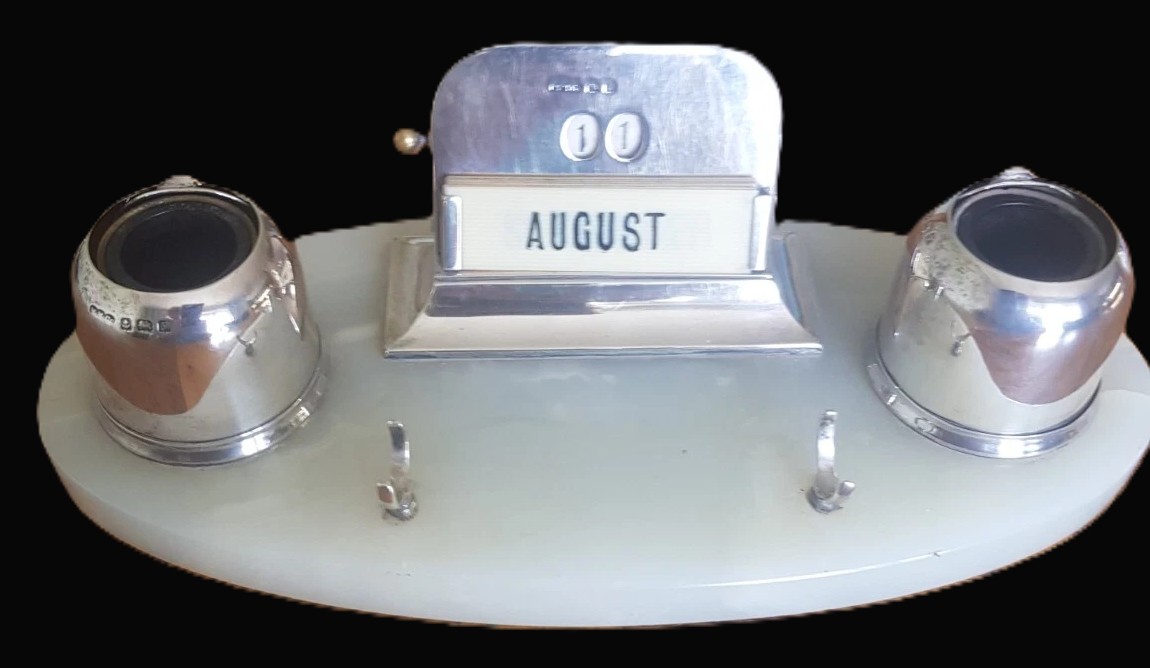
Flanking the central calendar are two matching silver inkwells. These feature a distinctive “Revolving” or “Rolling Dome” lid mechanism. Rather than a standard hinge, the covers consist of concentric silver sections that slide smoothly into one another to reveal the interior.
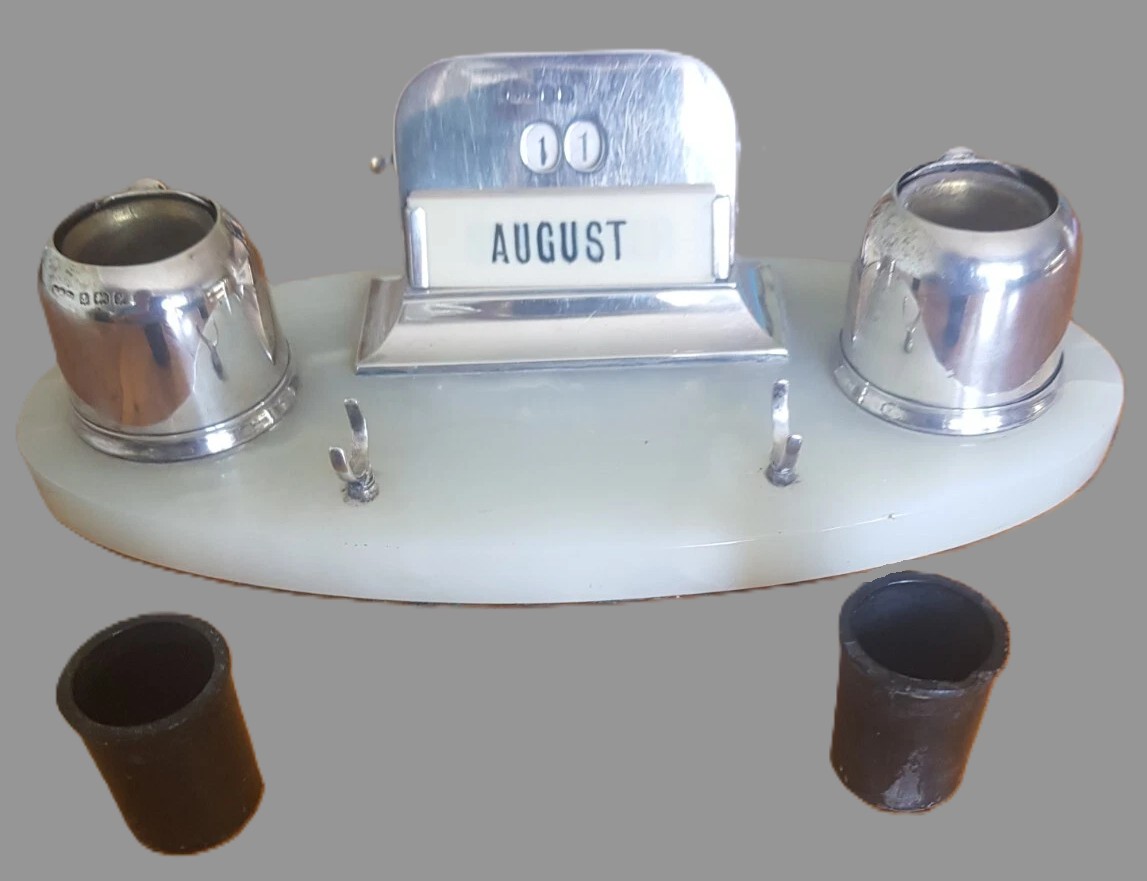
- Inserts: Both wells contain their original, removable black Bakelite inserts.
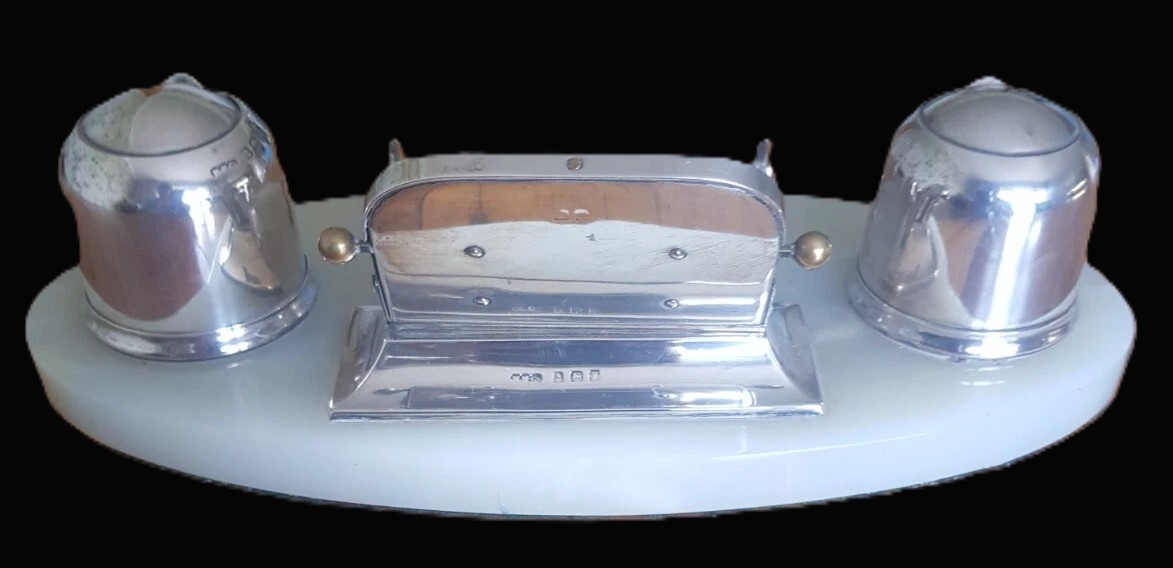
- Hallmarks: Each inkwell is individually hallmarked, confirming they are a true matched pair.
The Perpetual Calendar
Positioned centrally is a perpetual calendar housed in a hallmarked silver frame.
- Mechanism: It features a spring-loaded date adjustment system, operated by a small side knob to flip the numerical digits.
- Month Display: Below the date is a window for slot-in month cards allowing the user to keep the desk set current year after year.
Provenance & Hallmarks
The silver is fully hallmarked for Birmingham, 1923. This date marks the very beginning of the Art Deco era, evidenced by the clean lines and lack of Victorian fussiness. The maker’s mark is for the Wilmot Manufacturing Company, a firm well regarded for their high-quality silver-mounted desk items during the early 20th century.
The hallmarks on this 1923 Birmingham silver desk set follow the traditional British system. On early 20th-century pieces like this, you will typically find a row of four distinct “punches” that act as a legal certificate of the item’s origin and quality.
The Hallmark Symbols Identified
| Symbol | Meaning | Description |
| W.M.Co | Maker’s Mark | The initials for the Wilmot Manufacturing Company. On this piece, these are typically enclosed in three joined circles or a rectangular shield. |
| Standard Mark | The Lion Passant (a walking lion with one paw raised). This is the most famous British mark; it guarantees the silver is Sterling (.925 purity). | |
| Town Mark | An Anchor. This is the symbol for the Birmingham Assay Office, where the silver was tested and stamped. | |
| y | Date Letter | A lowercase “y”. In the Birmingham cycle, a lowercase “y” inside a shield with a pointed base specifically denotes the year 1923. |
The History of Wilmot Manufacturing Co.
- Origins and Amalgamation (1912) The company was officially formed in 1912 through the merger of three established Birmingham firms:
- Wilmot Brothers (based at York Works).
- Norton & White.
- Walsam & Co.
By joining forces, they consolidated their expertise in both sterling silver and high-quality electroplate, operating out of the Eastern Works at 92-100 Camden Street, Birmingham.
- The Partners The business was led by Walter Henry Marks, John Paul Wilmot, and William Slaney Wilmot. Interestingly, William Slaney Wilmot retired in 1915, leaving Walter and John Paul to navigate the firm through the First World War and into the boom of the 1920s – the era when this inkstand was created.
- Pioneers of the Art Deco Style In the early 1920s, the company became highly regarded for embracing the Art Deco movement before it was even fully named. They moved away from the ornate, flowery patterns of the Victorian and Edwardian eras in favor of:
- Geometric Precision: Clean, architectural lines seen in the calendar housing.
- Mechanical Novelties: They specialized in “stationery novelties,” specifically the “Rolling Dome” or revolving lid mechanism on these inkwells, which was considered a high-tech luxury at the time.
- Transition to “Wilmot Breeden” (1927) A major turning point occurred in 1927. The firm was reformed as Wilmot Breeden. If that name sounds familiar, it’s because they became one of the most famous automotive component manufacturers in the world, producing handles, bumpers, and locks for brands like Rolls-Royce, Jaguar, and Aston Martin.
Note: This 1923 inkstand represents the company at its absolute “Silver Zenith”—just a few years before their focus shifted toward the massive industrial engineering contracts of the mid-20th century.
Sold for $200 in February 2026
Content disclaimer. The information posted is the owner’s best knowledge and may not have been vetted by the SOIC. We welcome comments, corrections, and additions, working to make our website information comprehensive and accurate.
Join the Society of Inkwell Collectors (SOIC) – it’s free!
Founded in 1981 as a non-profit organization,
we are documenting inkwells (and accessories).
We’re here to help and inform!