


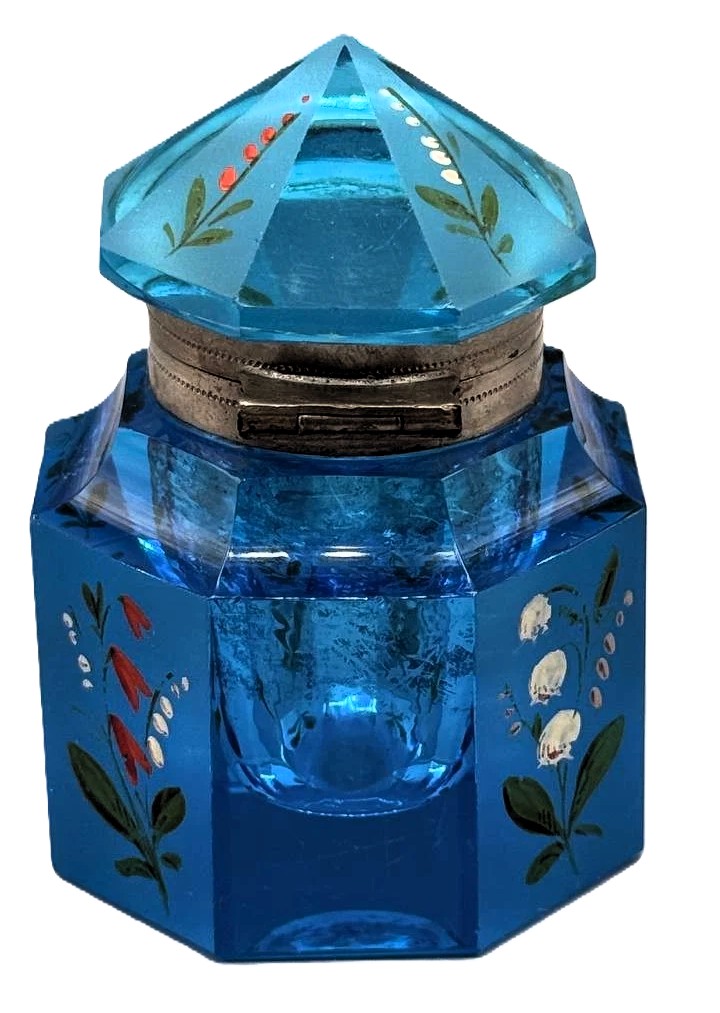
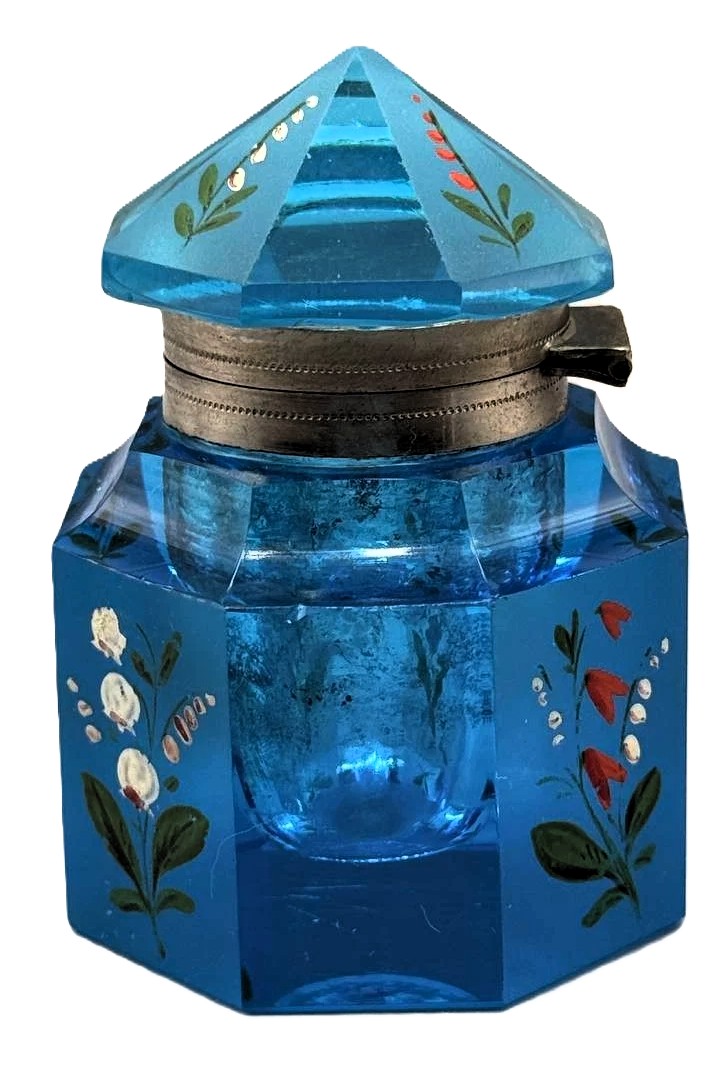
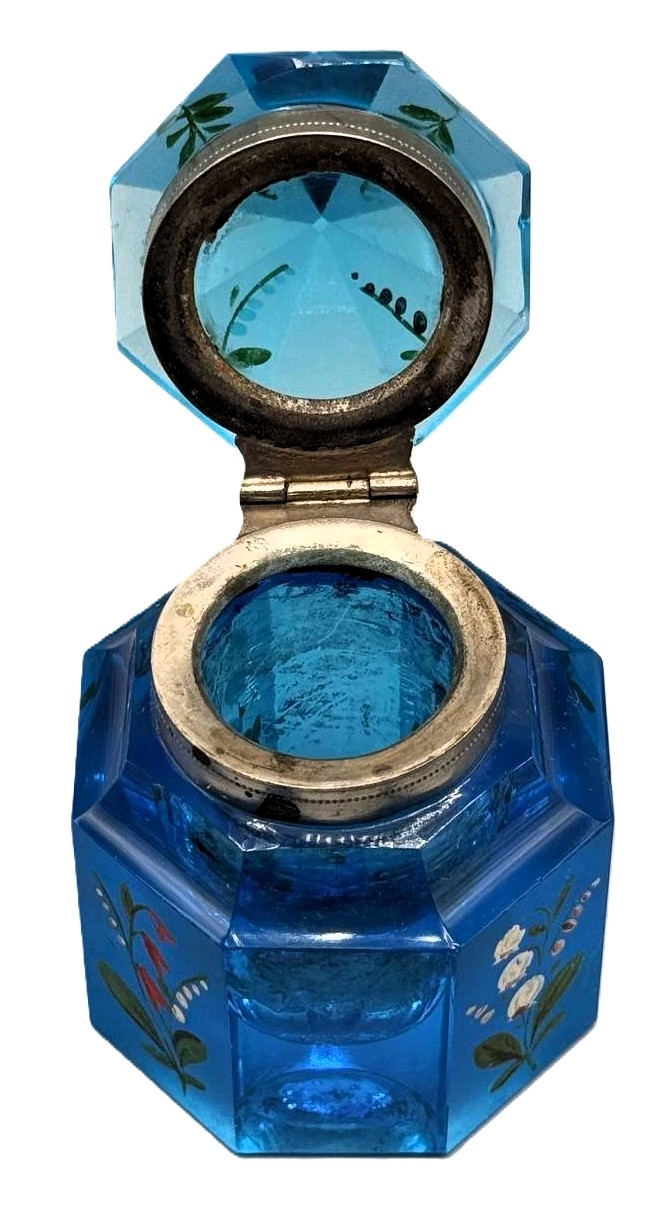
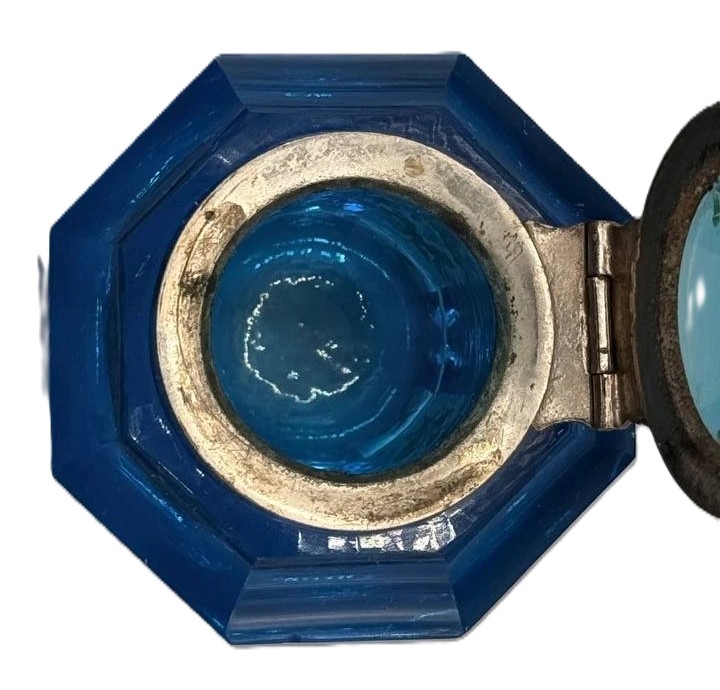
Blue Cut Glass Inkwell with Hand-Painted Flowers
| Categories | Glass - Non-figural |
| Material | Glass |
| Markings | Unmarked |
| Manufacturer | Undetermined |
| Origin | Undetermined |
| Date or Era | circa 1890 |
| Measuring | 2 ¼” across; 3 ½” high |
The glass is a vibrant Cerulean or Zaffre blue. In the context of 19th-century glassmaking, this specific hue is typically referred to as Bristol Blue or Cobalt glass.
- How the color is achieved: This deep, consistent blue is created by adding cobalt oxide to the molten glass batch. Cobalt is an incredibly powerful coloring agent; even a very small amount (less than 0.1%) produces an intense blue.
- Clarity: The transparency and lack of air bubbles (seeds) suggest a high-quality lead glass or soda-lime glass, which was typical for decorative “fancy” glass of this era.
Form and Decoration
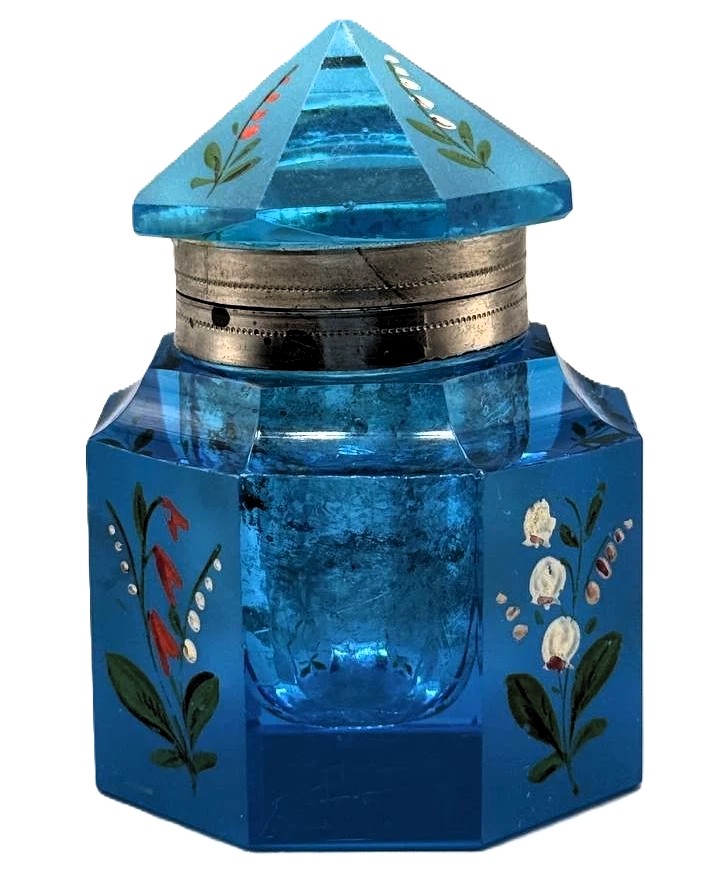
The inkwell features a sophisticated geometric architecture contrasted with delicate, hand-painted botanical motifs.
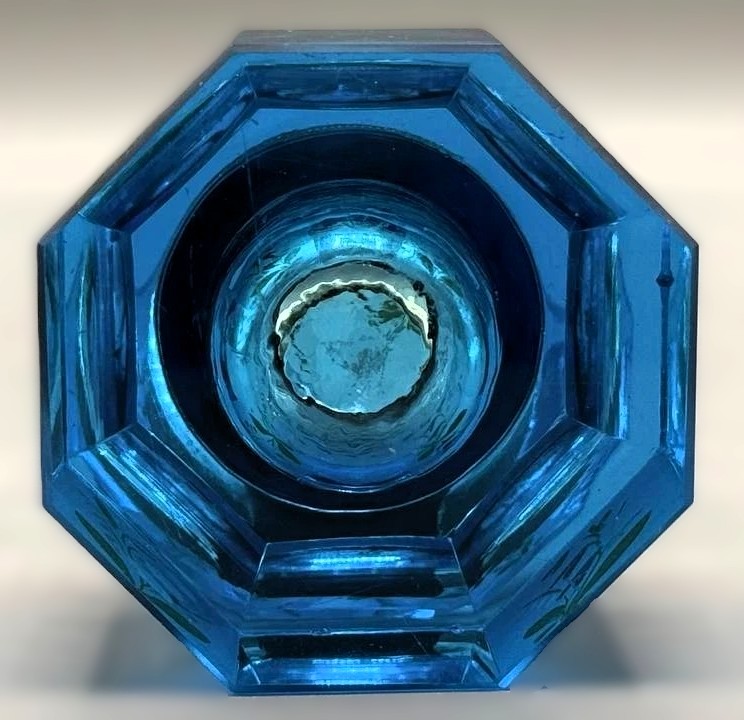
- Shape: It has an octagonal (eight-sided) body with deep vertical mitre cuts that create facets, allowing the glass to catch and refract light. The pyramid-shaped lid is also faceted to match the base.
- The Metalwork: The silver-toned coupling is likely nickel-plated brass or “German Silver” (an alloy of copper, nickel, and zinc). This was a standard, durable material for inkwell hinges in the 1880s–1900s. The hinge is a simple collar-and-pin design.
- Enameling: The hand-painted decorations appear to be Lily of the Valley (white) and possibly Fuchsias or Bluebells (red). This style of “cold painting” or fired enamel was very popular in Bohemian glassworks.
Origin and Dating
Based on the style of the glass cutting and the specific floral enameling, this piece most likely originated in Bohemia (modern-day Czech Republic) or France.
- Date: Circa 1880–1910.
- Regional Style: The combination of heavy faceted cutting with delicate, slightly raised enamel painting is a hallmark of Bohemian glass houses like Moser or the various glassworks in the Jablonec region. Similar styles were also produced by French makers like Baccarat or Saint-Louis, though Bohemian pieces often favored this specific combination of bold cobalt glass and “meadow flower” motifs.
Summary Table
| Feature | Description |
| Glass Type | Cobalt / Bristol Blue Glass |
| Form | Faceted Octagonal Base with Pyramidal Lid |
| Decoration | Hand-painted botanical enamel (Lily of the Valley) |
| Hardware | Nickel-plated metal or German Silver hinge |
| Origin | Bohemia (Czech) or France |
| Period | Victorian / Late 19th Century |
Sold for $112 in January 2026
Content disclaimer. The information posted is the owner’s best knowledge and may not have been vetted by the SOIC. We welcome comments, corrections, and additions, working to make our website information comprehensive and accurate.
Join the Society of Inkwell Collectors (SOIC) – it’s free!
Founded in 1981 as a non-profit organization,
we are documenting inkwells (and accessories).
We’re here to help and inform!