


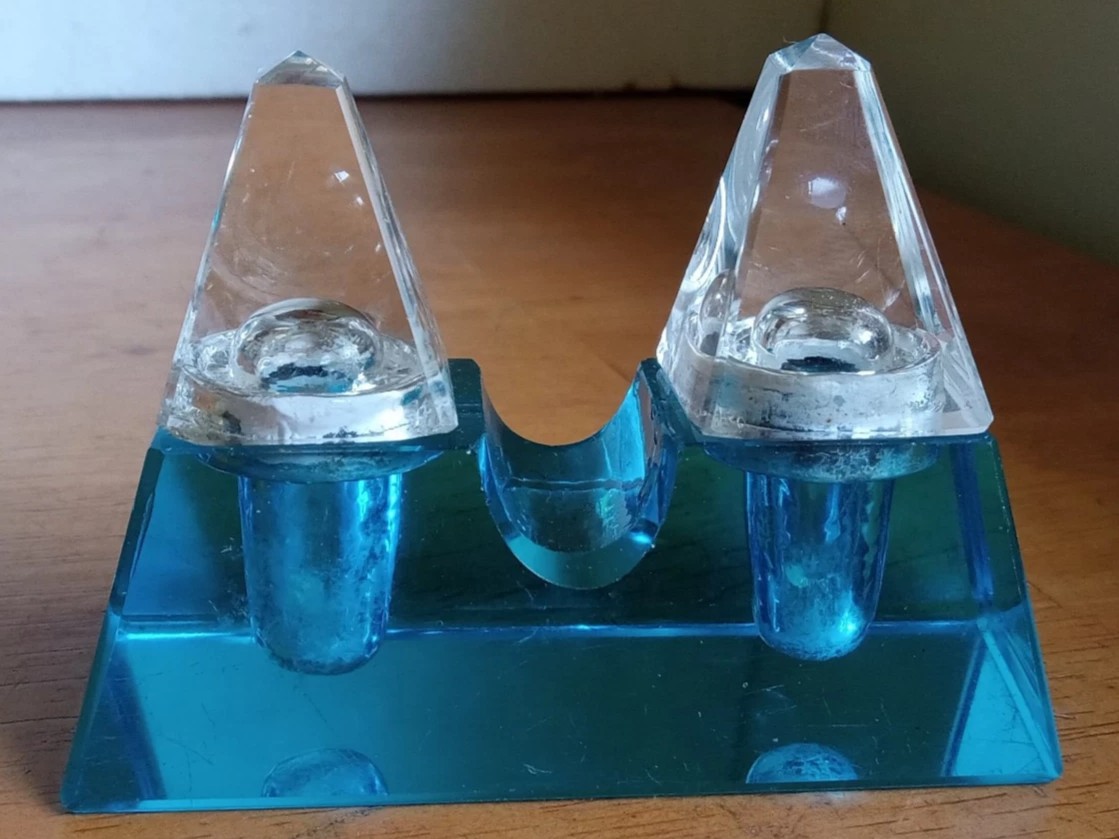
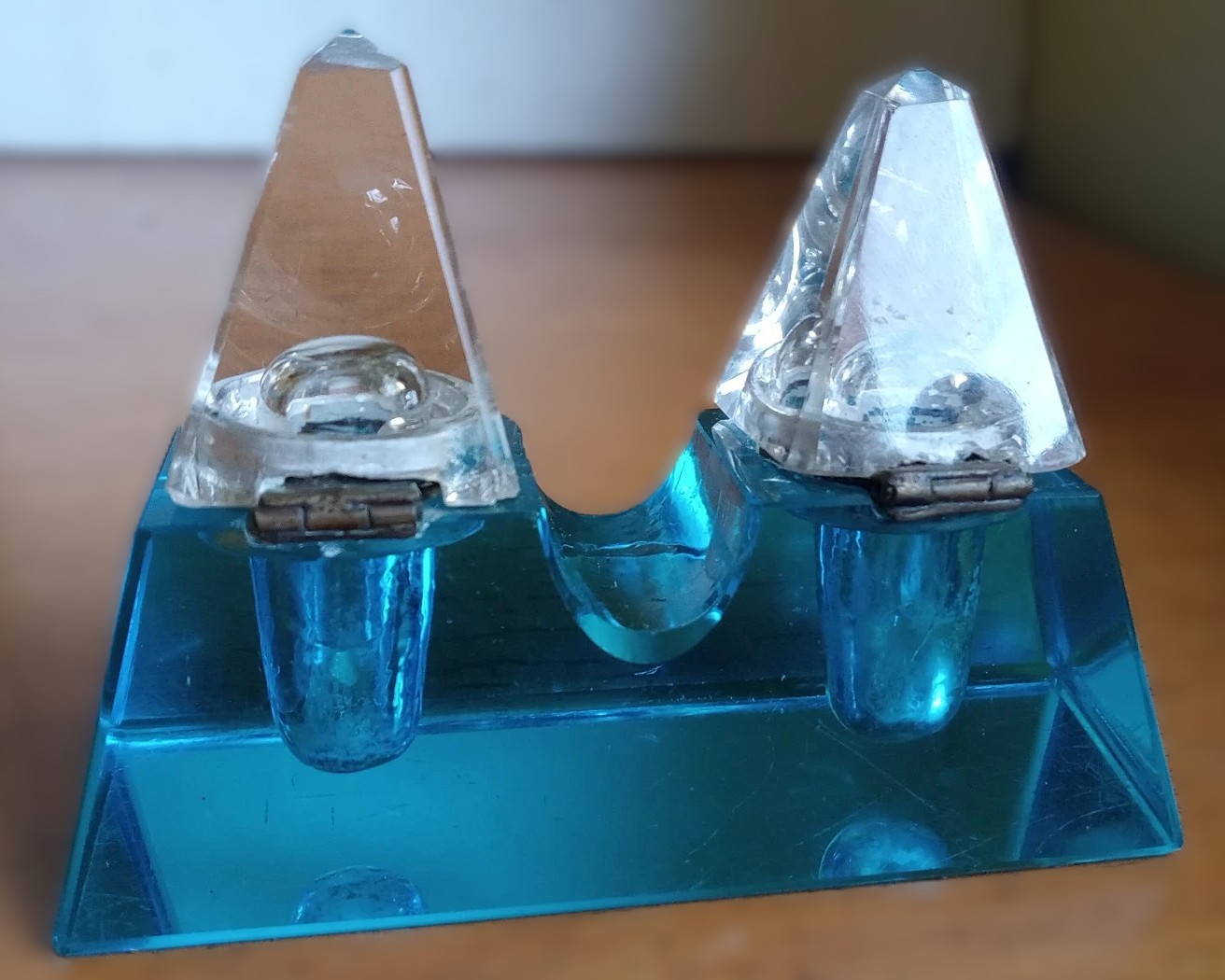



Trapezoidal Double Pyramid Blue Glass Inkwell
| Categories | Glass - Non-figural |
| Material | Glass |
| Markings | Unmarked |
| Manufacturer | Undetermined |
| Origin | United States |
| Date or Era | circa 1880 |
| Measuring | 3 ⅝” x 1 ¾” x 2 ⅝” high |
Description
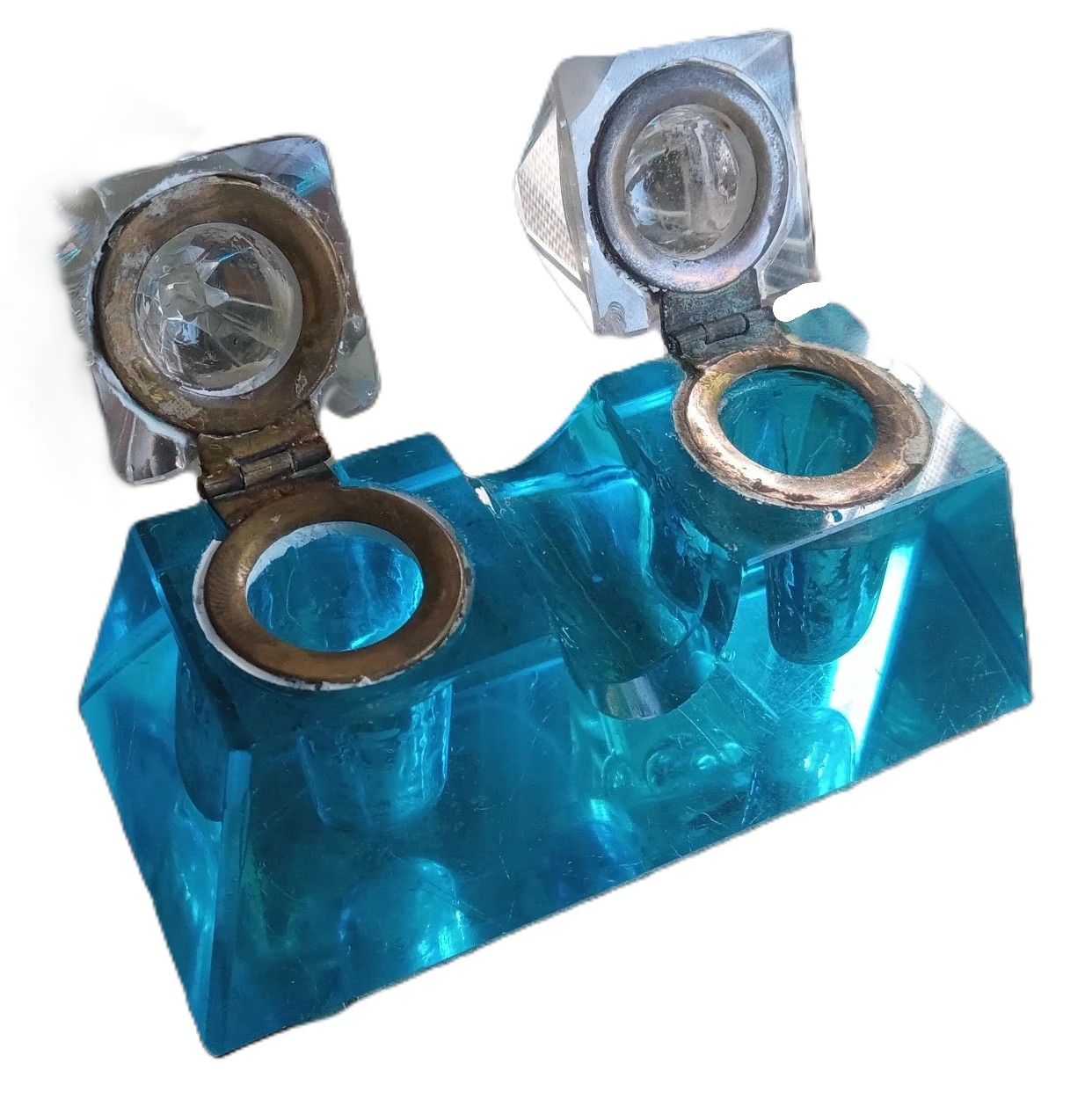
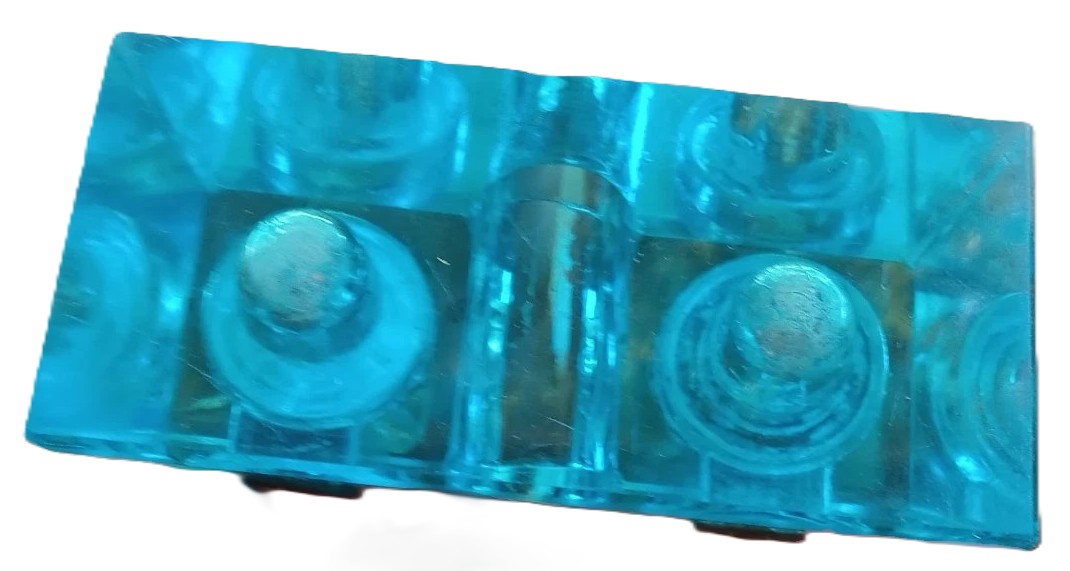
- Form: A monolithic, trapezoidal base made of thick, translucent teal or “aquamarine” glass. It features two deep cylindrical wells and a central U-shaped “pen rest” groove for a dip pen.
- Lids: Two hinged, clear-glass pyramidal covers.
- Materials: Lead crystal or high-quality heavy glass, with brass hinges.
- Craftsmanship: The piece is cold-worked, meaning the glass was cast into a rough shape and then ground and polished by hand on wheels to achieve those sharp, light-refracting edges and the perfectly flat “mirror” bottom.
Age and Origin
While its sharp, geometric form looks incredibly “modern” (which is why many people mistake it for 1920s Art Deco), this aesthetic was actually the height of fashion during the American Brilliant Period (ABP) of cut glass, which flourished roughly between 1876 and 1917.
Here is why the 1880s American origin fits:
- The “Pre-Deco” Aesthetic
In the 1880s, American glass houses like Boston & Sandwich, Mount Washington, and Libbey were experimenting with “Novelty” shapes. The pyramid form was a specific obsession following the Egyptian Revival movement. The fact that this is a double pyramid makes it a “scarce” luxury version of the more common single pyramid wells.
- Evidence of the 1880s
- The Color: That specific shade of vibrant teal/aquamarine was popular in American glass during the late 19th century.
- The Metalwork: The simple brass hinges and the way the collars are fitted are consistent with 1880s hardware.
- Possible Makers
If it is American, a top candidate would be the Boston & Sandwich Glass Company (Massachusetts) or the New England Glass Company. They were famous for “cold-working” glass—grinding and polishing thick, colored blanks into these sharp-edged architectural forms.
How It Was Made
The production of a piece like this was a labor-intensive process involving several skilled artisans:
- Molding: Molten glass was pressed into a preliminary mold to create the basic block shape and the hollows for the wells.
- Annealing: The glass was cooled very slowly in a kiln (lehr) to prevent it from shattering due to internal stress.
- Cutting & Grinding: Once cool, a “master cutter” used iron or stone wheels with abrasive slurries to grind the flat facets and the pen groove. This is where the “pyramid” shapes are perfected.
- Polishing: The matte surfaces left by grinding were polished using cork or felt wheels with fine powders (like cerium oxide) to achieve the high-gloss, “wet look” finish.
- Fitting: Finally, the metal collars and hinges were cemented to the glass, and the clear lids were attached.
Sold for $140 in January 2026
Content disclaimer. The information posted is the owner’s best knowledge and may not have been vetted by the SOIC. We welcome comments, corrections, and additions, working to make our website information comprehensive and accurate.
Join the Society of Inkwell Collectors (SOIC) – it’s free!
Founded in 1981 as a non-profit organization,
we are documenting inkwells (and accessories).
We’re here to help and inform!