



Millefiori Inkwell by Paul Ysart
| Categories | Glass - Non-figural |
| Type | Millefiori |
| Material | Glass |
| Markings | Signed |
| Origin | Scotland |
| Date or Era | circa 1960 |
| Measuring | 4 ¼” diameter; 4 ⅞” high |
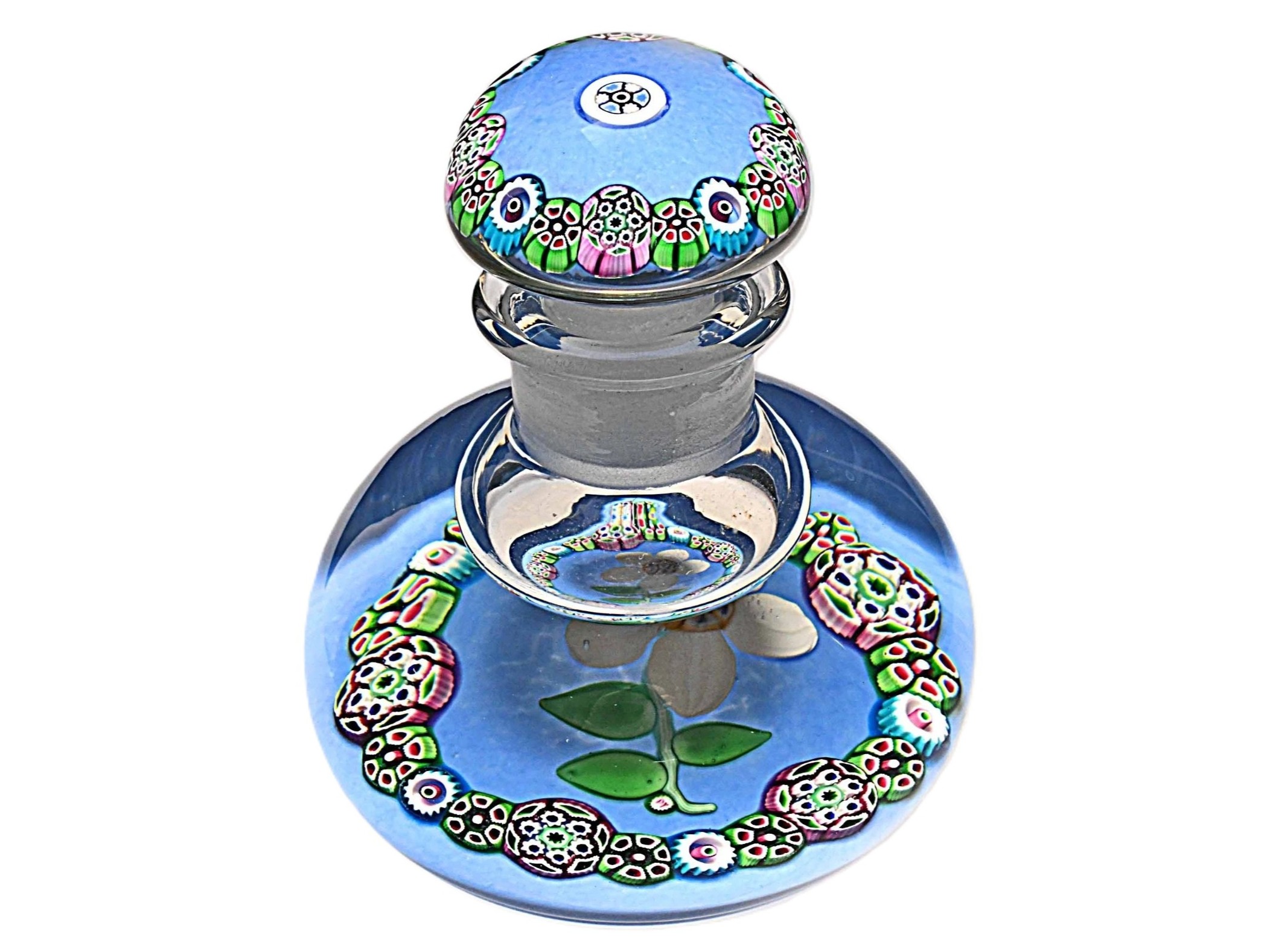
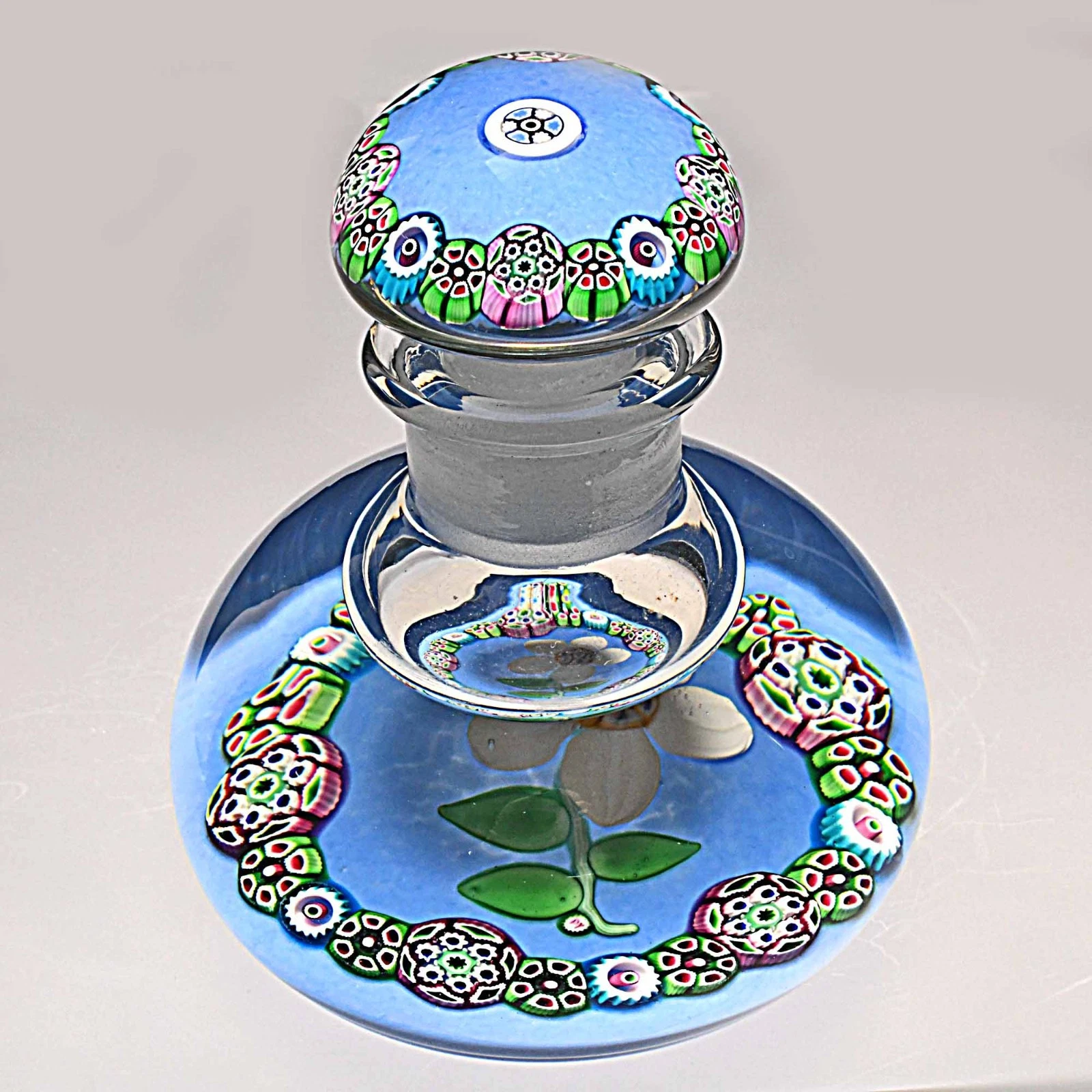
This is a stunning example of Paul Ysart’s mastery of the lampwork and millefiori techniques. This inkwell combines delicate floral artistry with the geometric precision of traditional paperweight design.
Description
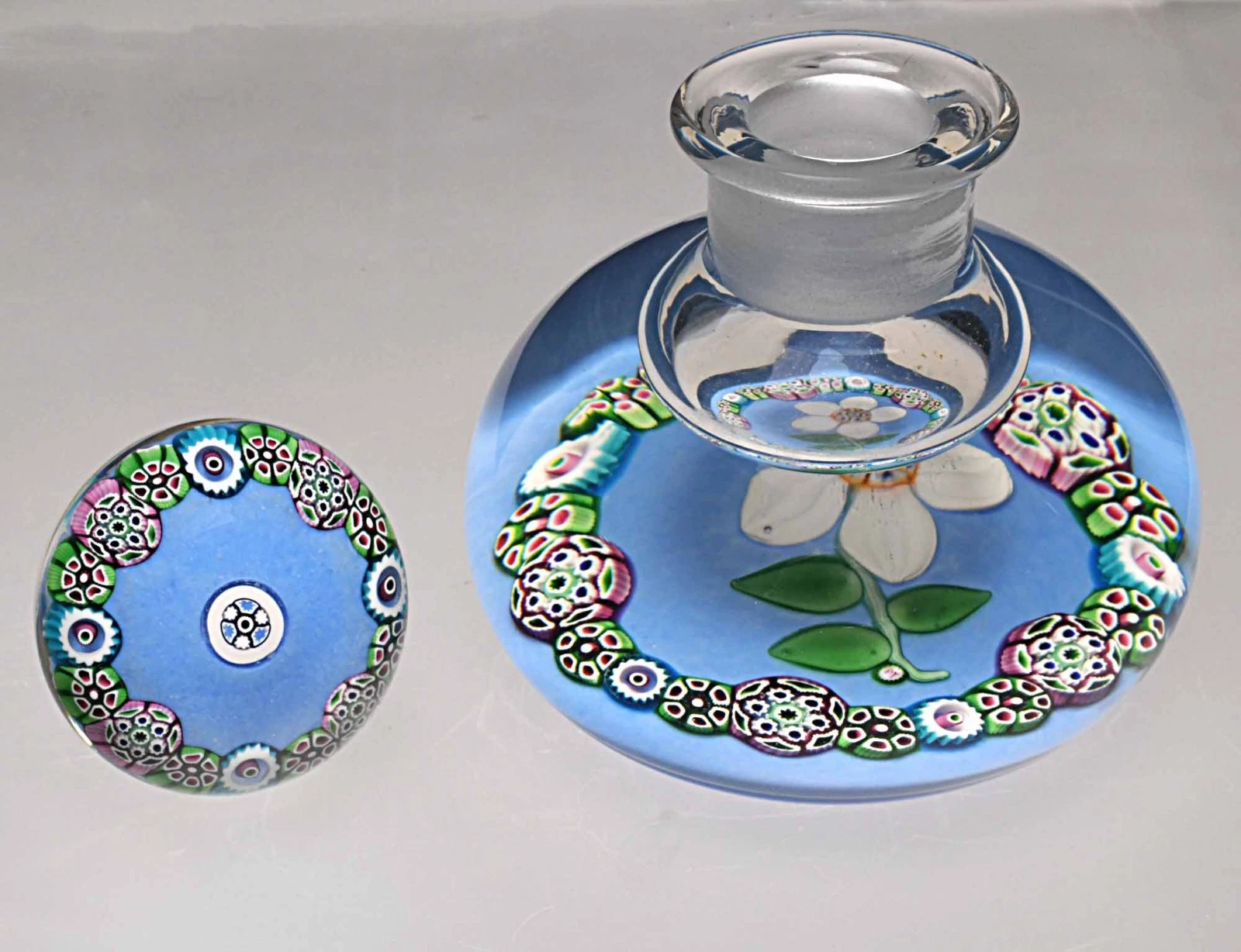
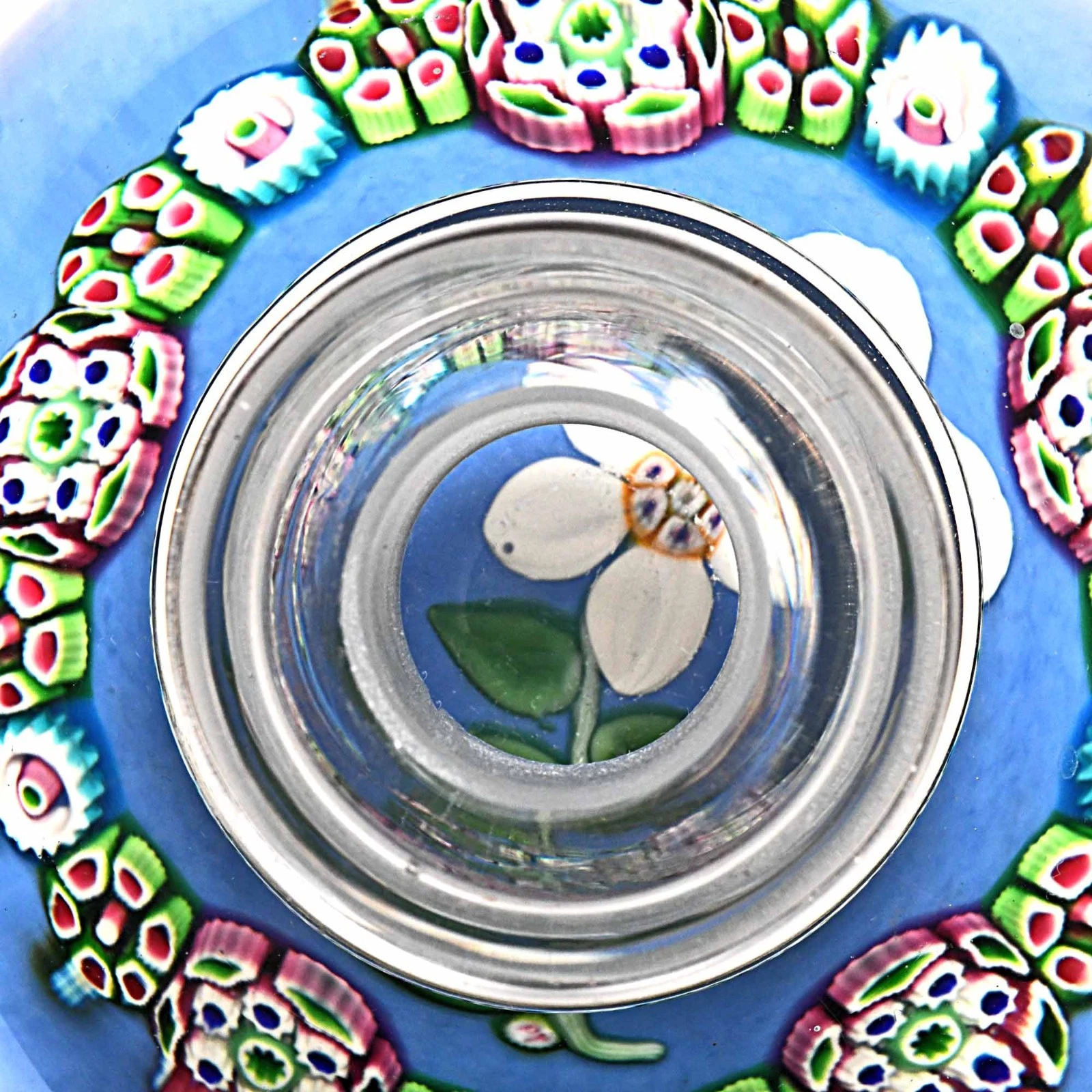
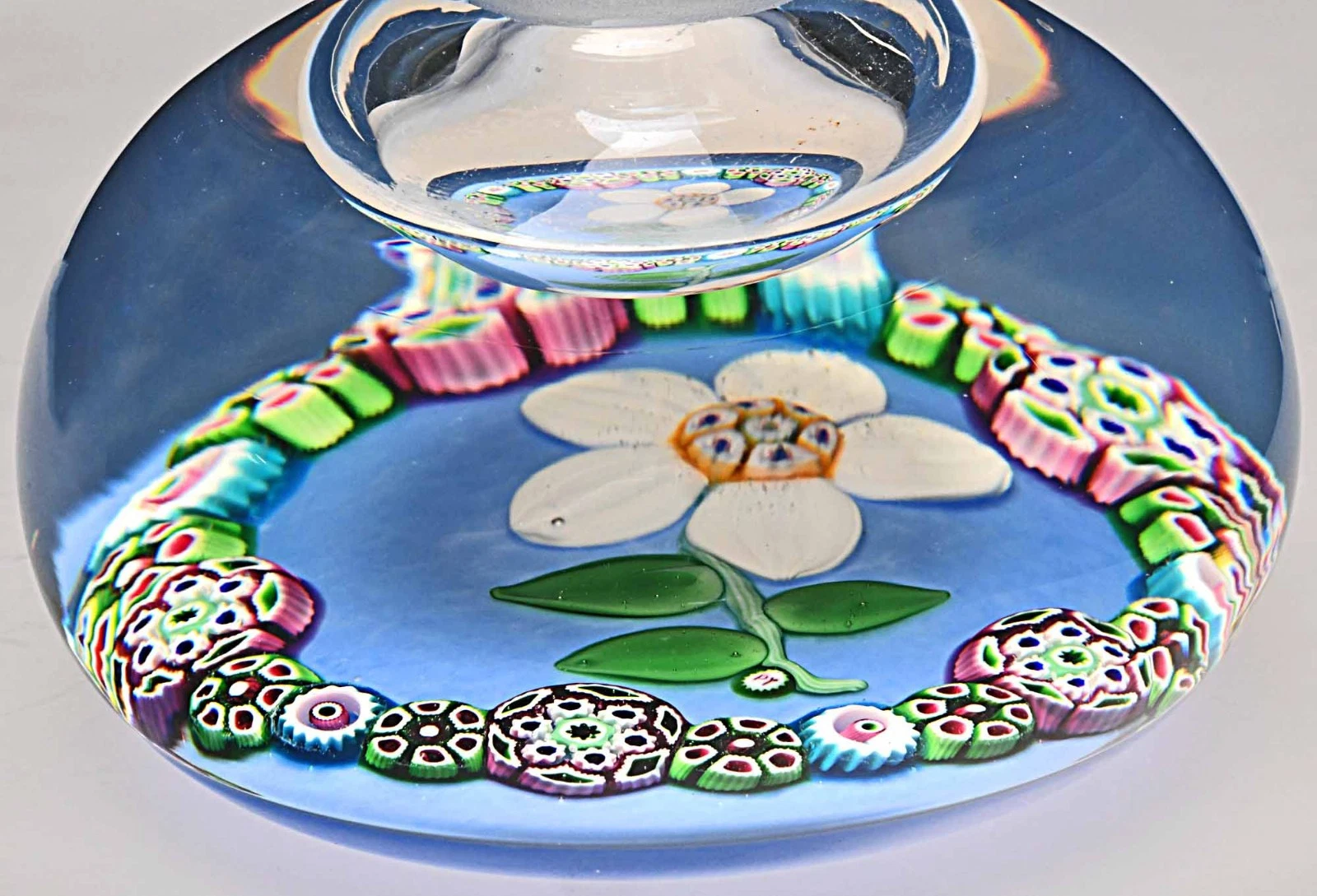
The Interior Motif – At the heart of the bottle rests a large, multi-petaled lampwork flower in a crisp, opaque white. The flower is detailed with a complex center cane featuring yellow and red accents. It grows from a slender, elegantly curved green stem flanked by two smooth green leaves.
The Background and Surround The entire floral arrangement is set against a vibrant, opaque light blue ground that provides a high-contrast backdrop for the white petals. Encircling the flower is a wide garland of complex millefiori canes. This border features a rhythmic variety of patterns, including:
- Pink and white “cog” canes.
- Green and white star-shaped canes.
- Blue-centered pastry-mold canes.
The Signature A definitive “PY” signature cane is expertly placed near the base of the flower’s stem, rendered in white with purple/black lettering, certifying this as an authentic Ysart creation.
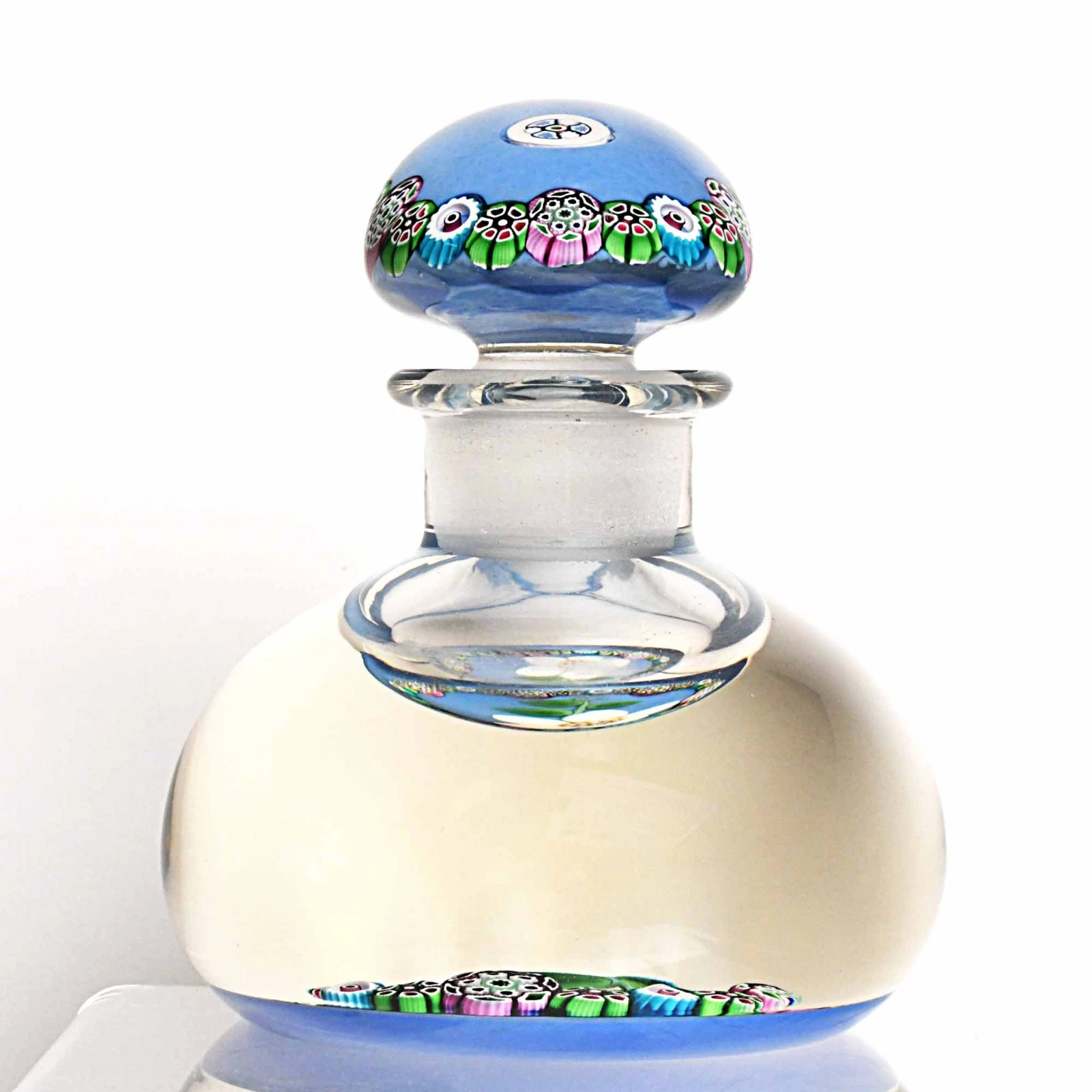
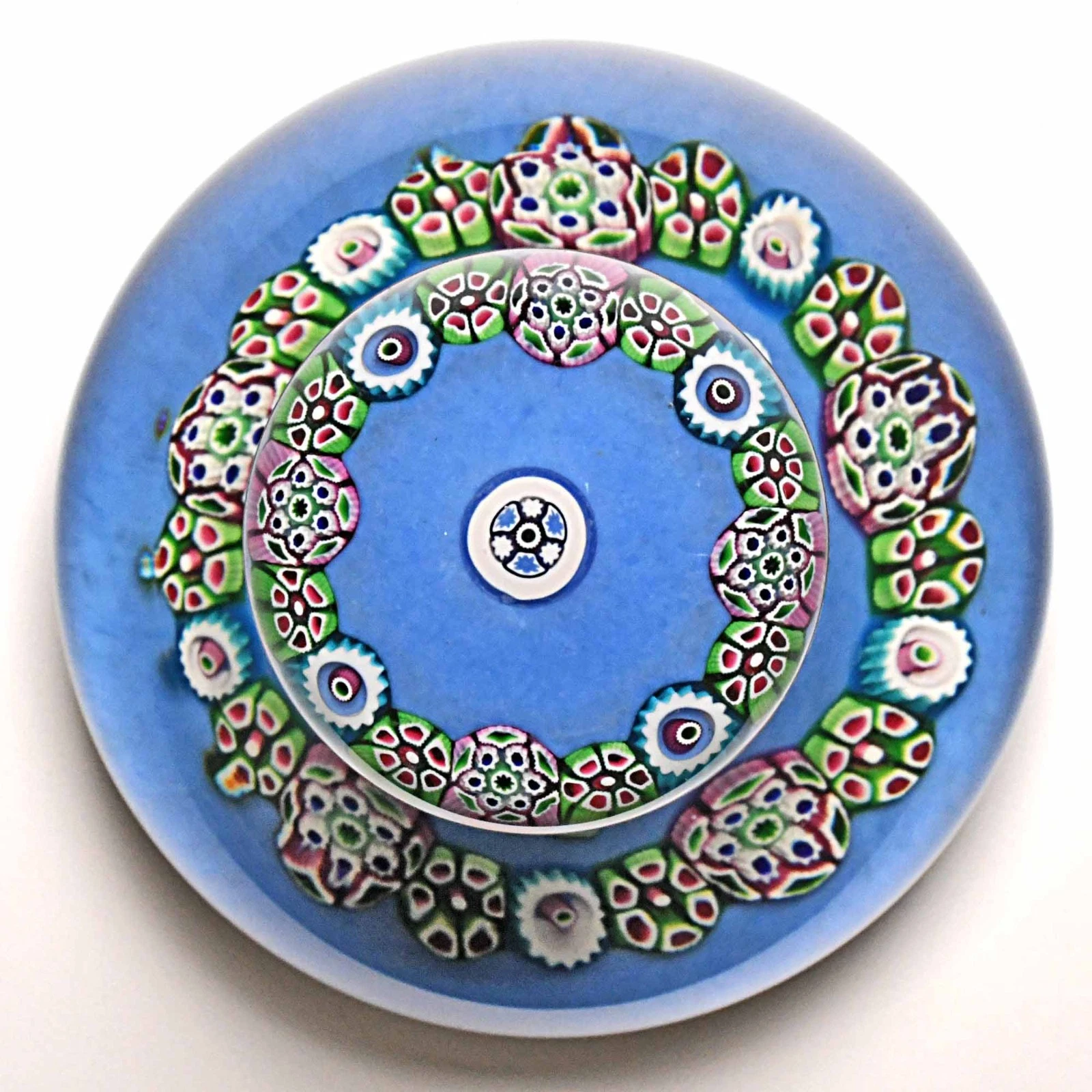
The Stopper The bottle is topped with its original matching stopper, which echoes the design of the base. It features a large, complex central millefiori cane on a matching light blue ground, surrounded by a tight ring of various canes that mirror the garland in the bottle’s base. The stopper’s ground joint ensures a seamless, flush fit.
Physical Characteristics
- Artisan: Paul Ysart
- Technique: Lampwork (flower) and Millefiori (canes)
- Form: Squat, bulbous body with a heavy clear glass encasement that acts as a magnifying lens for the interior design.
- Condition Note: The clarity of the glass and the crispness of the canes suggest a high-quality strike from Ysart’s mid-to-late period.
Paul Ysart was essentially the “James Bond” of 20th-century glass—mysterious, revolutionary, and arguably the most important figure in the Scottish glass renaissance.
Born in Spain in 1904 into a dynasty of glassblowers, he eventually moved to Scotland where he became a master at Moncrieff Glassworks (known for Monart glass) and later Caithness Glass. He is credited with single-handedly rediscovering the complex 19th-century French techniques that had been lost to time, earning him the title of the father of the modern paperweight movement in the UK.
Age and Provenance
Based on the distinct features of this piece, here is the breakdown of its history:
- Age: This inkwell most likely dates to the mid-20th century, specifically between 1955 and 1970.
- Location: It was made in Scotland, either at the Moncrieff glassworks in Perth or during his tenure at Caithness Glass in Wick.
- The Signature Clue: The “PY” signature cane is the smoking gun for dating. While Ysart used various marks, the “PY” cane was used throughout his career but became particularly standard for high-quality pieces exported to the United States (via collector Paul Jokelson) between the mid-1950s and 1970.
The “Clear Glass” Indicator
Older pre-war models often have a slightly “smoky” or greyish tint to the clear glass. The high clarity and “pure” look of this inkwell suggest it was produced after 1950, when glass batches became much clearer, allowing the lampwork flower and the light blue ground to pop with that crisp, modern aesthetic.
This piece is a “collector’s trifecta”: it has the signature cane, a matching stopper, and a complex lampwork motif, making it a very desirable example of his studio work.
Lampwork is a specialized glass working technique where a torch or lamp is used to melt rods and tubes of colored glass. Once the glass is in a molten state, it is formed by blowing and shaping with tools, hand movements, and gravity.
The name comes from the historical use of oil lamps (often fueled by animal fat) and foot-powered bellows to create enough heat to melt the glass. Today, artists like Paul Ysart use high-heat oxygen and propane torches, but the term “lampwork” stuck.
How it differs from “Offhand” Glassblowing
Unlike the large-scale glassblowing you might see in a “hot shop” (with massive furnaces and long pipes), lampwork is a much more intimate, desktop-sized process.
- Scale: Lampworkers usually work on a small scale—perfect for the delicate flower petals, dragonflies, or tiny details seen in paperweights and inkwells.
- Precision: Because the artist is holding the glass just inches from the flame, they have an incredible level of control. This is how the white flower in this inkwell was “built” petal by petal before being encased in the clear glass body.
Why it matters for this Ysart piece
Paul Ysart was a pioneer because he combined lampwork (the central flower) with millefiori (the surrounding glass “thousand flowers” canes).
- He would first create the flower via lampwork.
- Then, he would set it into a mold.
- Finally, he would pour molten clear glass over it to “trap” the art inside forever.
Sold for $800 in January 2026
Content disclaimer. The information posted is the owner’s best knowledge and may not have been vetted by the SOIC. We welcome comments, corrections, and additions, working to make our website information comprehensive and accurate.
Join the Society of Inkwell Collectors (SOIC) – it’s free!
Founded in 1981 as a non-profit organization,
we are documenting inkwells (and accessories).
We’re here to help and inform!