






Elaborate French Porcelain Inkstand with Gilt-Metal Filigree – A Woman Captured by Treasure
| Categories | Ceramics/Porcelain Figural |
| Material | Ormolu, Porcelain |
| Markings | See Narrative |
| Manufacturer | Undetermined |
| Origin | France |
| Date or Era | circa 1880 |
| Measuring | 11 ¼” x 8” x 5 ¼” high |
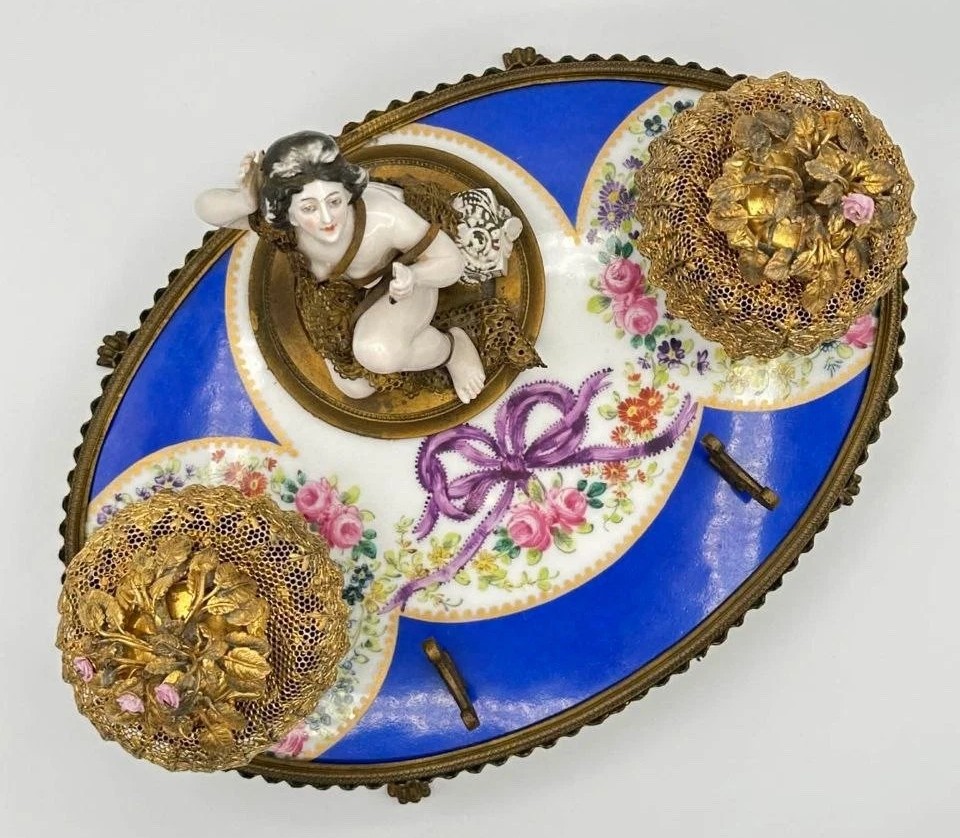
This French porcelain and ormolu inkstand is a masterwork of the Napoleon III (Second Empire) period, dating to approximately 1875–1885. It represents a pinnacle of Parisian “mixed media” design, where the fragility of hand-painted porcelain is deliberately contrasted with the heavy, architectural detail of gilt-bronze (ormolu) filigree.
The Central Narrative: Captured by Treasure
The centerpiece features a finely modeled bisque porcelain figure of a woman in a dramatic moment of discovery. Kneeling upon a circular ormolu plinth, she gazes upward with an expression of awe, her hand raised to her brow as if dazzled by the riches before her.
Beside her sits a small, ornate casket—a treasure chest—overflowing with what appears to be strands of pearls and jewels. The most striking feature is the gilt-metal filigree that drapes across her body. Rather than being mere clothing, this intricate metal “lace” represents the very treasures she has found: gold mesh and jeweled adornments that literally and figuratively “bind” her to the wealth she has uncovered.
The Elaborate Inkwells: “The Bloom of Wealth”
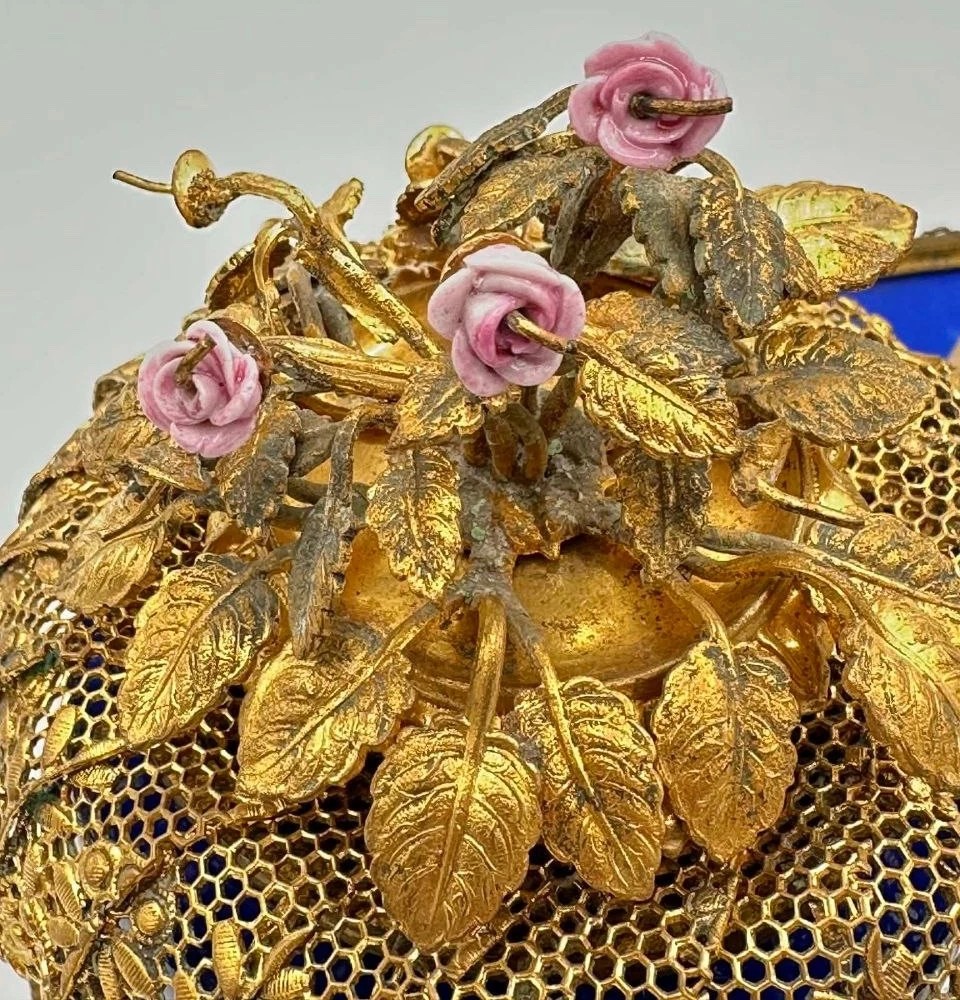
Flanking the central figure are two cobalt blue porcelain inkwells, though their color is nearly obscured by an extraordinary display of metalwork.
- The Bodies: Each well is encased in a dense, honeycomb-patterned ormolu filigree jacket, mimicking the most delicate Point d’Alençon lace.
- The Lids: The lids are sculptural masterpieces, featuring a thicket of gilt-bronze leaves from which emerge hand-modeled porcelain rosebuds in a soft pink. These represent “Nature protected by Art”—the roses are held within the golden framework, symbolizing a garden of eternal wealth.
The Porcelain Base
The entire scene is set upon a grand, oval porcelain base that serves as a stage for the drama above.
- Color & Gilding: A wide border of Sevres-style cobalt blue provides a regal frame. The edge is finished with a pierced ormolu gallery and supported by four trifid scroll feet.
- The Hand-Painted Reserve: The central white panel is decorated with a vibrant polychrome floral garland of roses, violets, and yellow wildflowers.
- The Tethered Bow: At the very front of the scene is a prominent, hand-painted purple ribbon bow. This bow acts as a visual anchor, appearing to “tether” the floral sprays together, reinforcing the theme of things being beautifully bound or gathered.
- The Hardware: Two elegant, curved ormolu pen brackets are mounted symmetrically on the blue border, framing the central floral display.
Technical Details
- Origin: Paris, France (Vieux Paris).
- Markings: The underside bears the impressed model number 510, a code used by high-end workshops specializing in reticulated and mixed-media luxury goods.
- Condition: The preservation of the delicate porcelain rosebuds within the heavy metalwork suggests this was a highly prized “cabinet piece,” intended more for display than for daily rugged use.
Note: The juxtaposition of the woman’s “subdued” posture and the overwhelming amount of gold mesh over her body creates a classic 19th-century allegory: the idea that great beauty is often “captive” to the weight of great fortune.
Sold for $579 in January 2026
Content disclaimer. The information posted is the owner’s best knowledge and may not have been vetted by the SOIC. We welcome comments, corrections, and additions, working to make our website information comprehensive and accurate.
Join the Society of Inkwell Collectors (SOIC) – it’s free!
Founded in 1981 as a non-profit organization,
we are documenting inkwells (and accessories).
We’re here to help and inform!