


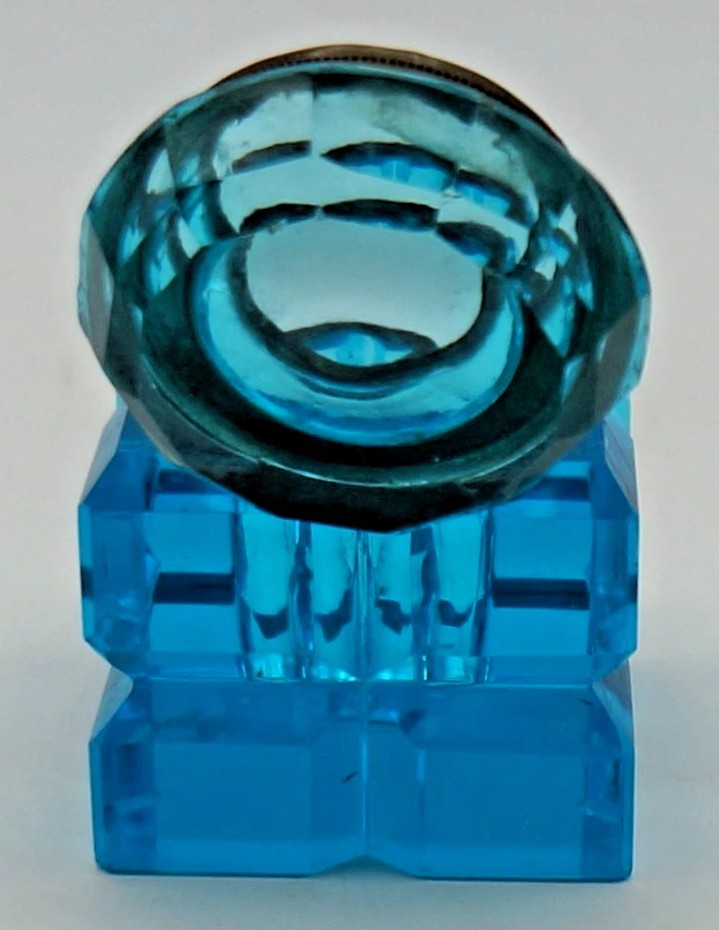


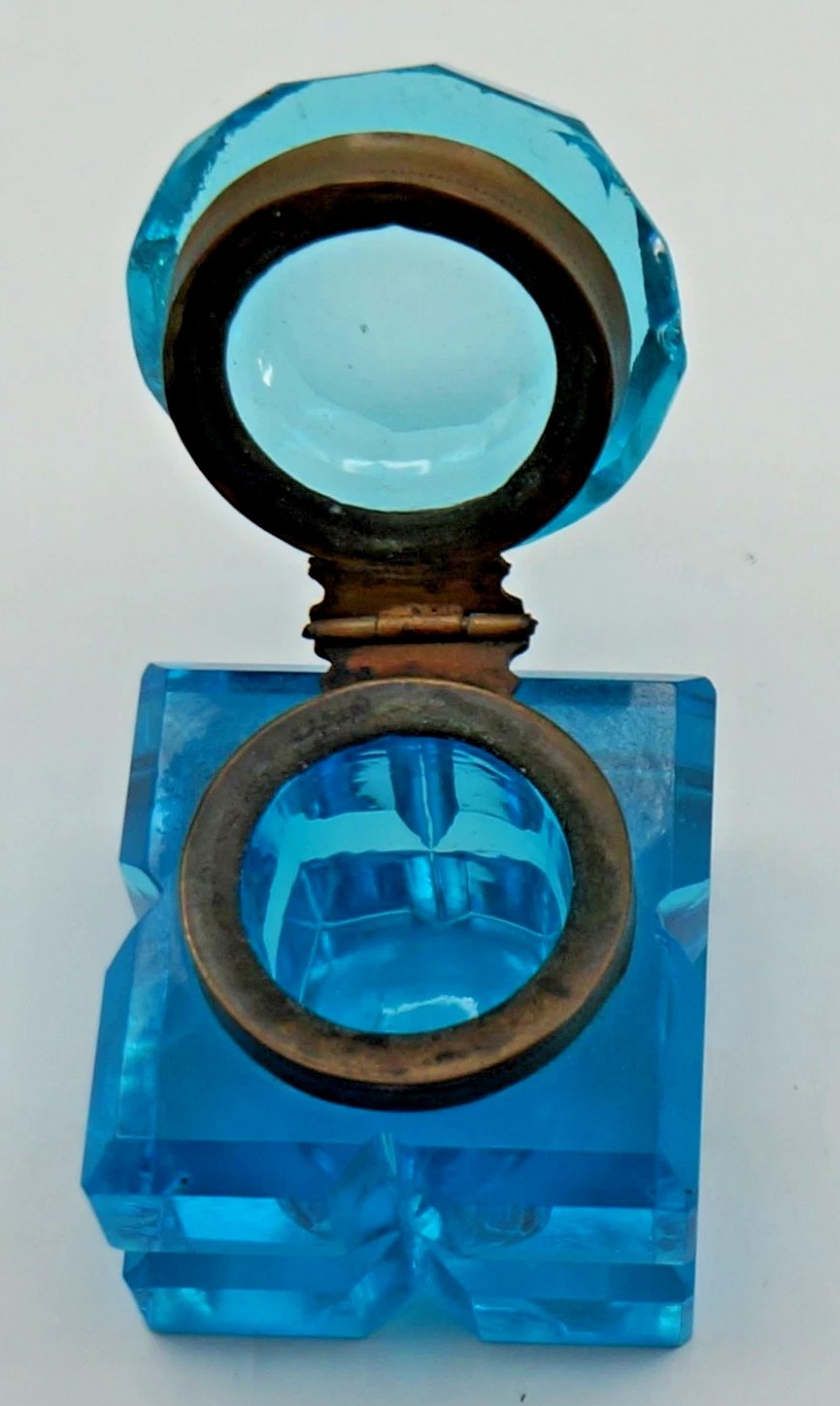
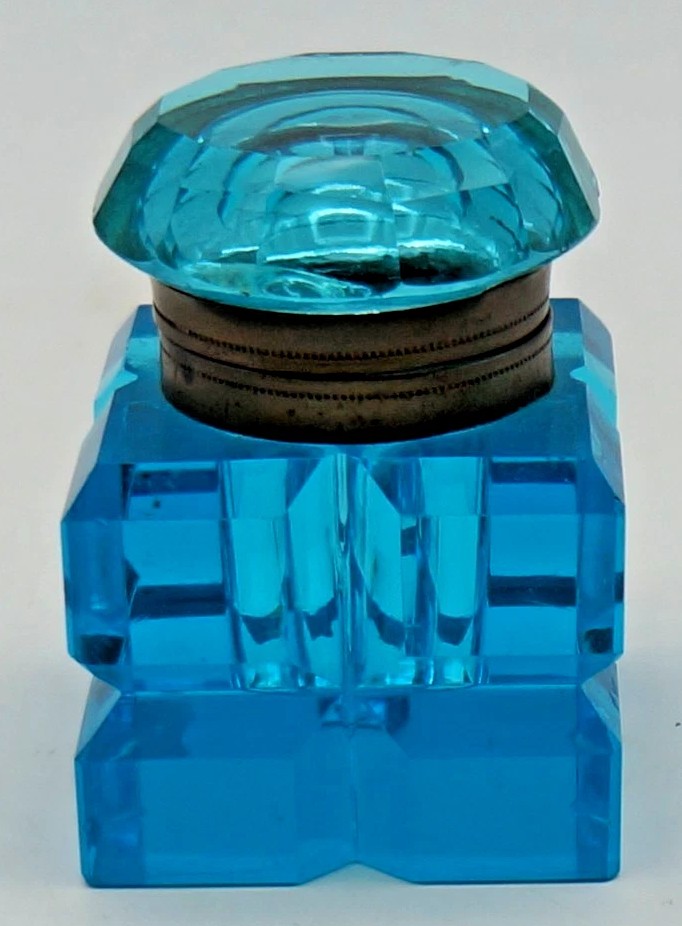
Faceted Blue Glass Inkwell
| Categories | Glass - Non-figural |
| Material | Glass |
| Markings | Unmarked |
| Manufacturer | Undetermined |
| Origin | Undetermined |
| Date or Era | circa 1900 |
| Measuring | 1 ⅞” x 1⅞” x 2 ¼” high |
This vibrant blue faceted inkwell is characterized by its sharp geometric lines and brilliant color.
Detailed Physical Description
- The Crystal Body: The inkwell features a heavy, square block base with deep horizontal and vertical miter cuts. These cuts create a tiered effect that plays with light, a style very popular during the American Brilliant Period and late-Victorian era.
- The Lid: It has a faceted crystal lid designed to match the base. The top of the lid is cut into twelve sections.
- The Hardware: The lid is attached to the body by a simple brass collar and hinge.
How This Inkwell Was Made
This piece was produced using a combination of molding and manual finishing:
- Pressing: Molten glass was initially pressed into a mold to create the basic square form and the hollow interior for the ink.
- Cutting: Once cooled, a master cutter used a rotating stone or iron wheel to grind the deep geometric facets into the glass.
- Polishing: The sharp edges were then polished with a felt wheel and a fine abrasive (like pumice or cerium oxide) to give the crystal its high-gloss, light-refracting finish.
- Fitting: Finally, the brass collar was cemented to the glass shoulder, and the hinged lid was attached.
Achieving the Blue Coloring
The striking blue hue of this inkwell is intrinsic to the glass itself.
- The Secret Ingredient: The glassmaker achieved this specific shade (often called “Electric Blue” or “Peacock Blue”) by adding cobalt oxide to the molten glass batch.
- Cobalt’s Properties: Cobalt is a potent coloring agent; even a tiny amount—less than 0.1%—is enough to produce an intense, saturated blue. Because cobalt is highly stable, this color will never fade, even after a century of exposure to light.
Design and Faceting Observations
- Symmetry: The 12-section cut (dodecagon) is a highly symmetric geometric arrangement that was a hallmark of late 19th-century Bohemian and American Brilliant Period glassware. It ensures that regardless of the angle, the lid captures and refracts light with maximum brilliance.
- The “Jewel” Top: These 12 triangular facets meet at a central point, creating the “jewel-like” appearance. This specific faceting technique was intended to give the glass the multi-dimensional depth of a large, cut gemstone.
- Comparison to the Base: While the lid is cut into 12 sections, the square base of the inkwell features tiered horizontal and vertical cuts. This deliberate contrast between the circular, many-faceted lid and the sturdy, geometric base is characteristic of high-end desk accessories from the 1880s to 1910.
Manufacturing Significance
A 12-section cut required significant skill from the glass cutter. Because cobalt glass is exceptionally dense and dark, the cutter had to be precise; even a small misalignment in the facets would be immediately visible as an interruption in the flow of the blue color. The sharp, crisp edges of these 12 facets suggest that this was hand-cut on a wheel rather than simply being pressed from a mold.
Sold for $65 in December 2025
Content disclaimer. The information posted is the owner’s best knowledge and may not have been vetted by the SOIC. We welcome comments, corrections, and additions, working to make our website information comprehensive and accurate.
Join the Society of Inkwell Collectors (SOIC) – it’s free!
Founded in 1981 as a non-profit organization,
we are documenting inkwells (and accessories).
We’re here to help and inform!