

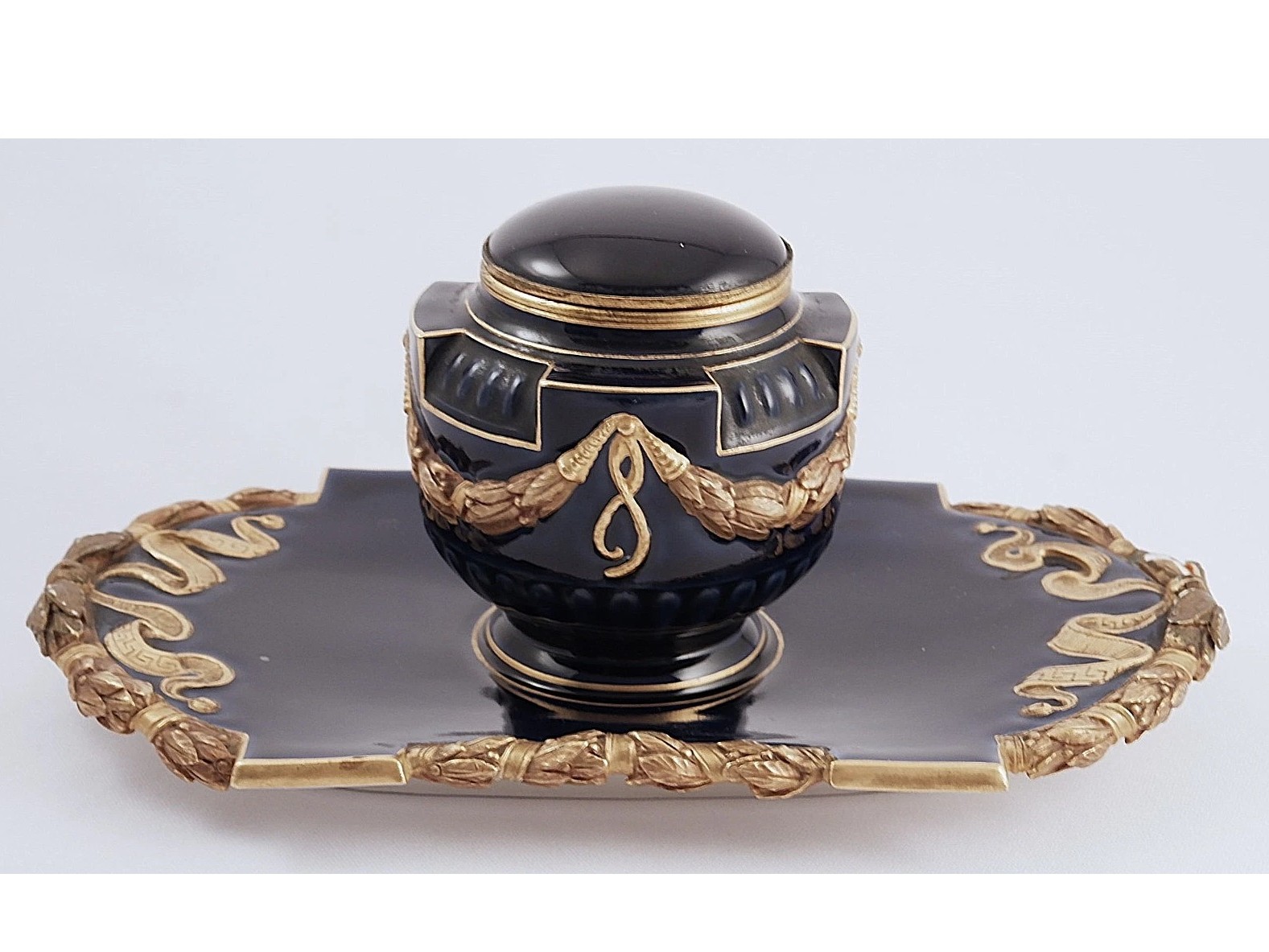


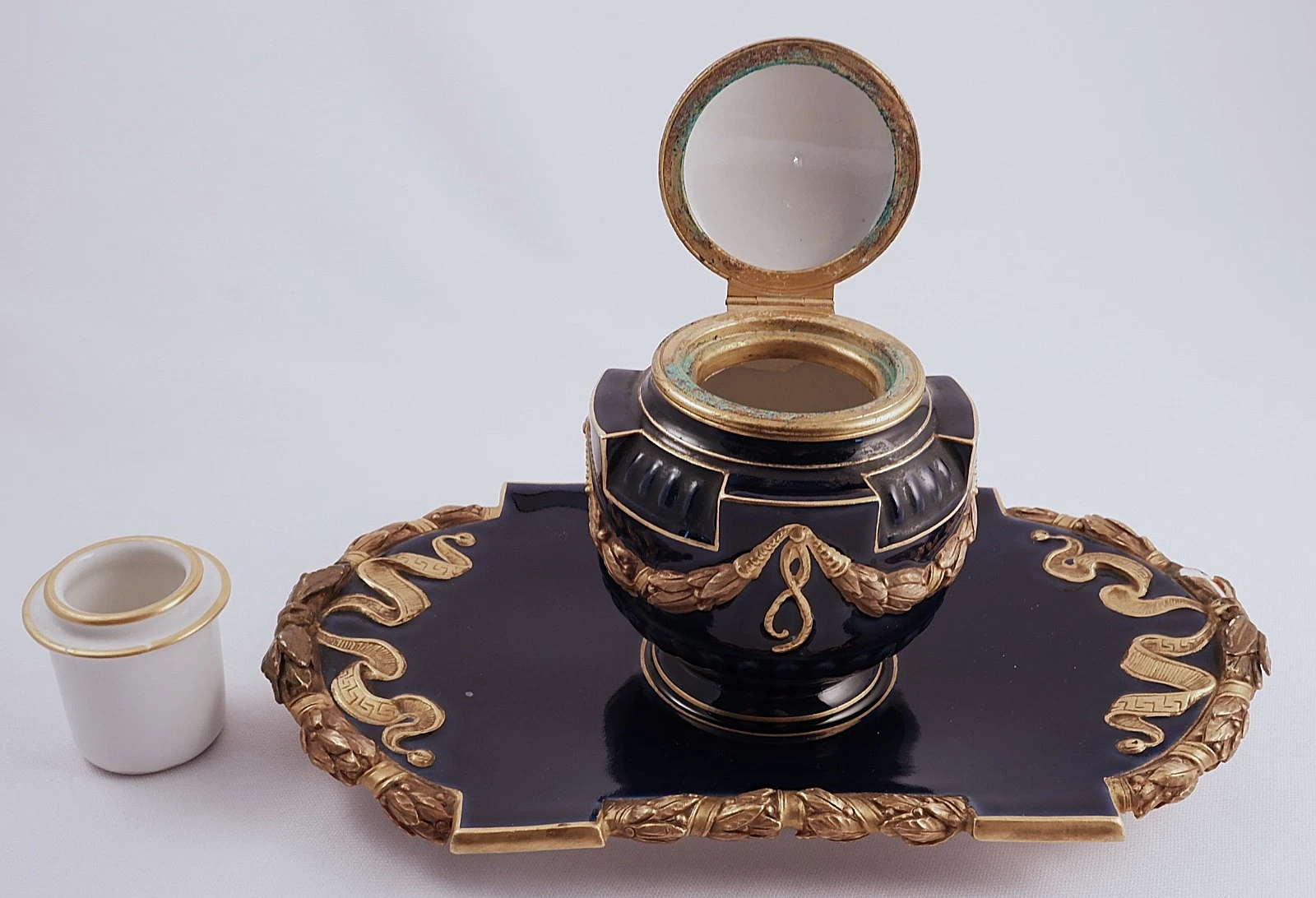


KPM Porcelain Inkstand
| Categories | Ceramics/Porcelain "Named" Makers |
| Material | Porcelain |
| Markings | See Narrative |
| Manufacturer | KPM |
| Origin | Germany |
| Date or Era | circa 1890 |
| Measuring | 7 ½” x 4 ¼” x 3 ¼” high |
Manufacturer Information: KPM Berlin
KPM (Königliche Porzellan-Manufaktur) was the royal porcelain factory of Prussia. An inkwell of this design was a “prestige” object, likely intended for a formal professional setting, such as a government office or a high-ranking official’s study. The minimalist gold-and-blue aesthetic was considered more “masculine” and sophisticated than the colorful floral patterns of the same era.
This is a minimalist, Neoclassical “Drum” inkwell characterized by its architectural simplicity and the high-contrast “Blue and Gold” aesthetic of the Berlin factory.
- The Form (Model 7603): The inkwell is a squat, cylindrical “drum” that sits on a wide oval base.
- The Lid: The lid is a flat, circular disc. It sits flush within the top rim of the cylinder, maintaining a smooth, uninterrupted top surface.
- The Decoration (Pattern /10): The decoration consists entirely of hand-applied gold banding against the brilliant white KPM porcelain:
- The Lid: A wide, solid burnished gold band covers the outer edge of the flat lid.
- The Well: A thick gold band encircles the top rim of the cylinder, and another thick band marks the bottom where the cylinder meets the base.
- The Base: The outer “step” of the circular base is also highlighted with a solid gold band.
- Central Detail: There is a thin, delicate gold line encircling the middle of the cylinder, adding a subtle horizontal break to the porcelain.
The Meaning of the Marks (7603/10)
- 7603 (The Form): This refers to the cylindrical drum shape with the flat-top lid. While many 7603 models featured handles or finials, this specific version was designed as a “Modernist” or minimalist variant, likely for a cleaner, more contemporary look at the turn of the century.
- ** /10 (The Pattern): In the KPM coding system, “10” refers to this specific “Strong Gold Banding” style. It was one of the factory’s most formal decors, intended to highlight the purity of the porcelain and the quality of the gold rather than the skill of a painter.
- The Red Orb: The Red Orb on this piece confirms that the gilding was performed in the Master Atelier. Because the gold is “burnished” (meaning it was polished with an agate stone after firing to create a deep, mirror-like shine), it was categorized as a high-tier decorative work.
- Blue Scepter: This is the standard factory mark for the Royal Porcelain Manufactory (KPM) in Berlin. The style of the scepter dates this piece to approximately 1890–1915.
Historical Significance
This specific “flat-top” design is quite sophisticated for its era. While most 19th-century inkwells were highly ornamental, this KPM model anticipates the Art Deco movement with its focus on geometry and restrained elegance. It would have been an expensive, top-of-the-line accessory for a professional’s desk.
The color of this KPM inkwell is Cobalt Blue (historically known as Königsblau or Royal Blue).
The confusion between blue and black is very common with this specific piece because the KPM factory used a highly saturated cobalt pigment that appears nearly black in low light or from a distance.
Why it is Cobalt Blue
- The Pattern Code (/10): In the KPM Berlin numbering system, the suffix “/10” on the model 7603 specifically identifies the Cobalt Blue ground decoration. At KPM, pattern codes are standardized; if this were the “Royal Noir” (black) version, it would carry a different decor number.
- The “Royal” Association: Solid cobalt blue with heavy gold banding was the “signature” formal look of the Prussian Royal Court. It was designed to be as deep and “inky” as possible to provide the maximum contrast for the hand-burnished gold.
The Red Orb & “No Flowers” Anomaly
- Standard Rule: Typically, KPM uses a Green Orb for strictly geometric or “non-floral” gold decorations.
- The Red Orb Exception: On high-end cobalt pieces like this, the Red Orb was sometimes used if the gold decoration was particularly complex or if the piece was part of a larger, hand-painted commission.
Summary
- Color: Deep, saturated Cobalt Blue (appearing black).
- Decoration: Formal gold bands (Pattern 10).
- Body Style: Model 7603 (Cylindrical “Drum” on a stepped base).
- Lid: Flat-top (no finial).
Estimated value: $200
Content disclaimer. The information posted is the owner’s best knowledge and may not have been vetted by the SOIC. We welcome comments, corrections, and additions, working to make our website information comprehensive and accurate.
Join the Society of Inkwell Collectors (SOIC) – it’s free!
Founded in 1981 as a non-profit organization,
we are documenting inkwells (and accessories).
We’re here to help and inform!