

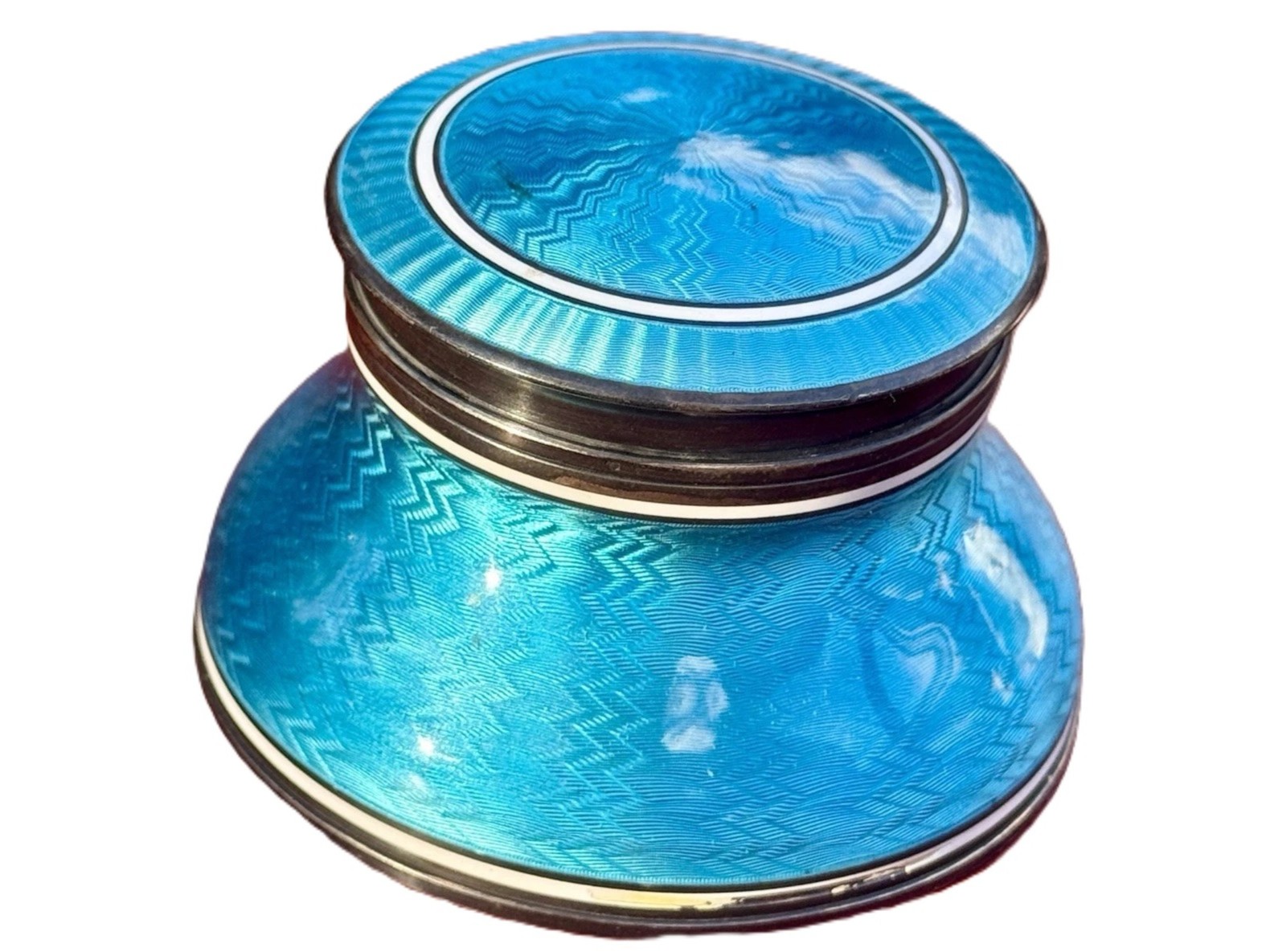
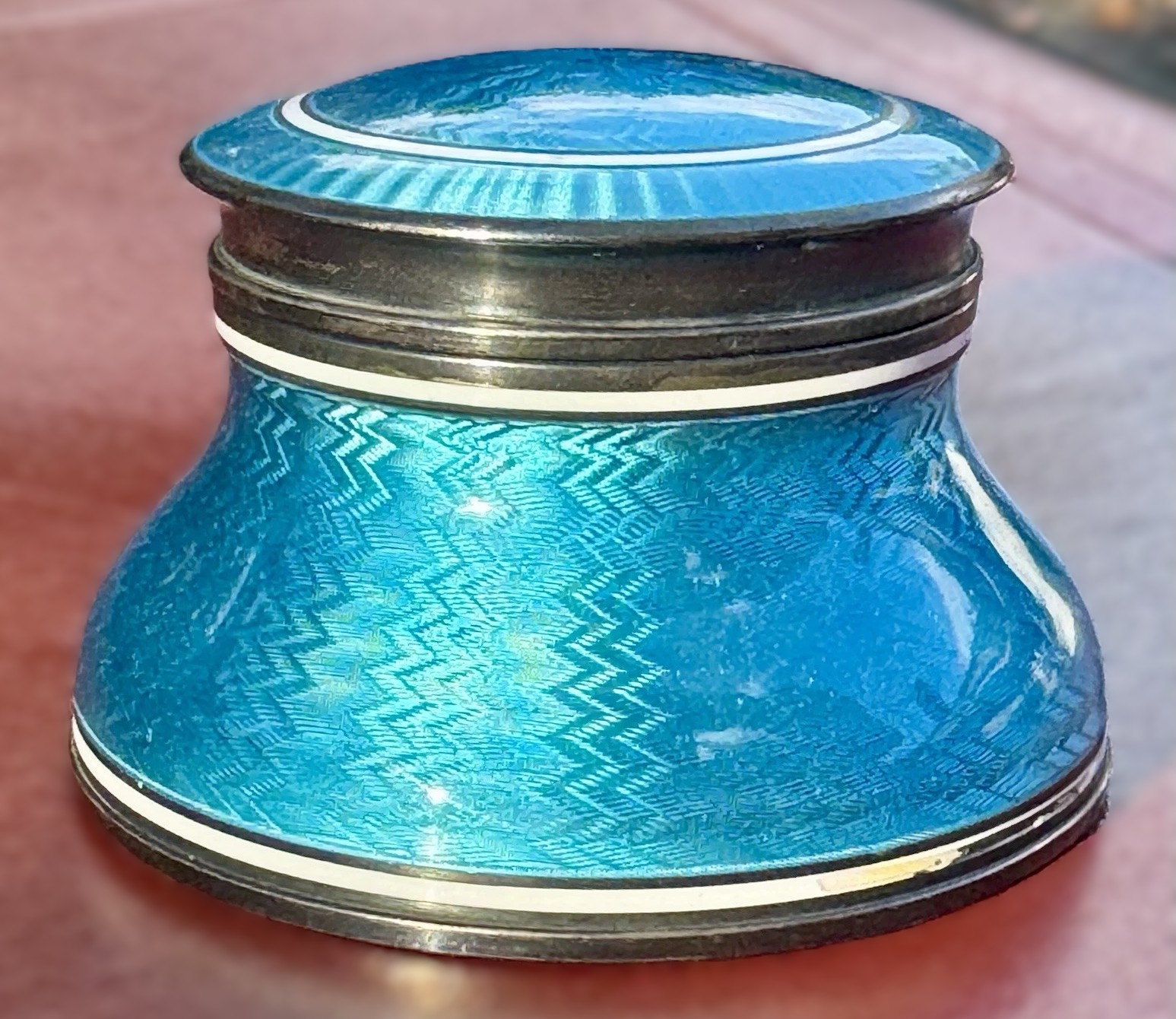
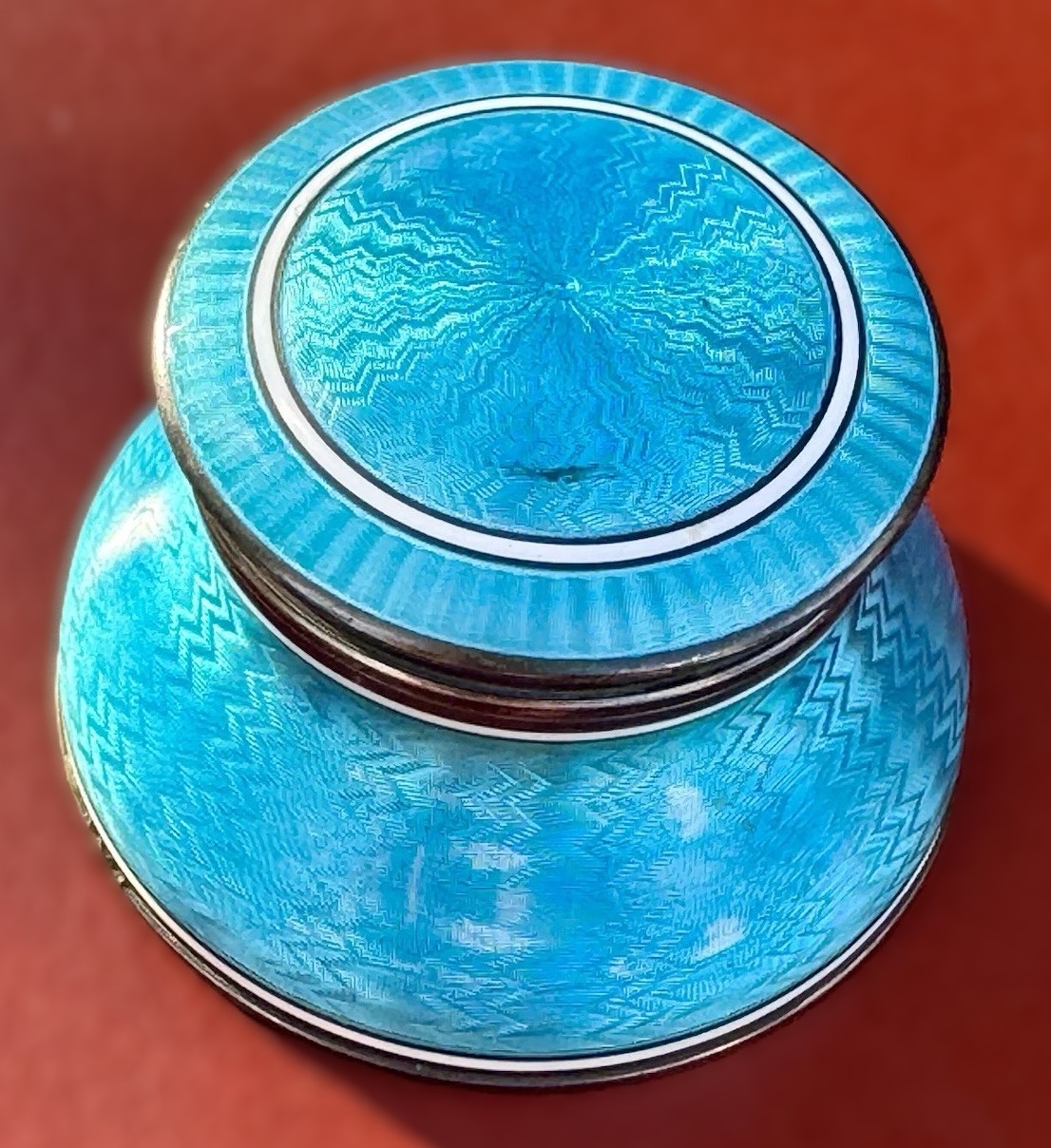


French Art Deco Blue Guilloché Enamel & Silver Inkwell
| Categories | Enameled Metal |
| Material | Enameled Brass/Bronze/Metal |
| Markings | See narrative |
| Manufacturer | Undetermined |
| Origin | France |
| Date or Era | circa 1920 |
A fine French desk accessory of capstan or bell form. The body is crafted from solid silver and decorated with high-quality translucent aqua/turquoise blue enamel over a guilloché ground. The engine-turned pattern beneath the enamel features a tight, rhythmic zigzag or chevron design that catches the light.
Construction: The inkwell features a hinged, domed lid with a white enamel border ring. It opens to reveal a gilded interior (vermeil) and a glass ink reservoir. The base is rimmed with a matching white enamel band.
Identification of the Maker & Mark
The full mark stamped on the underside of the silver base reads:
DUVERNEY CANNES FAITS-MAINS
- “Faits-Mains”: This is French for “Hand Made” (literally “made by hands”).
- “Duverney”: This refers to a luxury retailer or jeweler based in Cannes, on the French Riviera. While less globally famous than Cartier or Fabergé, Duverney would have been a high-end boutique catering to the wealthy tourists and aristocracy vacationing in the south of France during the early 20th century.
- The hallmark: There appears to be a tiny diamond-shaped hallmark near the center stamp. In France, a diamond shape indicates a maker’s mark (silversmith), whereas purity marks (like the Minerva head for sterling silver) are often found on the rim or lid. The construction is solid silver (likely .950 or .800 standard, typical for France).
Date & Origin
- Origin: France (specifically sold in Cannes).
- Date: c. 1910–1930 (Art Deco / Belle Époque transitional period). The electric blue color and the geometric “zigzag” engine-turned pattern are very characteristic of the Art Deco era.
The Process: Guilloché Enamel
The stunning visual effect of this inkwell is due to a technique called Guilloché (pronounced gee-oh-shay).
- Engine Turning: First, the solid silver body is mounted on a rose engine lathe. A craftsman mechanically carves a precise, repetitive geometric pattern into the metal. If you look closely, you can see the underlying pattern is a series of tight zigzags or chevrons.
- Enameling: The carved silver is then covered with a translucent (see-through) glass paste (enamel) colored with metal oxides (in this case, cobalt or copper for the turquoise/aqua blue).
- Firing: It is fired in a kiln at high temperatures until the glass melts and bonds to the silver.
- Polishing: Finally, the surface is polished perfectly smooth. The result is a “depth” where the silver pattern shines through the colored glass, creating a shimmering, water-like effect.
Sold for $171 in November 2025
Content disclaimer. The information posted is the owner’s best knowledge and may not have been vetted by the SOIC. We welcome comments, corrections, and additions, working to make our website information comprehensive and accurate.
Join the Society of Inkwell Collectors (SOIC) – it’s free!
Founded in 1981 as a non-profit organization,
we are documenting inkwells (and accessories).
We’re here to help and inform!