


A.S. Pushkin Figural Inkstand
| Categories | Ceramics/Porcelain Figural, Figural - Mythology; Literature; Religion; Fictional |
| Type | Literature |
| Material | Porcelain |
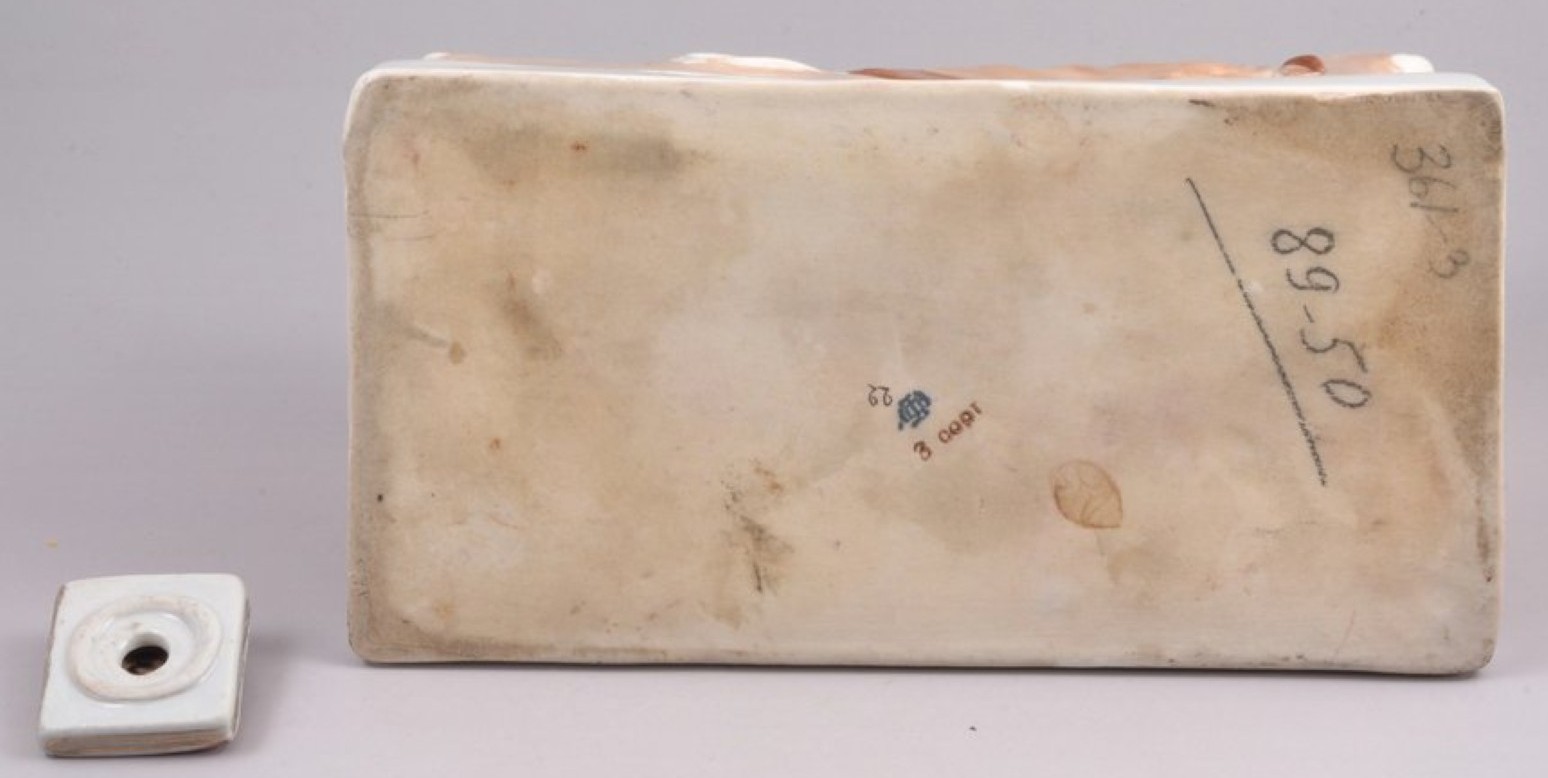
| Markings | See Narrative |
| Manufacturer | LFZ Lomonosov |
| Origin | Russia |
| Date or Era | circa 1937 |
| Measuring | 8 ½” x 4 ¼” x 7” high |
This inkstand is a blend of Russian literary heritage and early Soviet artistry, produced during the years leading up to World War II.
- The Subject: Alexander Sergeyevich Pushkin (1799–1837)
The inkstand celebrates Alexander Pushkin, widely recognized as the central figure of Russian literature and the founder of the modern Russian literary language.
- Literary Status: Pushkin’s works—including the verse novel Eugene Onegin, the drama Boris Godunov, and various poems and tales—are masterpieces of the Golden Age of Russian poetry. He is revered for his clarity, emotional depth, and ability to weave Russian folklore and history into his narrative.
- The 1937 Commemoration: The year 1937 marked the centenary of Pushkin’s tragic death in a duel. The Soviet government used this anniversary as a major opportunity for cultural patriotism, commissioning numerous commemorative artworks and items (like this inkstand) to honor him as a great national poet, emphasizing his legacy rather than his conflicts with the monarchy.
- The Pose: The reclining pose of this inkstand offers an intimate view, showing the poet not at a formal desk but in a moment of relaxed, deep thought, holding his quill ready for inspiration. This less formal depiction was part of the Soviet focus on making great figures relatable to the common person.
- The Artist: Natalia Yakovlevna Danko (1892–1942)
The piece is a testament to the skill of Natalia Danko, a prominent sculptor of the 20th century to work in porcelain.
- Master of Small Sculpture: Danko’s career spanned the transition from the Imperial to the Soviet eras at the factory. She was trained in various private studios and worked with influential architects before joining the Imperial Porcelain Factory in 1914.
- Head of Soviet Sculpture: After the 1917 Revolution, Danko transitioned the factory’s output to reflect the new state. She became the Head of the Sculpture Department in 1919, creating over 300 pieces of Soviet propaganda and genre figures (Soldier, Worker, Sailor, Chess).
- Danko’s Style: Her work is characterized by strong realism, attention to ethnographic detail, and a clear narrative focus. This “Pushkin” inkstand, modeled specifically for the 1937 anniversary, exemplifies her move to celebrate cultural giants alongside revolutionary heroes.
- Historical Context: Danko’s life ended tragically during the Siege of Leningrad in 1942, adding a layer of pathos to her legacy as an integral figure in Soviet art history.
III. The Producer: Lomonosov Porcelain Factory (LFZ)
This inkstand was produced by the historic Leningrad factory, whose reputation for quality dates back centuries.
- Founding and Imperial Era: The factory was founded in St. Petersburg in 1744 as the Imperial Porcelain Factory (IPF). It was the first porcelain factory in Russia and served the Tsarist court, establishing a reputation for the highest technical quality (hard-paste porcelain).
- Soviet Transformation: After nationalization, the factory became the State Porcelain Factory, eventually being named the Leningrad Porcelain Factory (LFZ). The focus changed from aristocratic luxury to mass-produced cultural and propaganda porcelain.
- Production Period (1937–1941): This specific inkstand was produced during a period of high artistic quality at LFZ, where Danko’s designs were executed using the factory’s technical expertise. Production halted when the Siege of Leningrad began in 1941.
- Composition and Pose
- The Subject: The sculpture depicts the great Russian poet, Alexander Sergeyevich Pushkin, in an intimate, contemplative pose, commemorating his life and work.
- The Pose: Pushkin is shown in a reclined position, resting on a chaise longue or daybed, with his elbow resting on the back cushion. His posture is one of deep thoughts or inspiration.
- The Action: He holds a quill pen in his hand, ready to write.
- The Lid: The pile of books resting on the settee is a removable lid. This piece lifts off to provide access to the concealed inkwell cavity below.
- Color and Finish
- Finish: The inkstand is made of fully glazed porcelain, giving the entire surface a bright, reflective shine.
- Dominant Color: The primary color of the piece is vibrant blue. This color is prominently featured on Pushkin’s overcoat or jacket.
- Hand-Painting: The detailed painting is visible in the realistic rendering of Pushkin’s face and hair, the coloring of his period clothing, and the individual titles and pages of the scattered books and papers. The colors are applied in rich enamels under the glaze.
Estimated value: $1000
Content disclaimer. The information posted is the owner’s best knowledge and may not have been vetted by the SOIC. We welcome comments, corrections, and additions, working to make our website information comprehensive and accurate.
Join the Society of Inkwell Collectors (SOIC) – it’s free!
Founded in 1981 as a non-profit organization,
we are documenting inkwells (and accessories).
We’re here to help and inform!