

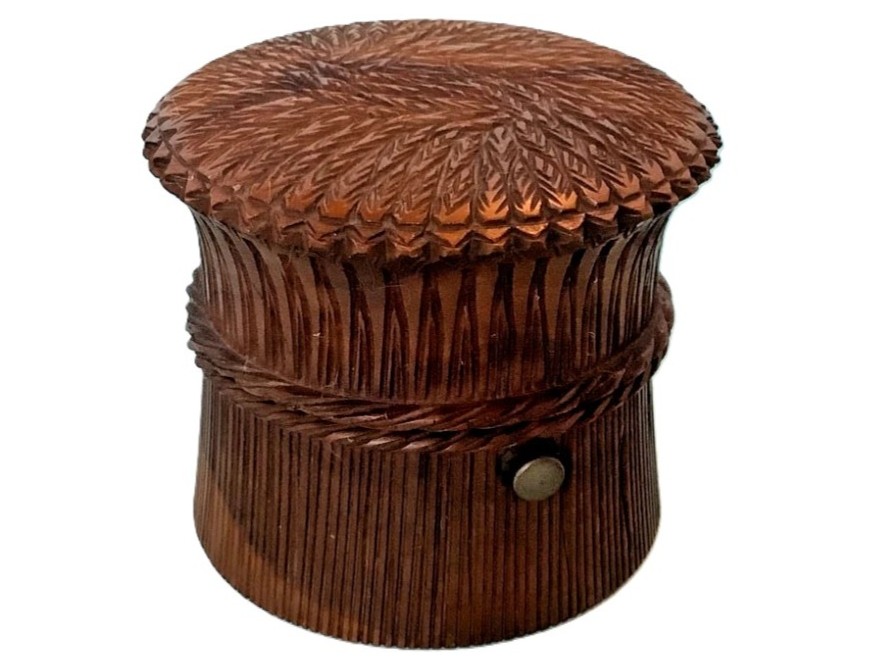


Carved Wheat Sheaf Inkwell
| Categories | Figural - Inanimate |
| Material | Wood |
| Markings | Unmarked |
| Manufacturer | Black Forest |
| Origin | Germany |
| Date or Era | circa 1900 |
| Measuring | 3” diameter; 2 ½” high |
This desk accessory is characterized by its skillful, naturalistic carving and mechanical design.
- Form: The inkwell is carved to resemble a tightly bound sheaf of wheat standing upright. The form is naturalistic, with distinct, individually rendered stalks and kernels, and a tie or ribbon carved around the middle to secure the bundle.
- Material: It is made of carved wood, likely walnut, fruitwood, or linden wood.
- Mechanism: The inkwell is a novelty piece with a dual opening system:
- The entire upper half of the carved wheat bundle is hinged and lifts open, revealing the inner mechanism.
- Within this space is the actual inkwell aperture, covered by a secondary, small, nickel-plated metal lid featuring a spring-loaded thumb release. This metal lid system was designed to securely seal the glass inkwell.
Age and Origin Estimate
This inkwell’s style, carving quality, and mechanical construction strongly place it within the Black Forest school of carving.
Origin: The Black Forest Region
- Location: The Black Forest region of Germany and Switzerland (particularly the Swiss town of Brienz) was the center for this type of decorative wood carving from the mid-19th century into the early 20th century.
- Aesthetic: While Black Forest carvings are famous for figural pieces (bears, dogs, hunters), they also produced smaller, highly detailed household and desk items based on rustic and agricultural themes, such as the “Sheaf of Wheat.” The wheat sheaf motif symbolized prosperity and abundance, making it a fitting subject for a desk item used by merchants or professionals.
Age: Late 19th to Early 20th Century (c. 1880–1910)
The construction details point to the prime period of Black Forest production:
- Carving Style: The high level of detail and naturalistic rendering are characteristic of the later, highly refined period of Black Forest work.
- Metal Mechanism: The use of a relatively sophisticated, nickel-plated, spring-loaded metal lid indicates manufacture during the late Victorian or Edwardian eras, when mass-produced, well-engineered metal hardware became standard in desk accessories.
Sold for $83 in October 2025
Content disclaimer. The information posted is the owner’s best knowledge and may not have been vetted by the SOIC. We welcome comments, corrections, and additions, working to make our website information comprehensive and accurate.
Join the Society of Inkwell Collectors (SOIC) – it’s free!
Founded in 1981 as a non-profit organization,
we are documenting inkwells (and accessories).
We’re here to help and inform!