


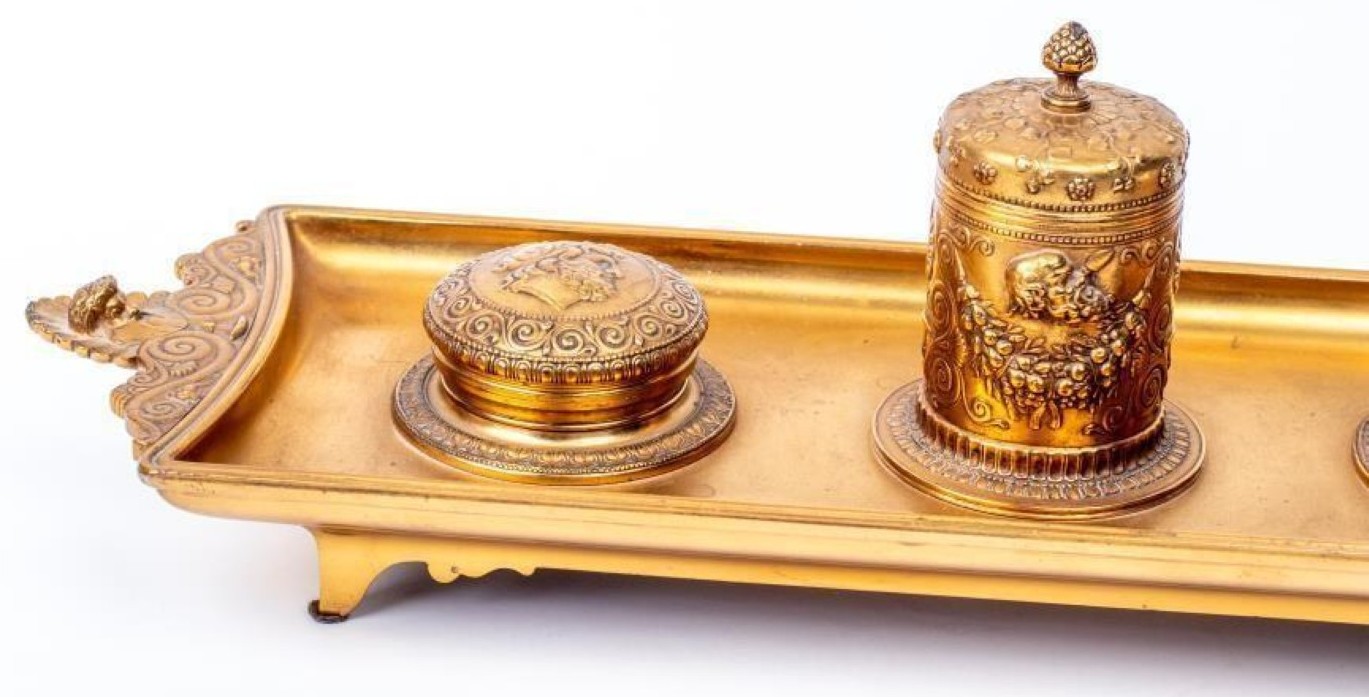

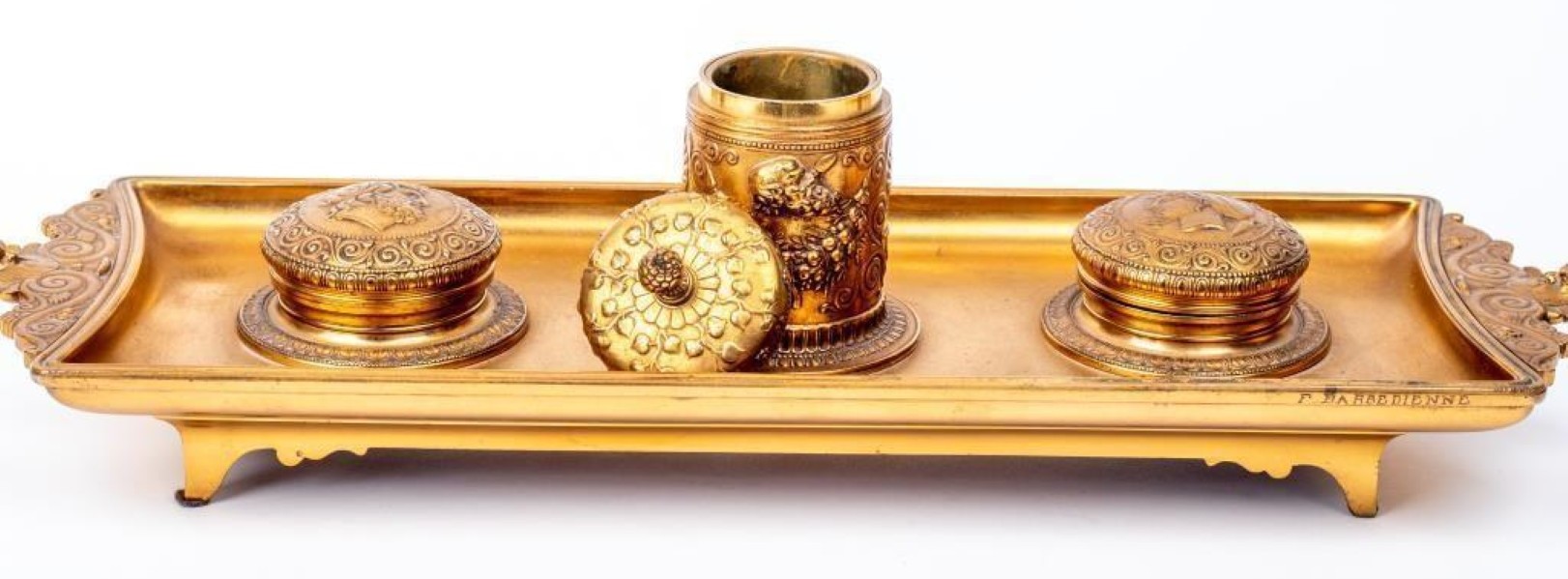
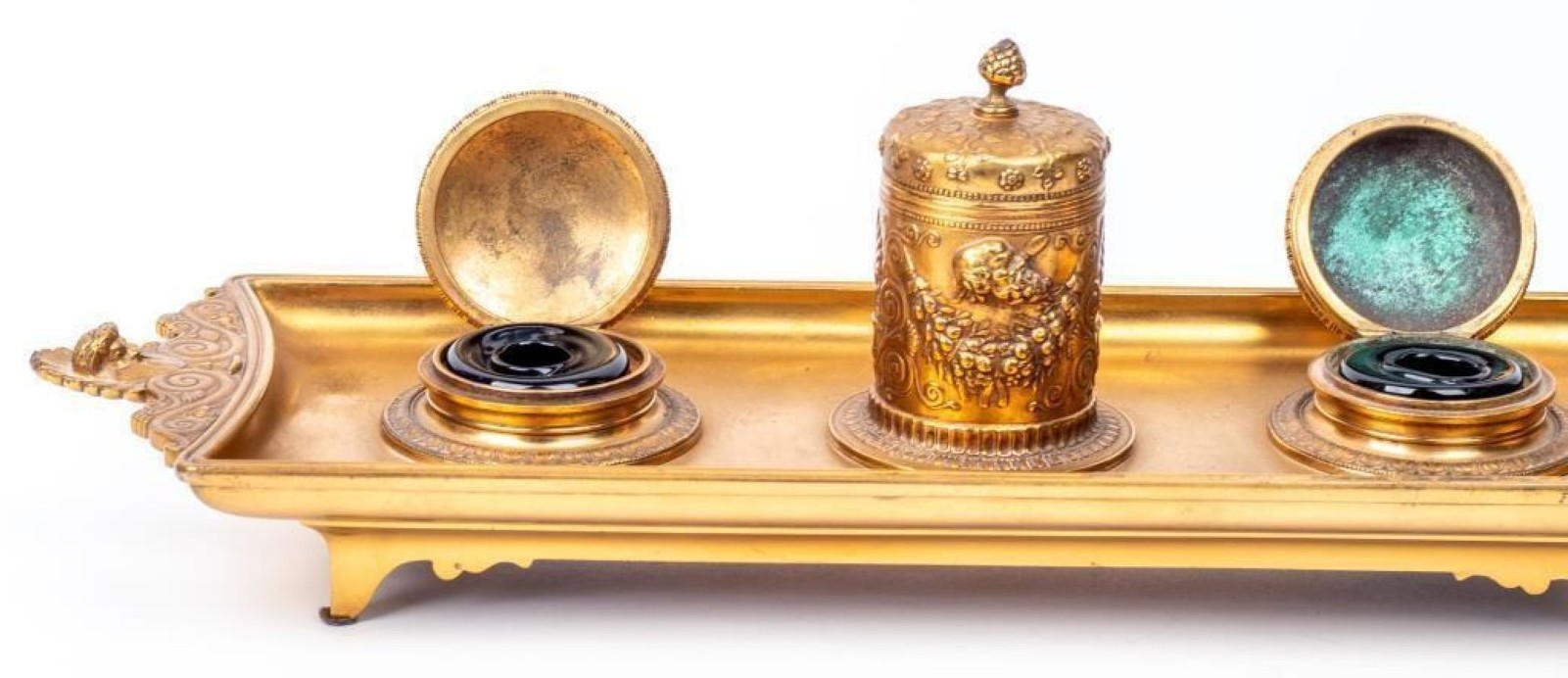
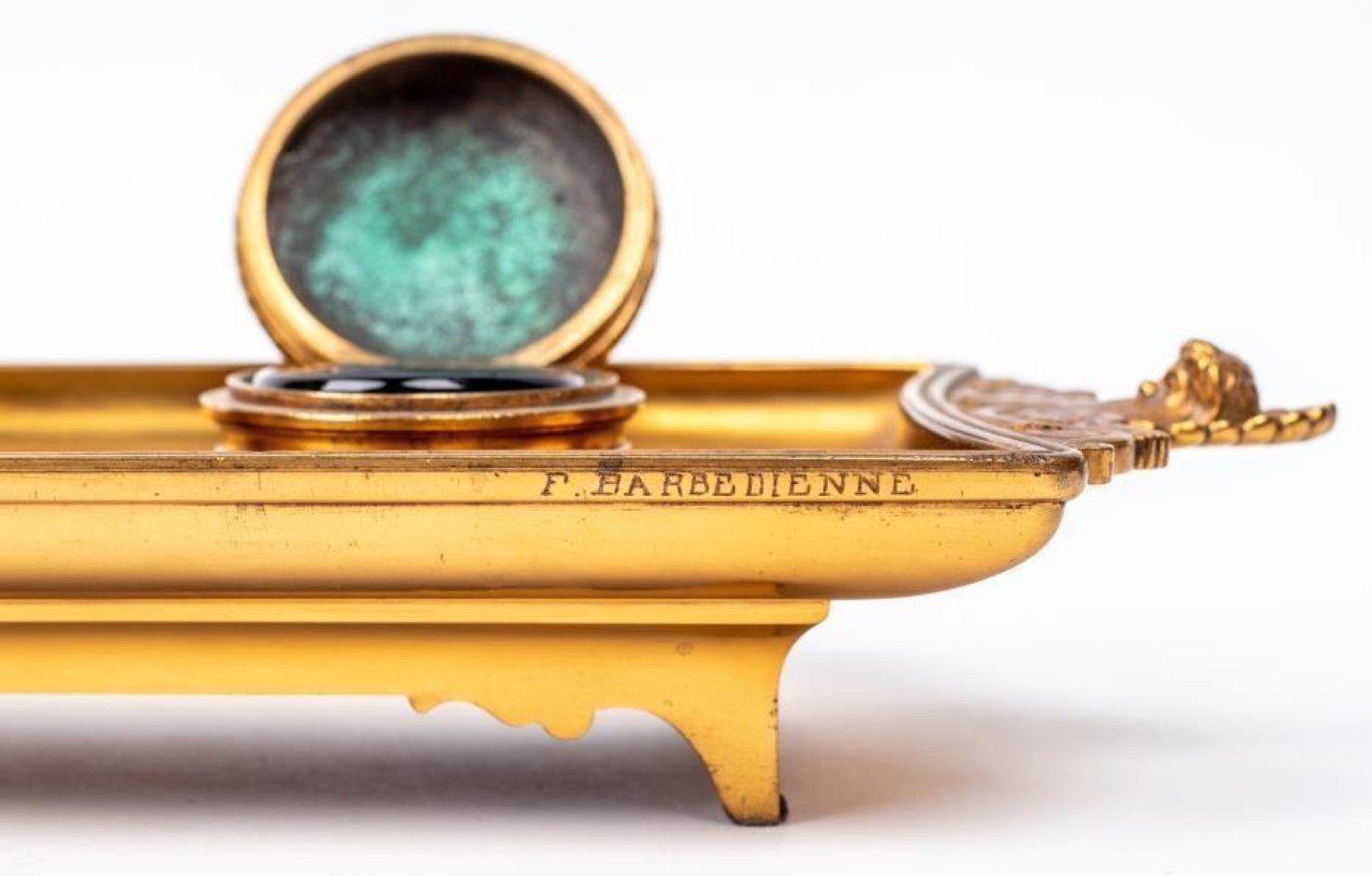


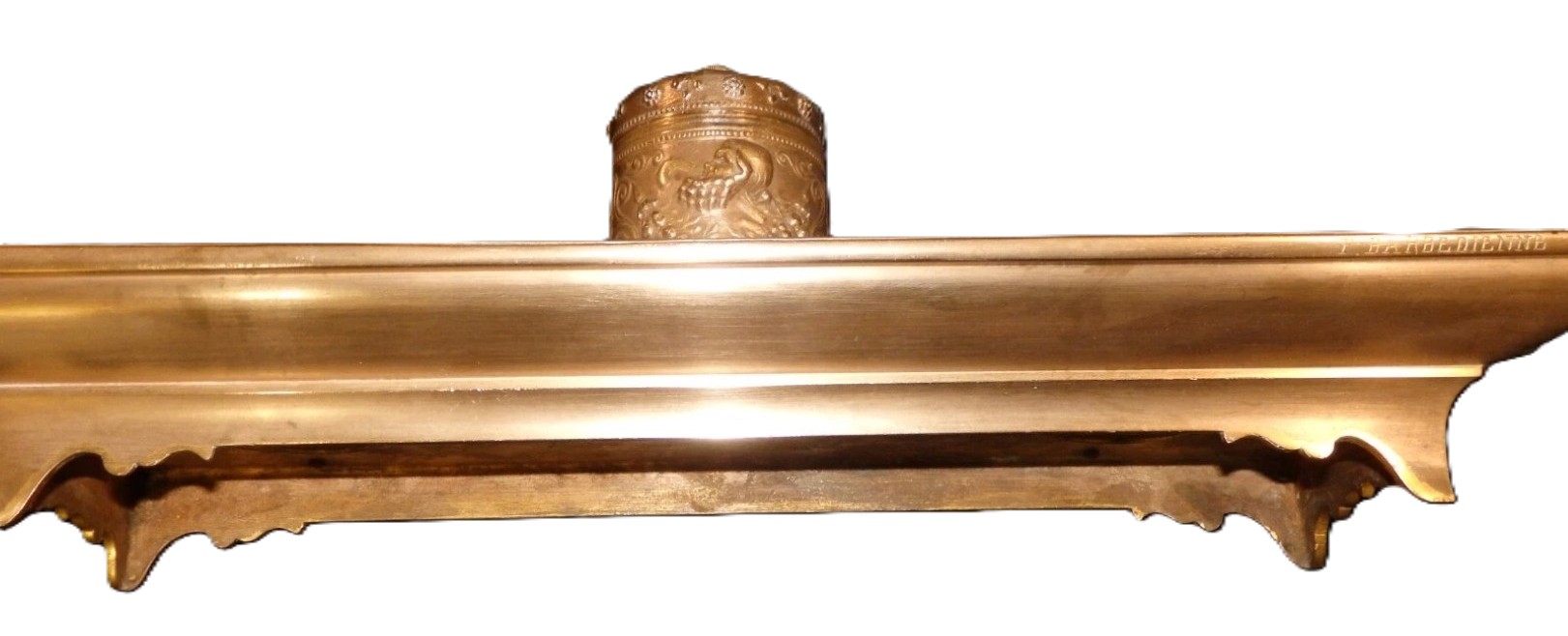


F. Barbedienne Gilt Bronze Double Inkstand
| Categories | Bronze - Brass - Copper |
| Material | Gilt Bronze |
| Markings | F. Barbedienne |
| Manufacturer | Barbedienne Foundry |
| Origin | France |
| Date or Era | circa 1870 |
| Measuring | 19 ½” x 6 ¼” x 6” high |
Description of the Inkstand
- Maker and Mark: F. Barbedienne (Ferdinand Barbedienne) in Paris. The presence of the founder’s mark confirms its authenticity and high-quality production.
- Material and Finish: Gilt Bronze (or ormolu). The piece is cast in bronze and then coated with a thin layer of gold, a demanding process that results in a lustrous, durable finish.
- Overall Form: A classically inspired double inkstand on a rectangular base, featuring two inkwells and a central container, all connected by detailed bronze scrollwork and decorative elements.
Figural Handles and Faces
The design of this inkstand suggests a Neo-Classical or Renaissance Revival style, drawing from Roman or Greek mythology.
Analysis of the Inkwell Lid Mascarons
The F. Barbedienne Foundry frequently used themes drawn from the Renaissance and Classical antiquity. The pair of faces (one male, one female) on the inkwells’ lids is characteristic of this tradition.
- The Female Face
- Appearance: This figure is typically smooth, youthful, and serene, with hair pulled back.
- Symbolism: She represents the idealized Classical Maiden or a Nymph. In the context of the pair, she often symbolizes Beauty, Joy, or Young Love.
- The Male Face
- Appearance: This figure is older, bearded, and highly expressive. The features—furrowed brow, heavy beard, and intense expression—align perfectly with popular representations of:
- Fauns or Satyrs: Minor deities associated with Dionysus (Bacchus), known for merriment, wine, and wildness.
- Elderly Philosophers or Poets: Figures of wisdom, often depicted in a weathered or serious manner.
The Most Likely Interpretation: Bacchic or Allegorical
When paired this way, the figures rarely represent named historical figures. Instead, they are typically allegorical, depicting concepts like:
- The Seasons
- Ages of Man (Youth and Age)
The presence of the expressive male face alongside the serene female face suggests a design inspired by the Bacchic cult, a popular decorative motif that was widely reproduced by high-end foundries like Barbedienne during the mid-19th century.
Handles (Figural Termini):
Given the strong jawline and short, curly hair, these busts are most convincingly interpreted as idealized male figures from classical mythology, such as:
- Apollo: God of music, art, and light, often depicted as a youthful, idealized male figure.
- Mercury (Hermes): God of travelers and commerce.
- A Youthful Philosopher or Poet: An unnamed figure representing wisdom or the arts.
The Barbedienne Foundry frequently mixed male and female elements within a single piece or even designed complementary male and female pieces. The combination of these male busts on the handles and the male/female mascarons on the lids creates a rich, complex thematic tapestry typical of 19th-century Neo-Classical design.
Central Container
The container in the middle often served multiple purposes on a desk.
- Function: It is a storage compartment for nibs, seals, or stamps.
- Decoration: The body of this container is decorated with finely detailed raised friezes (bands of sculpture).
Information Pertaining to F. Barbedienne
Ferdinand Barbedienne (1810–1892) was one of the most celebrated and important French art founders (bronzists) of the 19th century, renowned worldwide for the superb quality of his castings.
Key Facts about the Barbedienne Foundry
| Detail | Description |
| Foundation & Location | Founded in 1838 in Paris, France. |
| Reputation | Known for producing the highest-quality bronze reproductions (statues, clocks, chandeliers, and decorative arts like this inkstand) of Classical and Renaissance works. |
| Materials | Specializing in bronze and gilt bronze (ormolu), often using patinas and gilding of exceptional quality. |
| Major Works | The foundry held the rights to cast small-scale reproductions of works by famous sculptors like Antoine-Louis Barye and produced large quantities of classical subjects. |
| Style | Their work is characterized by technical perfection, intricate detail, and a focus on Neo-Classical, Renaissance Revival, and Neo-Gothic styles. |
| International Recognition | Barbedienne was a huge success at international exhibitions, winning numerous awards, including the Medal of Honour at the 1855 Paris Exposition Universelle. |
Age Estimate
The period of greatest output and fame for the Barbedienne firm was the mid-to-late 19th century, perfectly aligning with the style of this inkstand.
Age Estimate: circa 1850 – 1892
Sold for $175 in October 2025
Content disclaimer. The information posted is the owner’s best knowledge and may not have been vetted by the SOIC. We welcome comments, corrections, and additions, working to make our website information comprehensive and accurate.
Join the Society of Inkwell Collectors (SOIC) – it’s free!
Founded in 1981 as a non-profit organization,
we are documenting inkwells (and accessories).
We’re here to help and inform!