


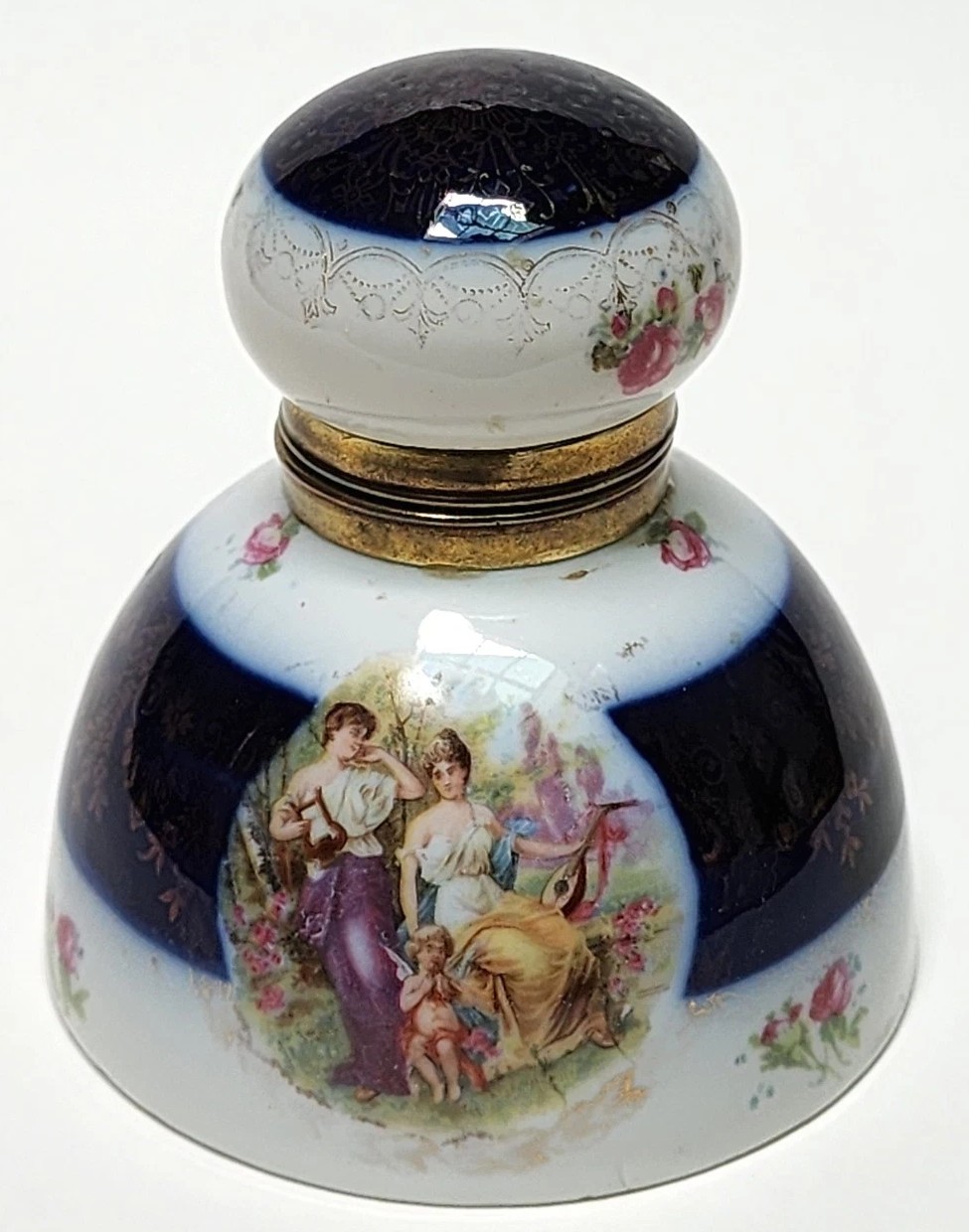


Porcelain Inkwell with Figural Transfer Print
| Categories | Ceramics/Porcelain non-Figural |
| Material | Porcelain |
| Markings | Unmarked |
| Manufacturer | Undetermined |
| Origin | Undetermined |
| Date or Era | circa 1900 |
| Measuring | 3 ⅝” diameter; 3 ⅞” high |
This is a single porcelain inkwell featuring decoration in a romantic style, executed via transfer-printing.
- Form and Construction
- Material: White Porcelain (or fine glazed earthenware).
- Form: The inkwell has a cylindrical body with a slight base molding.
- Lid: It features a fitted, domed porcelain lid secured by a small brass hinge at the back.
- Accents: The inkwell and lid edges are finished with painted gold accents.
- Decoration: Figural Transfer Print
The central decoration is a detailed, polychrome transfer print featuring figures in a romanticized natural setting.
- Color Palette: The colors are soft and muted, featuring browns, pinks, deep reds, and blues.
- The Scene: The image depicts three figures:
- Two Women: The composition centers on two adult female figures in classical attire. One is seated or reclining, dressed in a flowing garment holding a lute. The second woman stands nearbyhe first.
- One Cherub: A small, nude cherub or putto is prominently featured, often associated with love.
- Background: The figures are set against a background of foliage, trees, and sky, giving the scene a soft, painterly, and idealized outdoor setting.
III. Classical Scene Assessment
The scene depicts two adult female figures and a cherub in a lush, idealized environment.
- Is it a known classical scene? While it is not a direct, easily identifiable scene from Greek or Roman mythology (like Venus and Cupid), it certainly belongs to the Romantic or Neoclassical style of painting that was very popular in 19th-century decorative arts.
- Likely Subject: This type of transfer print usually represents a Pastoral or Allegorical scene of Love, Poetry, or Friendship. The cherub strongly suggests a theme related to Cupid (Eros) or a scene depicting Venus (Aphrodite) with a companion or mortal, alluding to love or beauty.
- Estimated Age and Origin
- Age: The style of the transfer print (romantic figures, soft colors) and the hinged porcelain form were very popular throughout the Late Victorian and Edwardian Eras, circa 1880–1915.
- Origin: The combination of detailed transferware and the porcelain quality suggest manufacture in a major European center, most likely England, Germany, or Austria (Continental Europe).
Sold for $75 in October 2025
Content disclaimer. The information posted is the owner’s best knowledge and may not have been vetted by the SOIC. We welcome comments, corrections, and additions, working to make our website information comprehensive and accurate.
Join the Society of Inkwell Collectors (SOIC) – it’s free!
Founded in 1981 as a non-profit organization,
we are documenting inkwells (and accessories).
We’re here to help and inform!