

Inkipedia
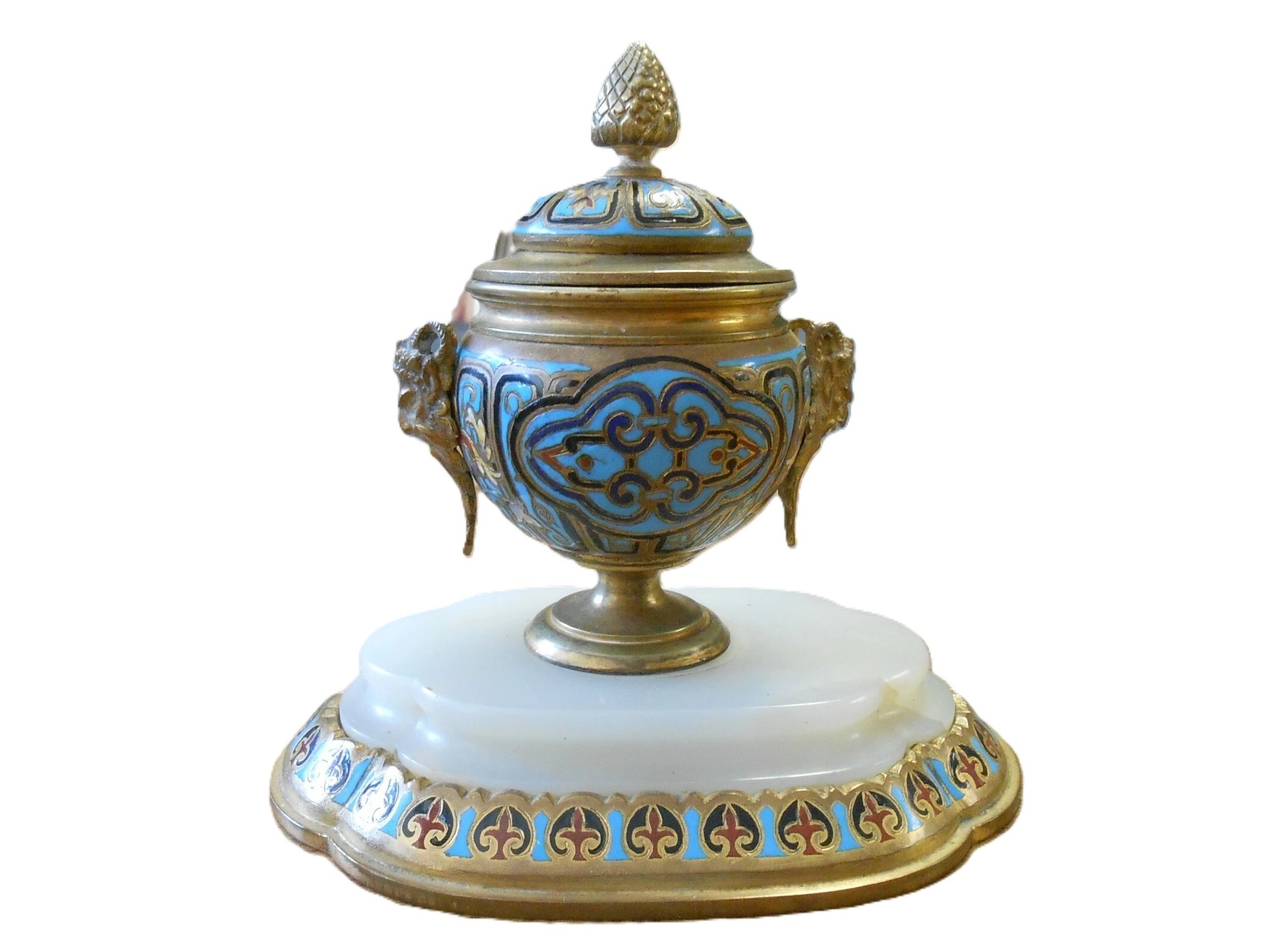


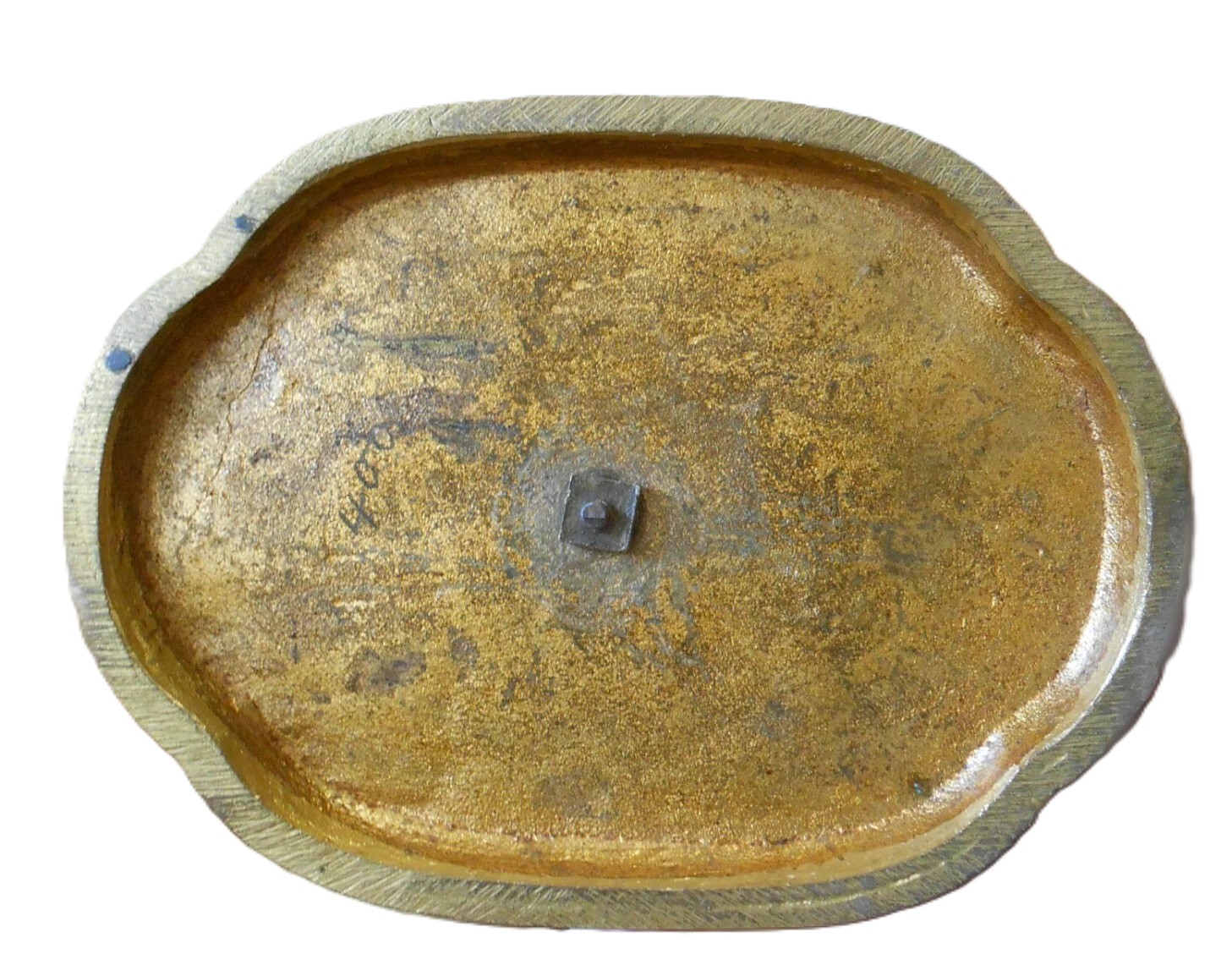

French Champlevé and Doré Bronze Inkwell
| Categories | Enameled Metal |
| Type | Champlevé |
| Material | Enameled Brass/Bronze/Metal, Gold Gilt Finish |
| Markings | Unmarked |
| Manufacturer | Undetermined |
| Origin | France |
| Date or Era | circa 1870 |
| Measuring | 5” x 3 ⅝” x 4 ½” high |
This inkwell resembles a classical urn, elevated by its rich materials and intricate enamel work.
- Materials and Construction
- Base: The foundation of the piece is a polished Onyx base. Onyx was favored in the 19th century for fine desk pieces to add a layer of natural luxury.
- Metalwork: The metallic components are made of bronze and finished with doré (French for gilded) bronze.
- Enamel Technique: The decorative bands on the bronze are executed in Champlevé enamel (see explanation below). The colors appear jewel-toned, featuring hues like deep blue, white, and red, arranged in precise geometric and symbolic patterns.
- Period: The style and craftsmanship confirm its dating to the 19th century, likely the Late Napoleon III or Belle Époque period (c. 1860–1890).
- Form and Decorative Elements
- Inkwell Body: The body is styled as a classical urn or vase.
- Handles (Figures): Serving as handles or decorative side elements are two detailed horned figures.
- Identification: Bacchus (Roman god of wine) or Pan (Greek god of the wild, often depicted with horns and goat legs) are possibilities. These figures represent Satyrs or Fauns—woodland deities often associated with revelry and classical themes—a popular motif in classical revival ornamentation.
- Base Decoration: Encircling the base of the urn is a band of enamel work featuring the fleur-de-lis, the stylized lily that is a historic symbol of the French monarchy and often incorporated into French decorative arts as a sign of heritage and elegance.
- Lid and Finial: The domed lid is hinged and crowned with an acorn finial.
III. Explanation of Key Terms
| Term | Definition and Context |
| Champlevé Enamel | A technique of enameling where the metal surface (usually bronze or copper) is first cut, etched, or dug out to create trenches or depressions. These depressions are then filled with colored enamel powder and fired. The metal walls remain exposed between the enamel areas, creating a clear outline for the design. |
| Doré Bronze | A term used primarily in French decorative arts to denote gilded bronze. It specifically refers to the technique where a layer of gold is applied to the bronze, typically using fire-gilding (ormolu) or electroplating, to create a bright, lasting, gold finish. |
| Fleur-de-lis | A stylized lily or iris that is the traditional emblem of French royalty. In decorative arts, its use evokes a sense of French heritage, nobility, and classical elegance. |
| Acorn Finial | A small, decorative element shaped like an acorn placed atop the inkwell lid. Acorns often symbolize longevity, strength, and prosperity in classical and Victorian symbolism. |
Sold for $250 in October 2025
Content disclaimer. The information posted is the owner’s best knowledge and may not have been vetted by the SOIC. We welcome comments, corrections, and additions, working to make our website information comprehensive and accurate.
Join the Society of Inkwell Collectors (SOIC) – it’s free!
Founded in 1981 as a non-profit organization,
we are documenting inkwells (and accessories).
We’re here to help and inform!