


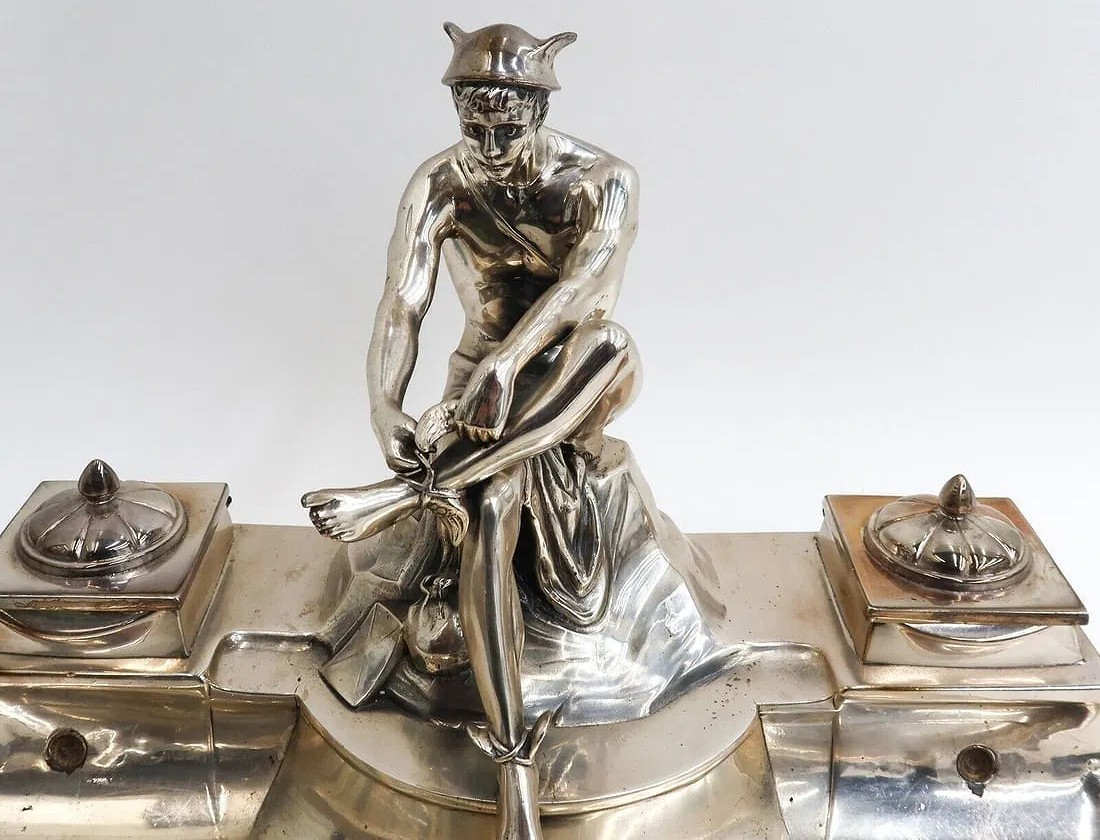


Figural Silverplated Inkstand – Hermes / Mercury
| Categories | Figural - Mythology; Literature; Religion; Fictional |
| Type | Mythology |
| Material | Silverplate |
| Markings | See Narrative |
| Manufacturer | WMF |
| Origin | Germany |
| Date or Era | circa 1900 |
| Measuring | 13 ½” x 8 ½” x 9” high |
This is a figural desk inkstand made from a base metal and finished with silverplating.
- The Figure: The central element is a detailed sculptural representation of the god Mercury (Roman) / Hermes (Greek). He is depicted in the classic pose of Fastening the Talaria (his winged sandals), often associated with the celebrated sculpture by Jean-Baptiste Pigalle. He is seated with his right leg crossed over his left and sits on a raised plinth. He is muscled, and characterized by the winged petasus (cap) he wears and the winged sandals, the talaria, which he is adjusting, emphasizing the divine messenger’s readiness for swift travel.
- Inkwells: The inkstand features two inkwells, one on either side of the seated god. They are box-shaped and integrated into the base. Each inkwell has a hinged lid and contains a removable glass insert for holding the ink.
- Style: The overall style is Neoclassical in its subject matter (the god) combined with the popular Art Nouveau/Jugendstil period’s use of silverplate for domestic objects and accessories, placing its probable date around the turn of the 20th century (c. 1890–1910).
- Attribution: The piece is attributed to the collaboration between J.P. Kayser & Sohn, Krefeld and the retail/distribution efforts of WMF (Württembergische Metallwarenfabrik).
The “ANEZIN” Mark
The letters “ANEZIN” are an abbreviation related to the metal alloy and process used in the piece’s manufacture.
- ANEZIN stands for Anti-Nickel-Zinc.
- It refers to a specific metal alloy (a type of white metal or Britannia metal) that was commonly used as the base material for silverplated objects by German manufacturers like J.P. Kayser & Sohn (Kayserzinn) and WMF in the late 19th and early 20th centuries.
- The use of a proprietary alloy like “ANEZIN” was a way for the manufacturer to indicate the quality and durability of the base metal used before the silverplating was applied. It essentially functions as a trade name for the specific metal composition.
Legend of Hermes / Mercury
Hermes (Greek) and his Roman counterpart, Mercury, are the gods of boundaries, travel, communication, commerce, and thieves.
| Feature | Greek God: Hermes | Roman God: Mercury |
| Domain | Messenger of the Gods, Travel, Trade, Thievery, Luck, Border Crossings. | God of financial gain, Commerce, Communications, Travelers, and Trickery. |
| Attributes | The Kerykeion (Caduceus): A winged staff entwined with two snakes. The Talaria: Winged sandals. The Petasus: A winged cap. | Same attributes as Hermes. His name is related to the Latin word merx (merchandise). |
| Legend | Born to Zeus and the nymph Maia. He was a mischievous child, famously stealing Apollo’s cattle shortly after birth, but appeasing him by inventing the lyre. He served as the psychopomp, guiding the souls of the dead to the underworld. | He evolved into a patron of merchants and travelers, often invoked for good fortune in trade and swift journeys. |
This inkstand perfectly captures the image of Mercury preparing for flight—fastening the sandals that allow him to move swiftly between the mortal and divine worlds to deliver messages.
History of WMF (Württembergische Metallwarenfabrik)
Württembergische Metallwarenfabrik (WMF) is one of the most important and historically significant manufacturers of domestic metalware in German history.
- Founding (1853): The company was founded in Geislingen an der Steige, Germany, from the merger of two smaller companies.
- Rise to Prominence (Late 19th Century): WMF quickly grew, becoming known for its high-quality electroplated metal goods (such as the silverplating on this piece), including tableware, cutlery, and decorative items.
- Acquisitions and Expansion: WMF became a powerhouse through key acquisitions. In 1880, WMF acquired the famous Kunstanstalt für Galvanoplastik, giving them expertise in creating large, high-quality, electroplated figures.
- Artistic Period (1890–1910): This is the period your piece likely belongs to. WMF excelled in the Art Nouveau (Jugendstil) style, creating magnificent and ornate designs, often incorporating mythical figures, flowing lines, and natural forms.
- Relationship with J.P. Kayser & Sohn: WMF had various arrangements with other German metalware manufacturers, including J.P. Kayser. Kayser was particularly famous for their high-quality pewter known as Kayserzinn. The attribution of this piece suggests that the initial casting or design (possibly the base metal) may have been related to Kayser’s production, and then finished and marketed through the larger distribution network of WMF.
Sold for $315 in October 2025
Content disclaimer. The information posted is the owner’s best knowledge and may not have been vetted by the SOIC. We welcome comments, corrections, and additions, working to make our website information comprehensive and accurate.
Join the Society of Inkwell Collectors (SOIC) – it’s free!
Founded in 1981 as a non-profit organization,
we are documenting inkwells (and accessories).
We’re here to help and inform!