







Rotating Inkstand for Cutler Rolltop Desk
| Categories | Mechanical - Levered or Rotating Lids |
| Material | Glass, Wood |
| Markings | Unmarked |
| Manufacturer | A. Cutler & Son |
| Origin | United States |
| Date or Era | circa 1890 |
| Measuring | 10” long; 4” wide |
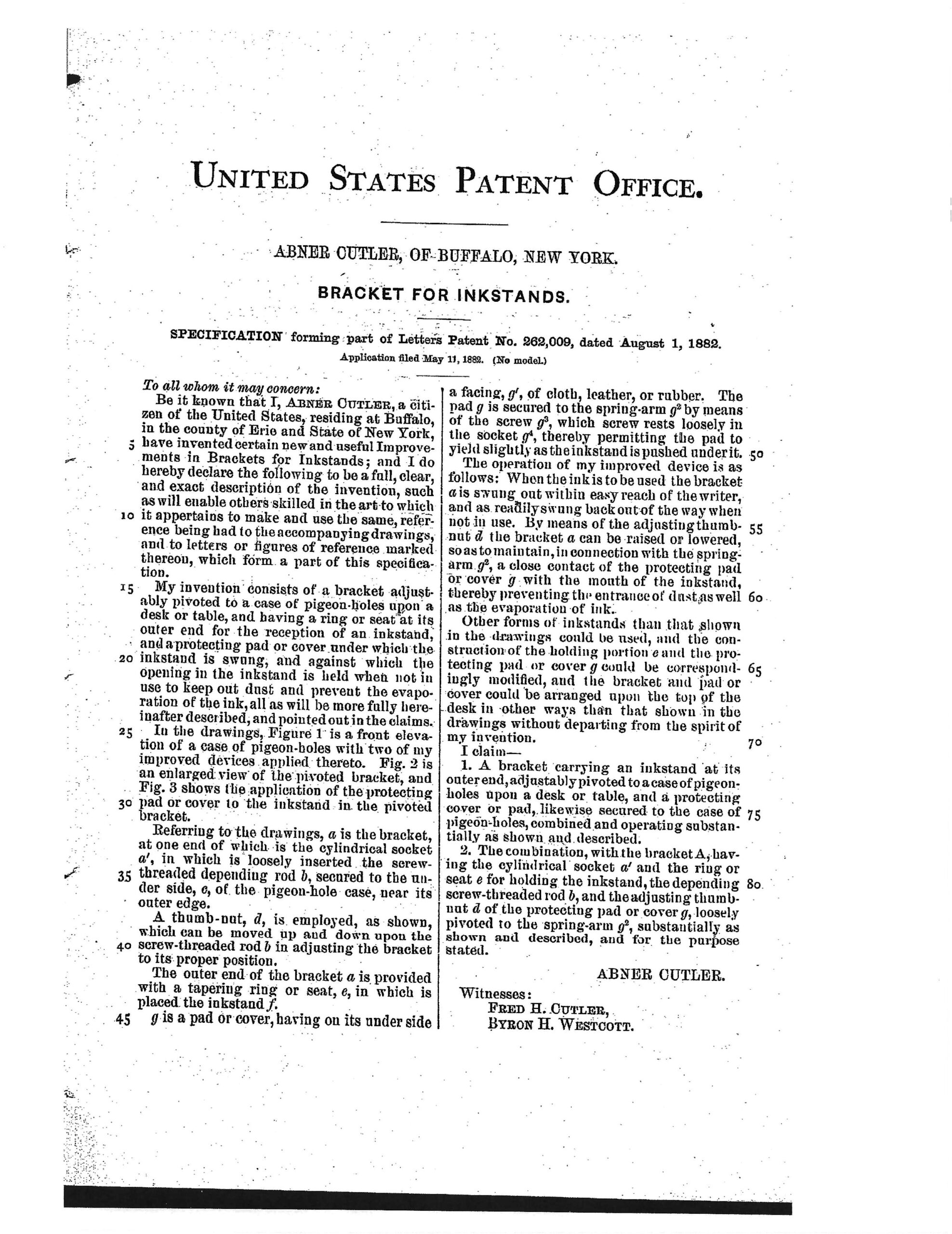
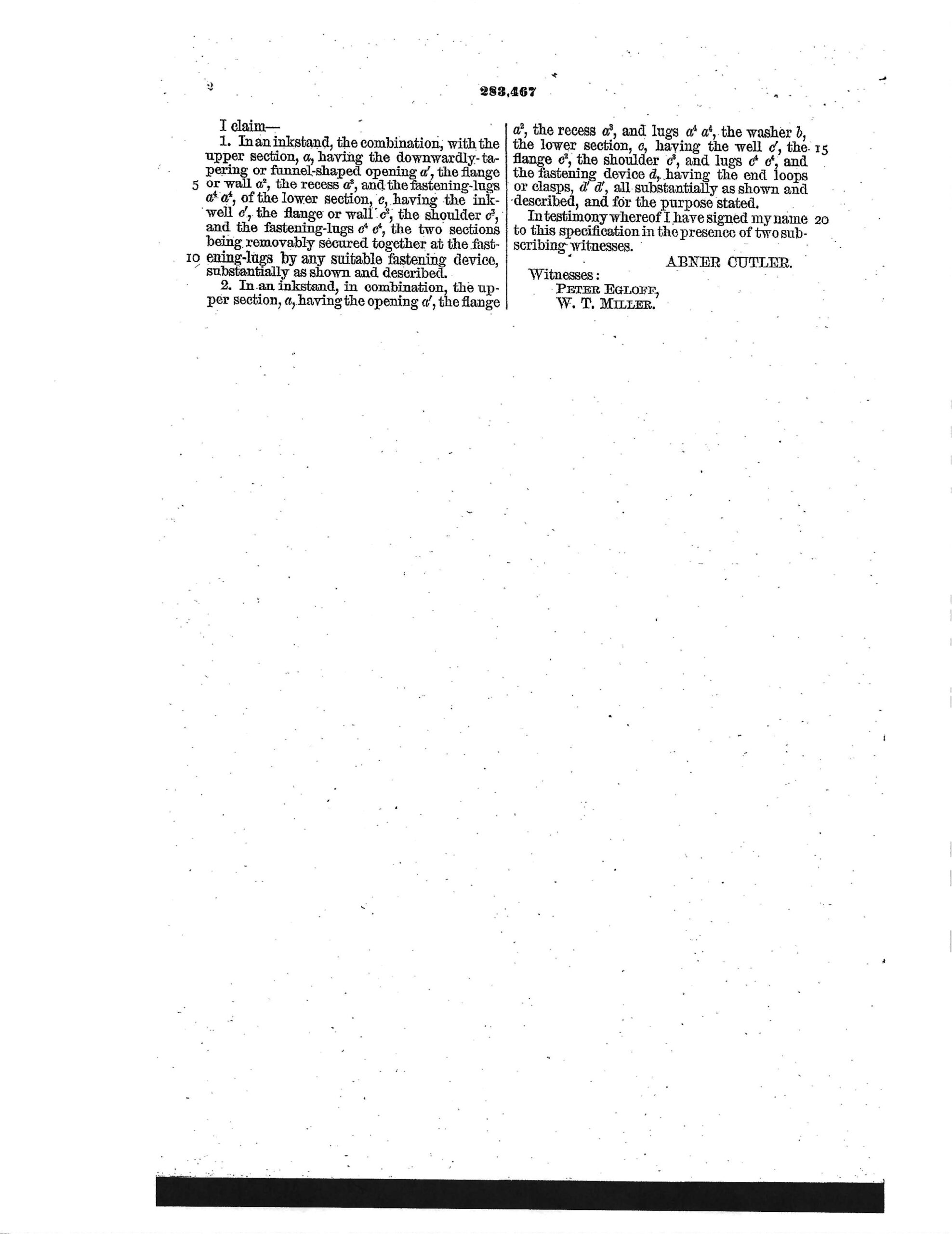
| Patent | No. 262,009 Patented Aug. 1, 1882; No. 283,467 Patented Aug. 21, 1883 |
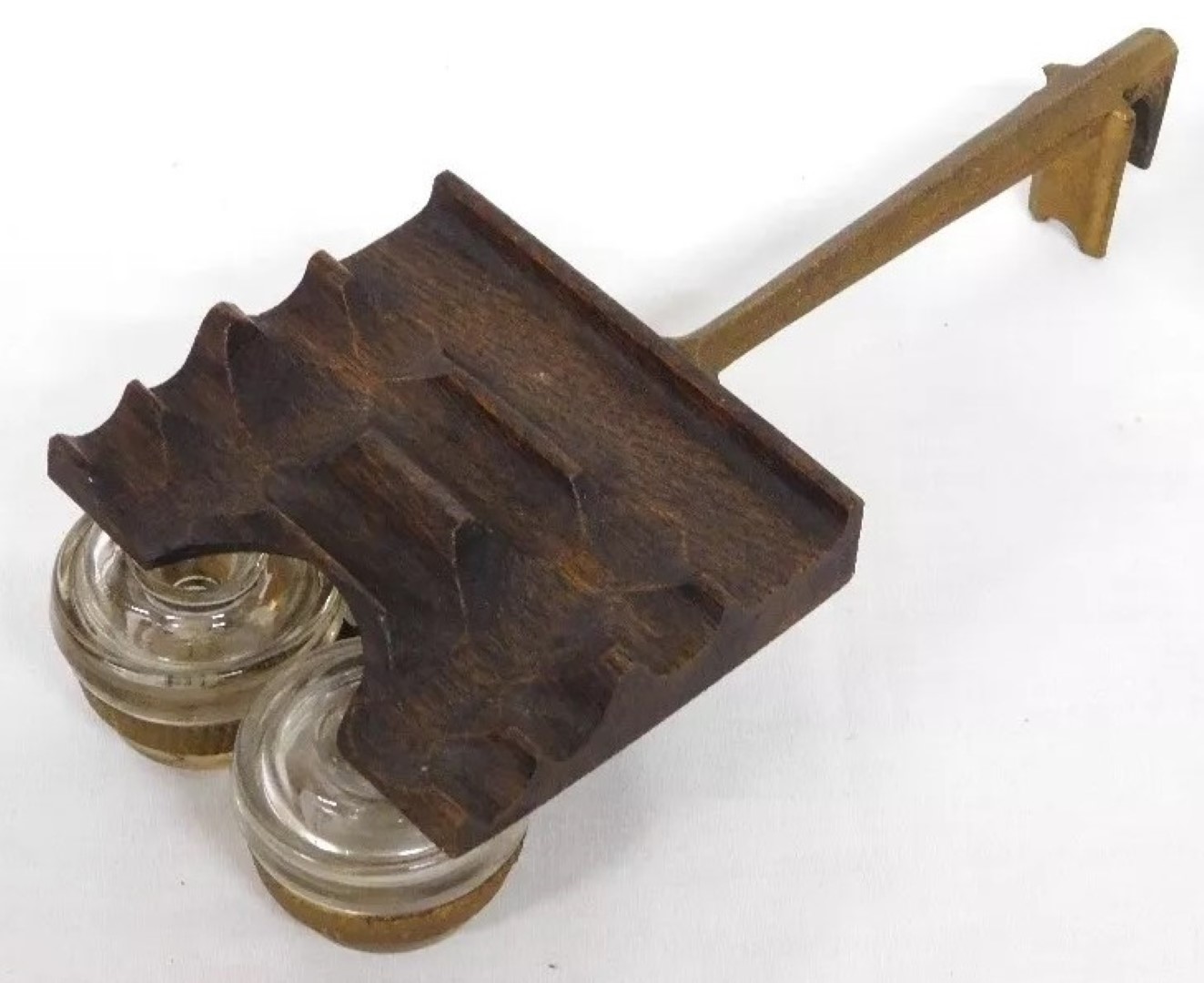
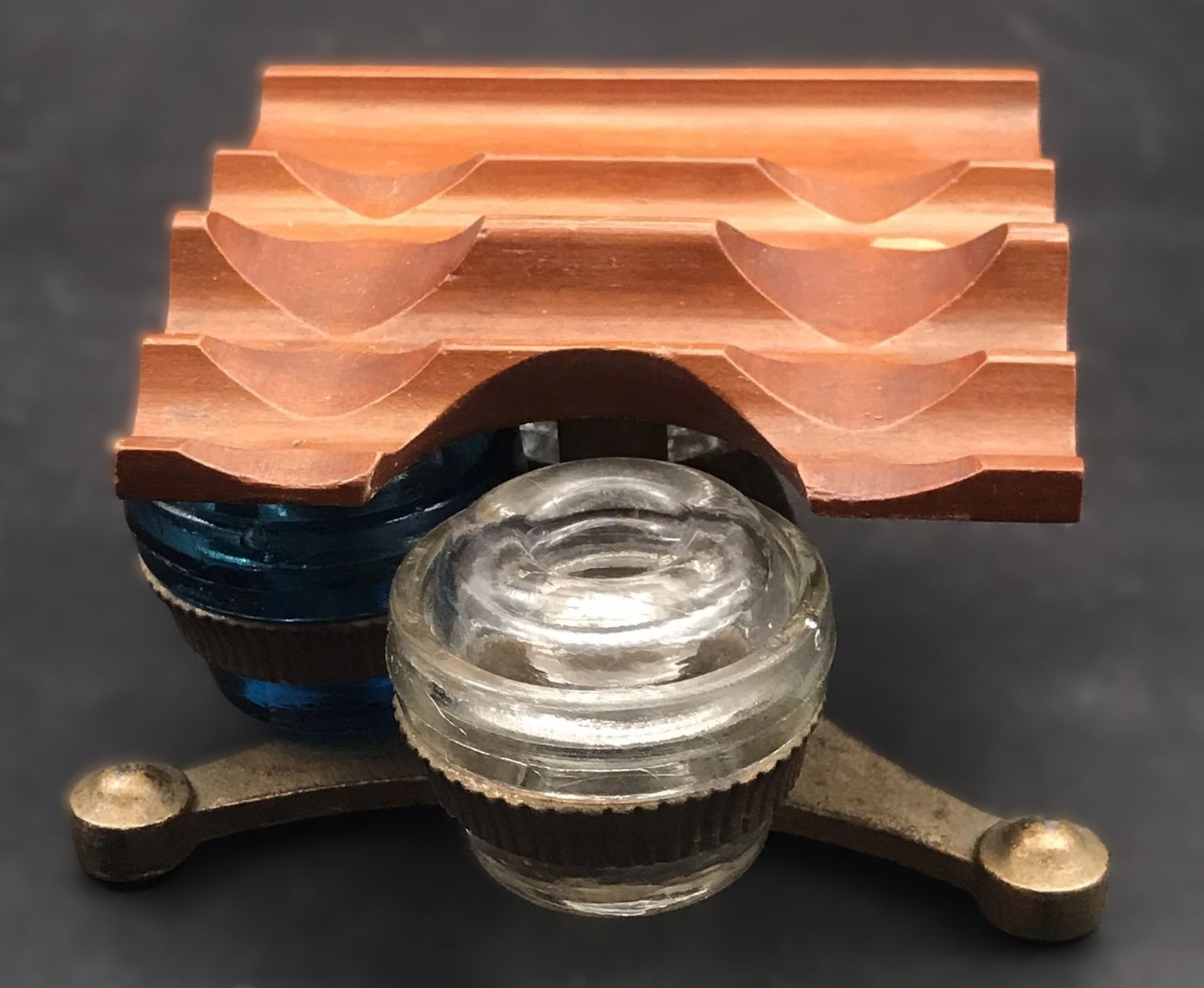
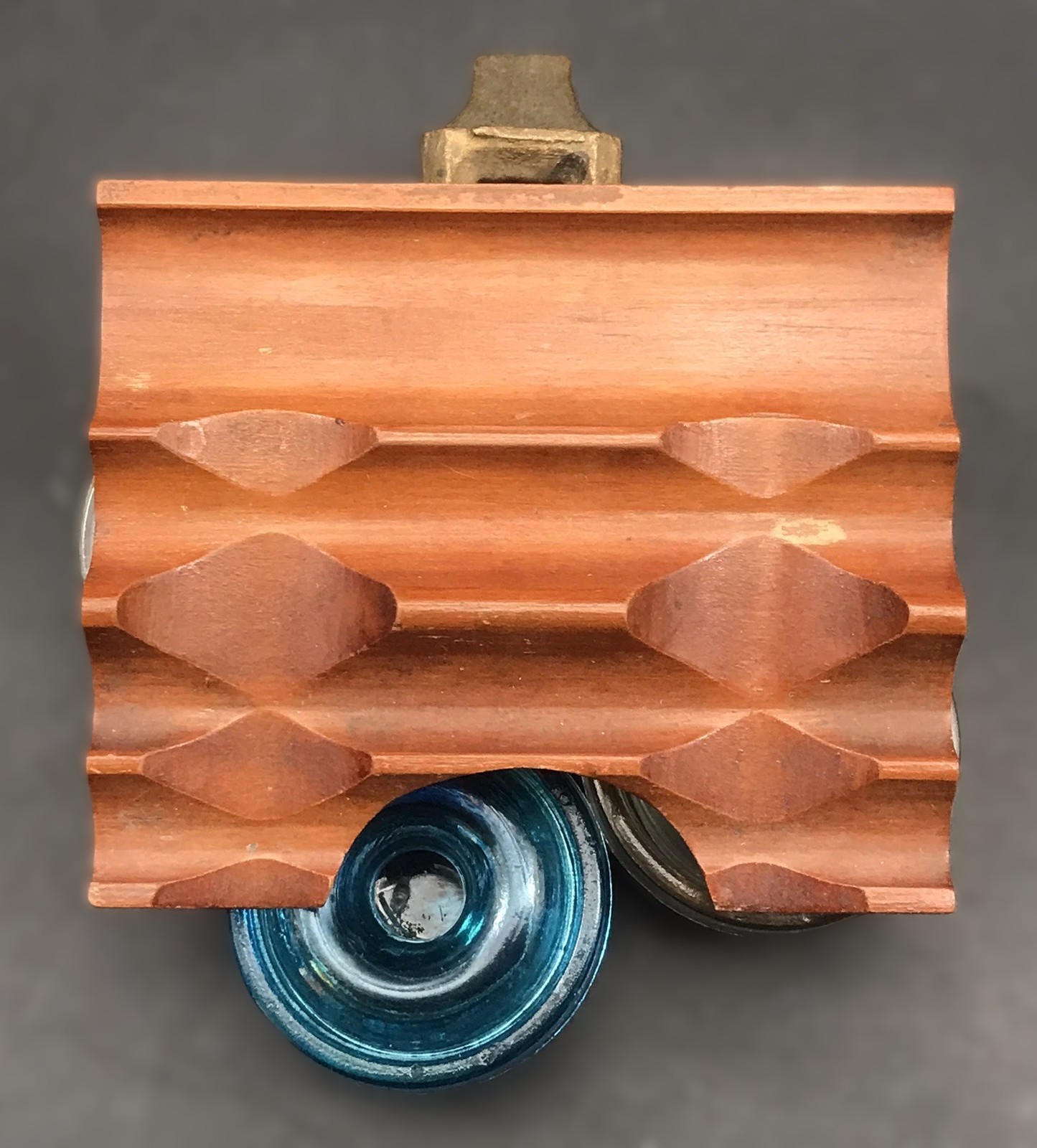
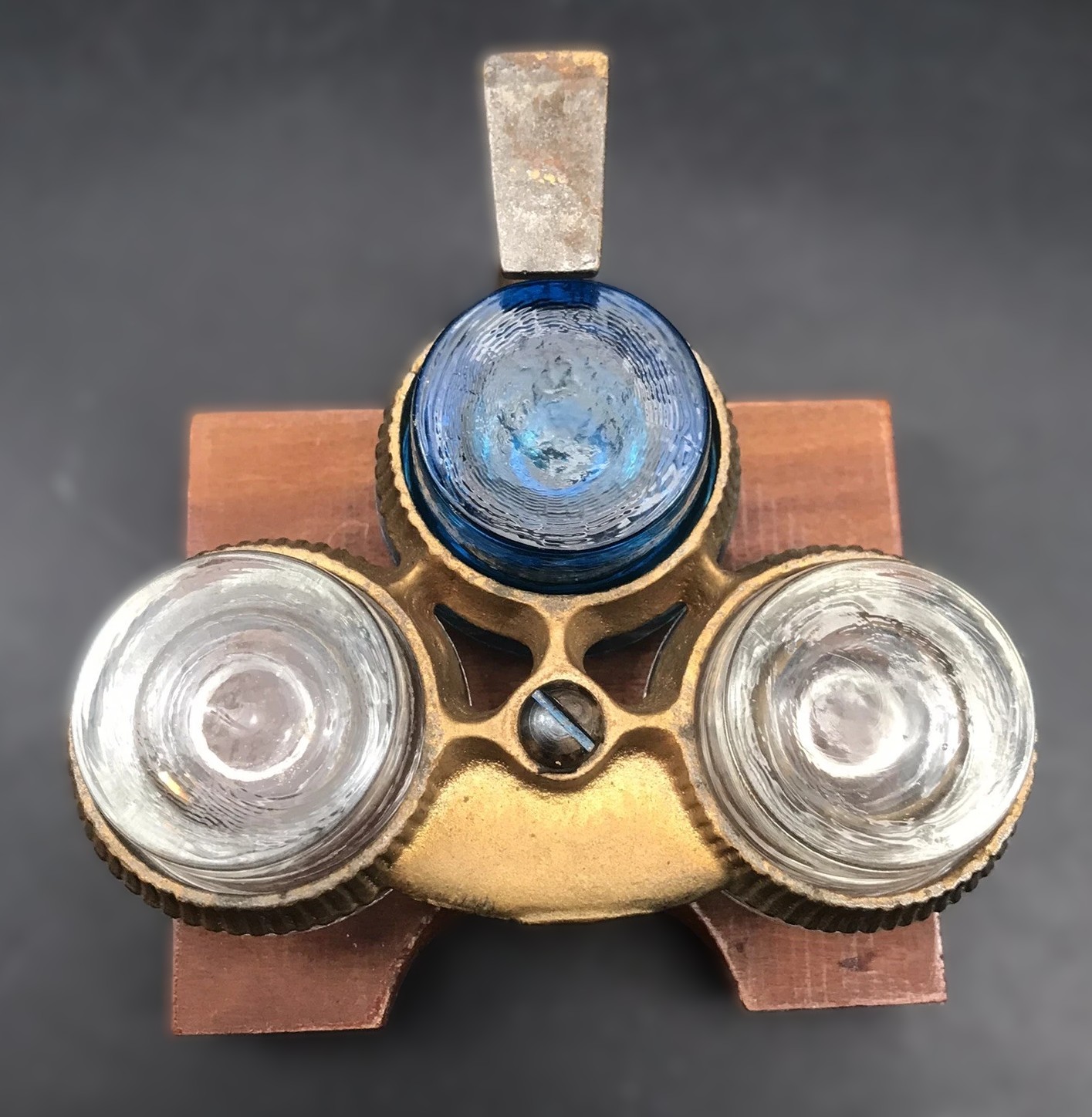
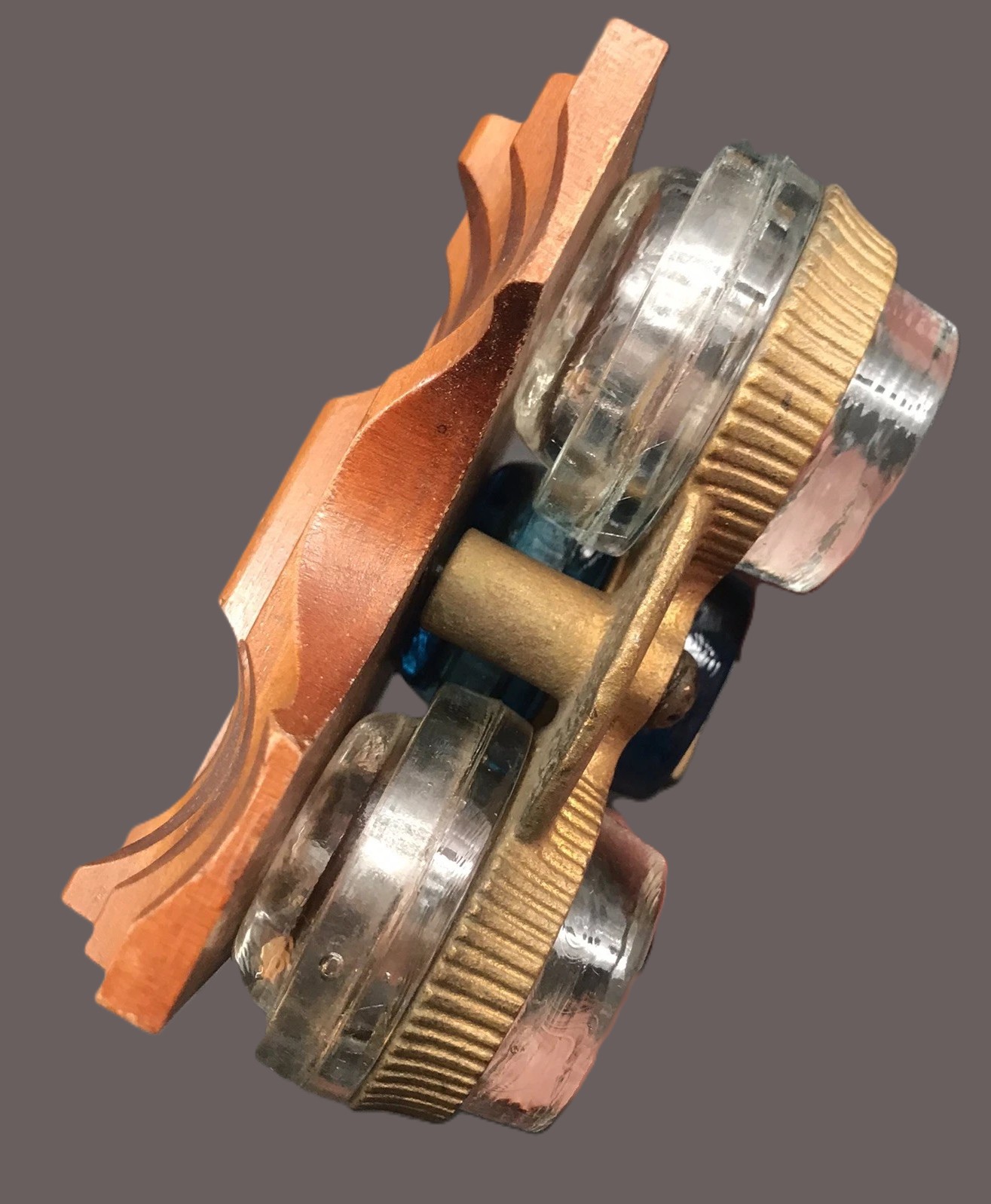
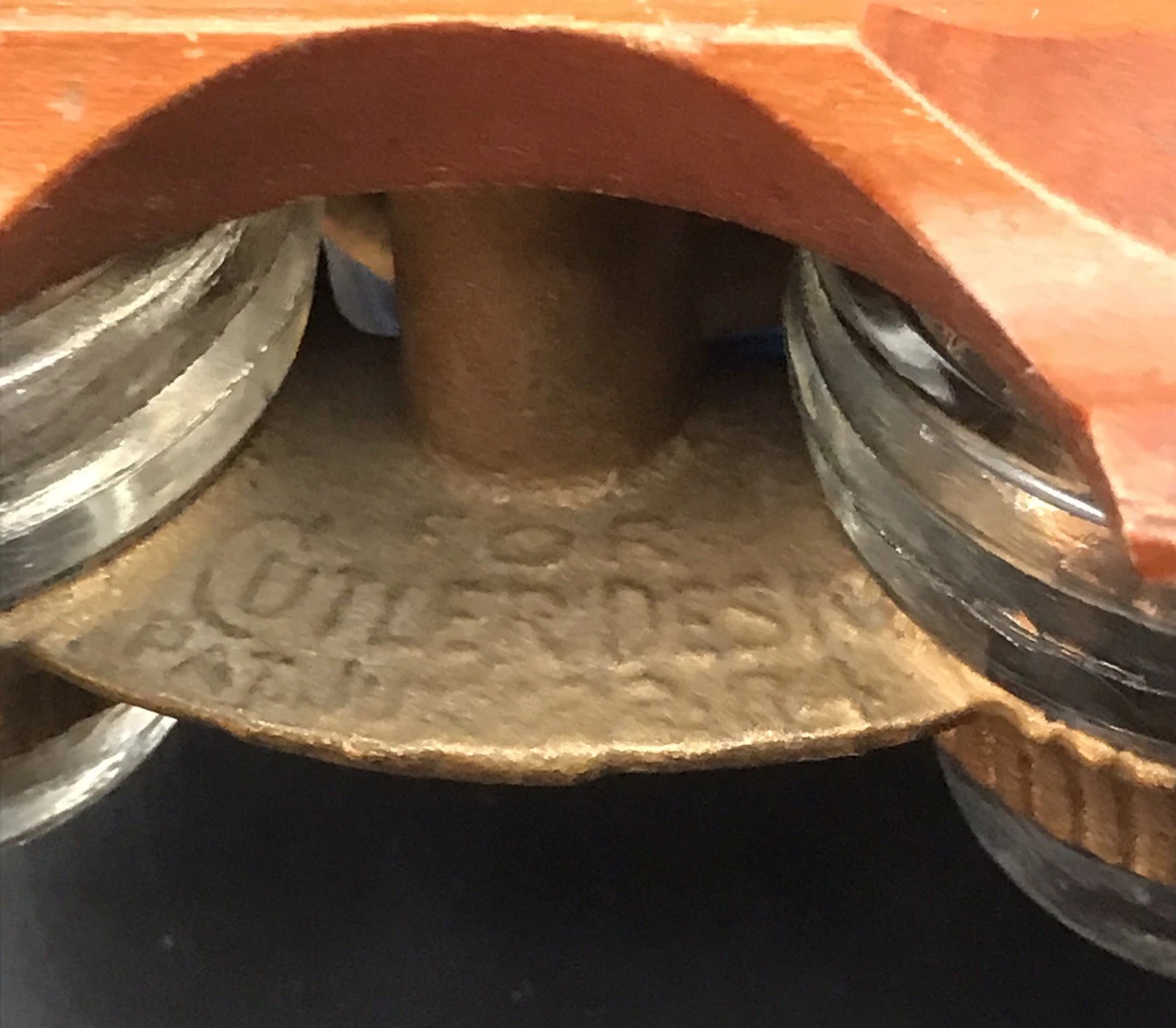
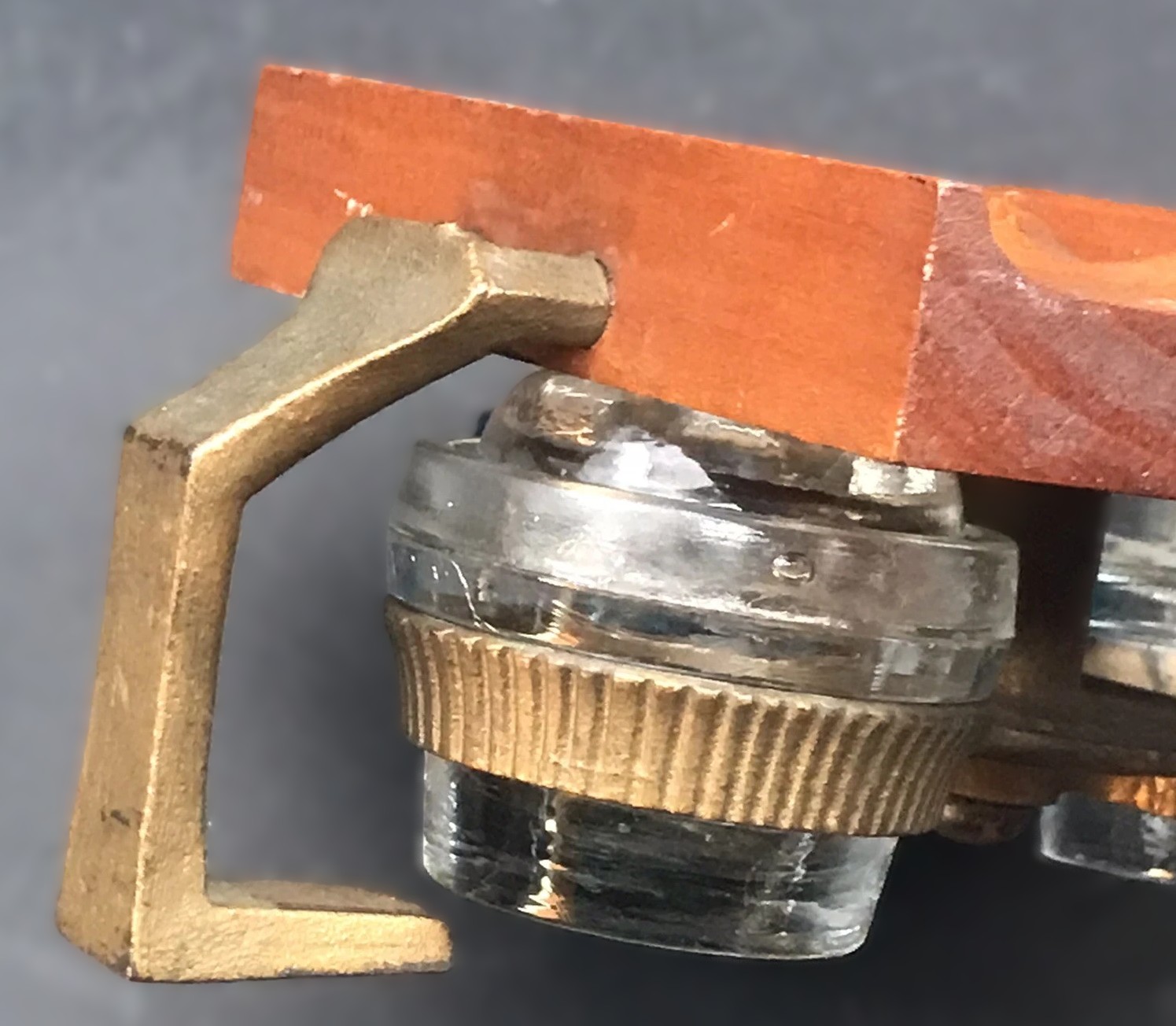
This Cutler inkwell desk accessory was designed to attach to the a Cutler rolltop desk from the late 19th century. Abner Cutler patented the rolltop desk in 1881, and this inkwell accessory was designed to complement the desk, providing a convenient way for storing ink. The top of the inkstand, made of wood to match the desk, has carved grooves to hold pens. Attached underneath is a metal bracket mounted on a pivot point which holds three inkwells. The inkstand includes an extending arm with an arrow-like point that clips into the mounting section of the desk, usually in the middle of the pigeonholes.
The metal bracket holding the three inkwells is designed to rotate or pivot, allowing each inkwell to align with an opening in the overhead wooden pen holder. When you want to dip a pen into the ink, you rotate the bracket so that one of the inkwells aligns perfectly with the opening in the wooden pen holder above.
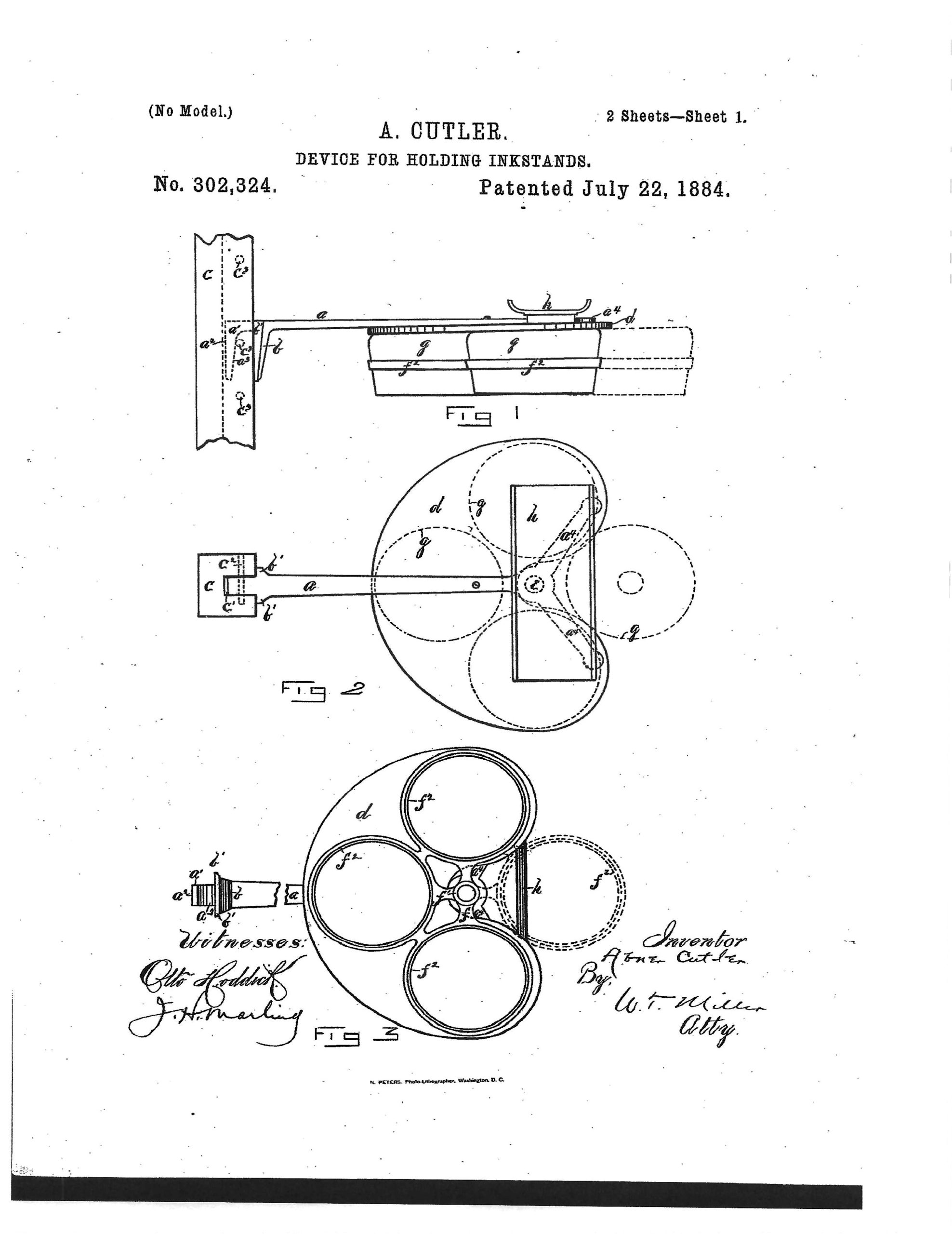
Abner Cutler, the man credited with perfecting the rolltop desk, wasn’t just about big furniture; he was concerned with keeping ink fresh and accessible without cluttering a desk. He had another patent approved on July 22, 1884.
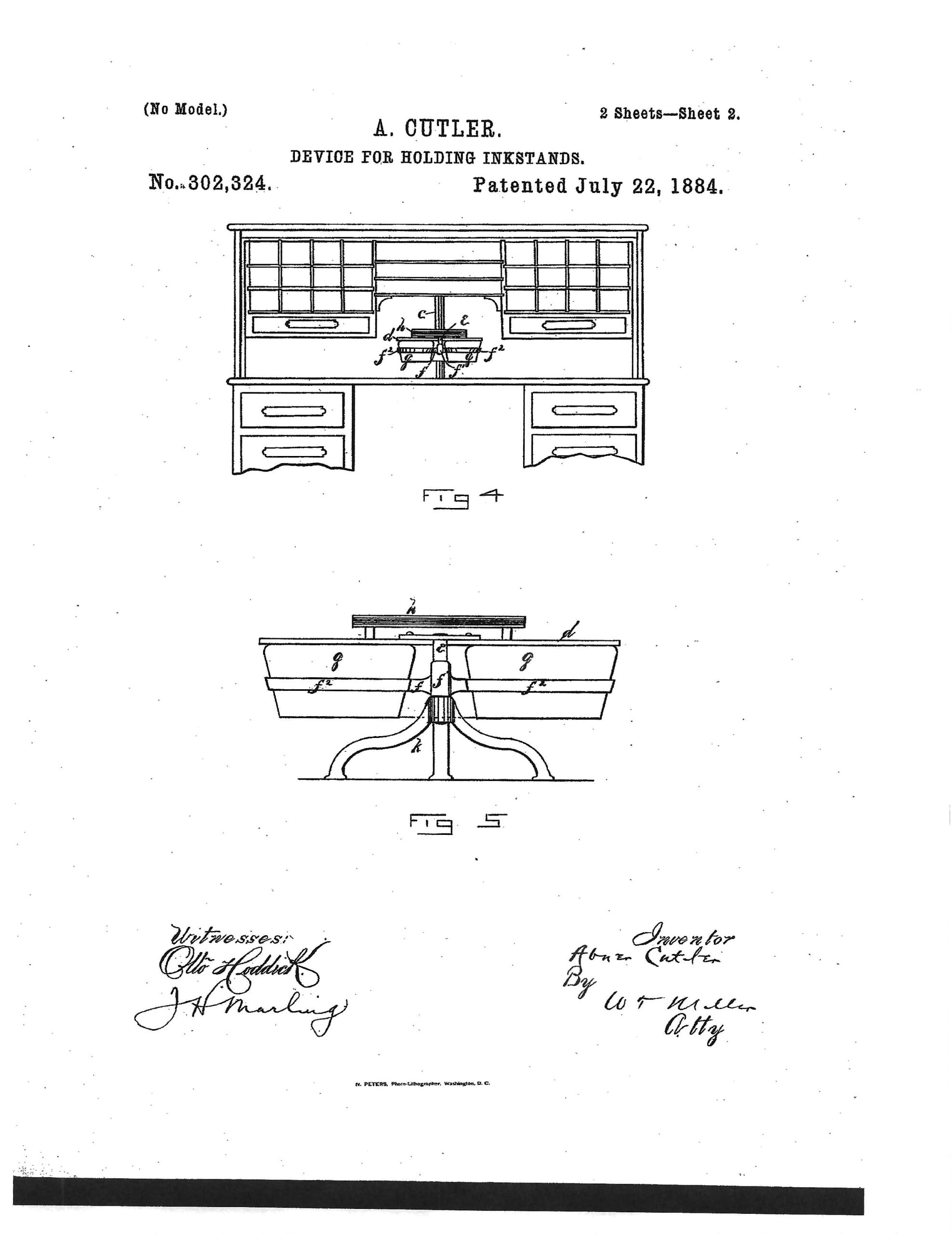
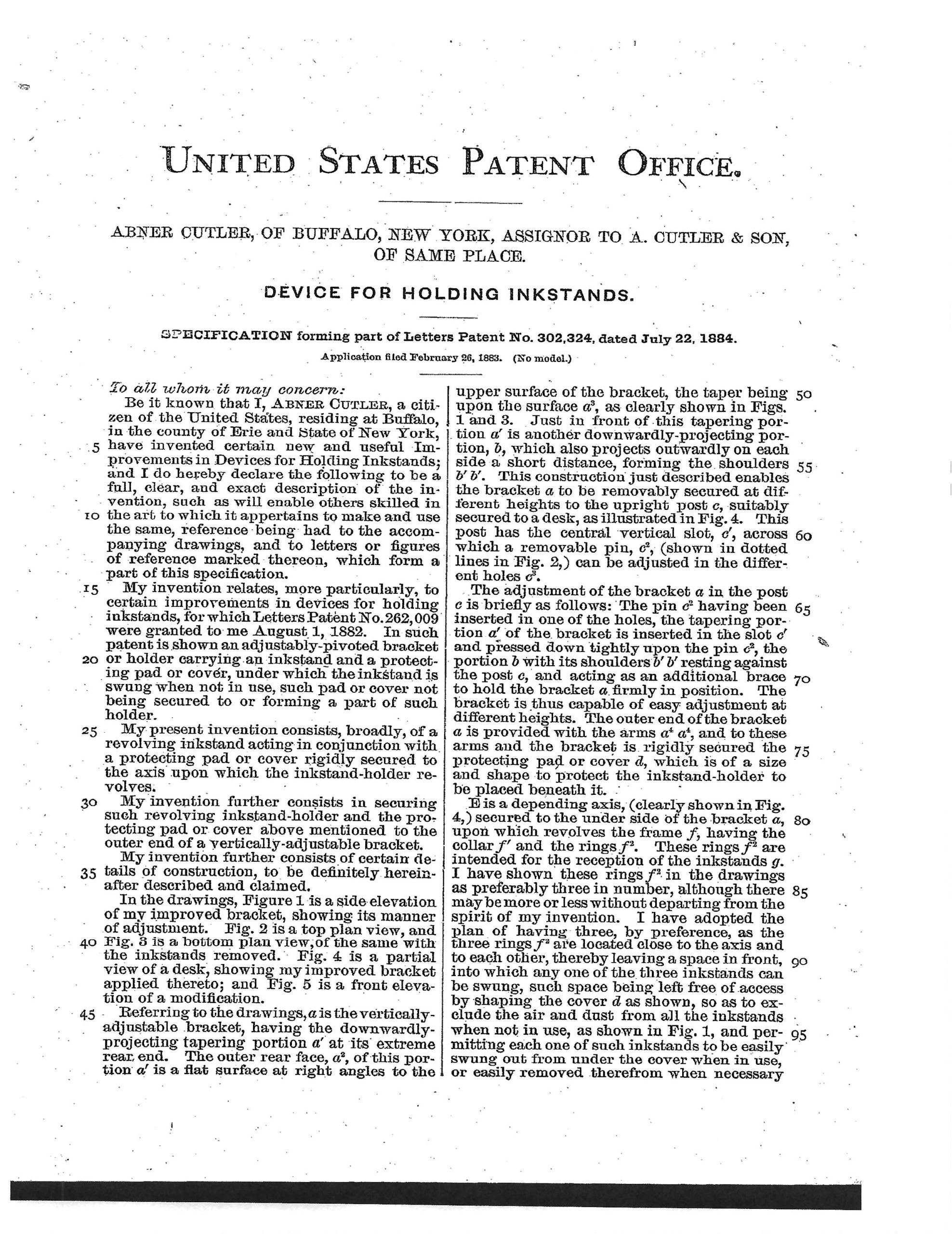
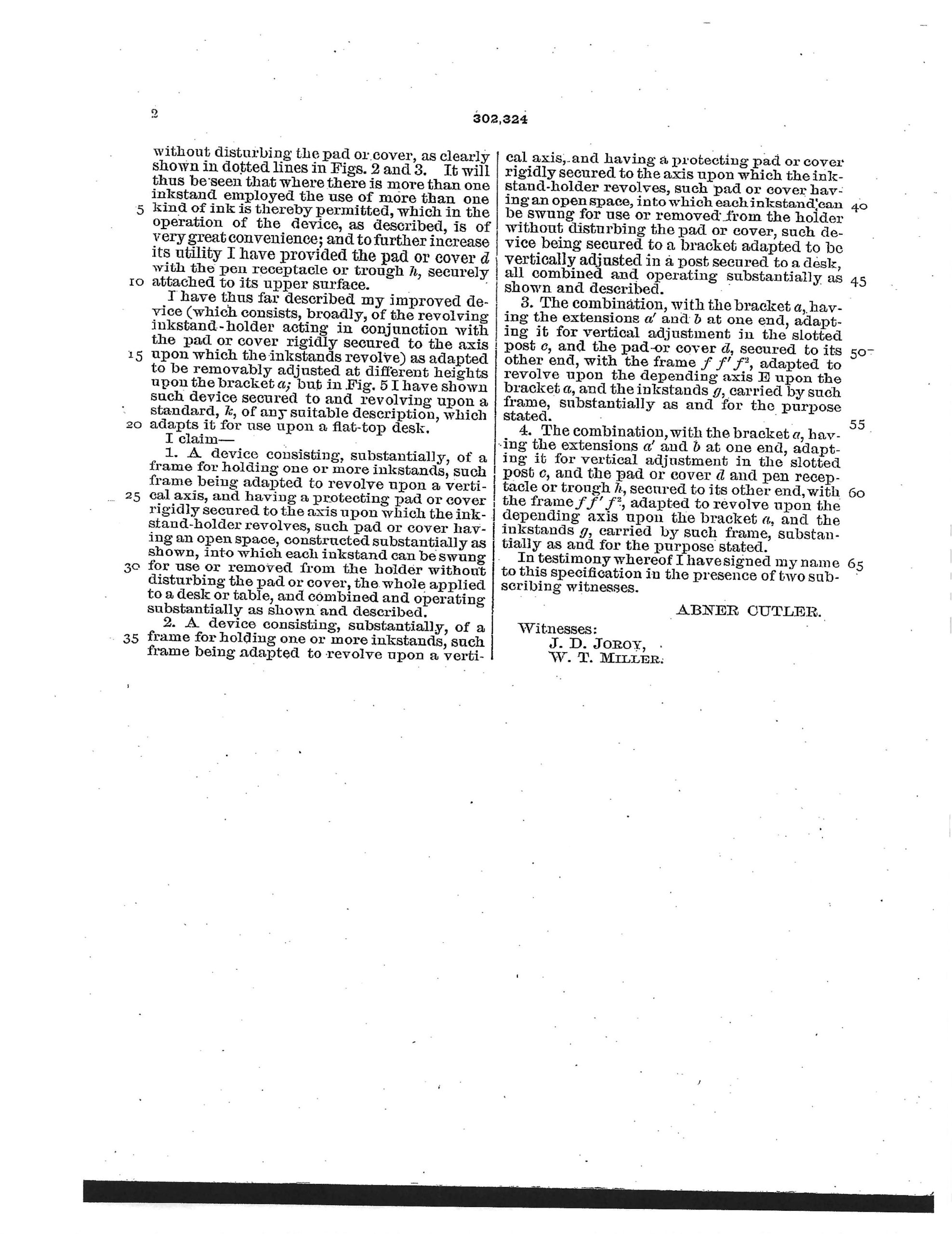
Summary of Patent No. 302,324 (July 22, 1884)
This patent represents an evolutionary step over Cutler’s previous design (Patent No. 262,009). The primary goal was to create a more modular and adjustable system for managing multiple ink types while protecting them from evaporation and dust.
- The Core Innovation: Stationary Cover vs. Revolving Wells
In previous designs, the cover usually moved with the inkstand. Cutler’s “improved device” reversed this:
- The protecting pad or cover (d) remains stationary.
- The inkstand-holder (f) revolves beneath it.
- This allows the user to swing a specific inkwell out from under the cover for use and then tuck it back in to “exclude the air and dust” without moving the entire assembly.
- Height Adjustability
The patent describes a slotted post (c) and a bracket (a). The bracket has a “tapering portion” (a’) that fits into the post. By using a removable pin (c²) placed in different holes (c³), the user could adjust the height of the inkwells to perfectly match their desk surface or personal preference.
- Dual Utility
The stationary cover (d) wasn’t just a lid; it served two other purposes:
- Pen Trough (h): The top of the cover features a receptacle for holding pens.
- Protection: The underside of the cover was often lined with a “pad” to ensure a snug, airtight fit against the tops of the glass wells.
Description of the Desktop Cutler Inkstand
The physical object pictured shows the “Desktop Model” referenced in Figure 5 of the patent.
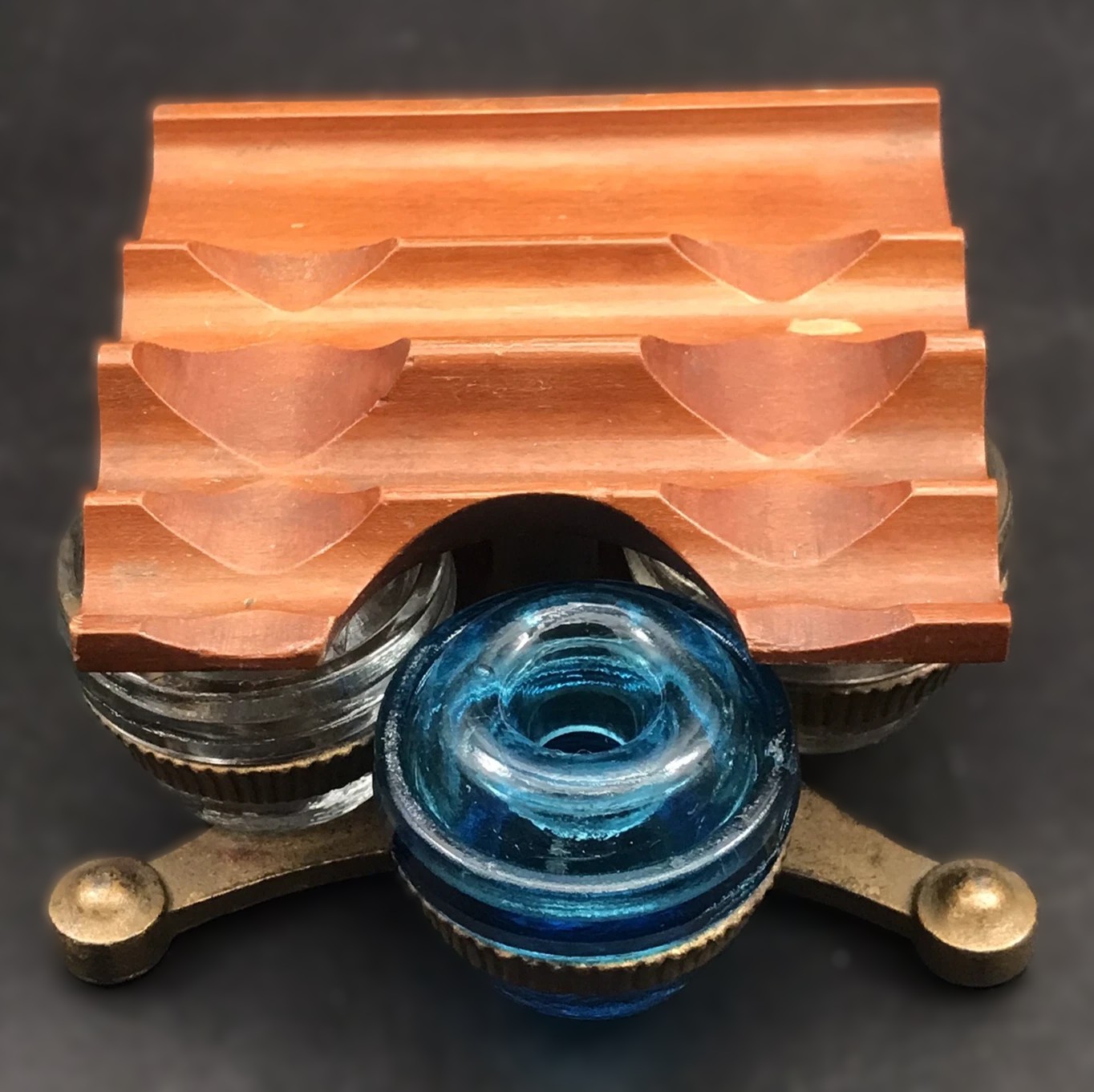
- The Cover (d): This is the carved wooden top. You can see the deep grooves (the trough h) designed to hold several dip pens. The “notch” or open space in the wood allows one inkwell to be exposed at a time.
- The Inkwells (g): a “triple” set—two clear glass and one striking cobalt blue. In the 1880s, this would likely have been used for different colors of ink (e.g., black for correspondence, red for bookkeeping/corrections, and perhaps a third for a different nib style).
- The Revolving Mechanism: The wells sit in metal rings (f³) attached to a central axis. The user rotates the metal base to bring the desired color into the “open space” for dipping.
Identifying the Mystery Part
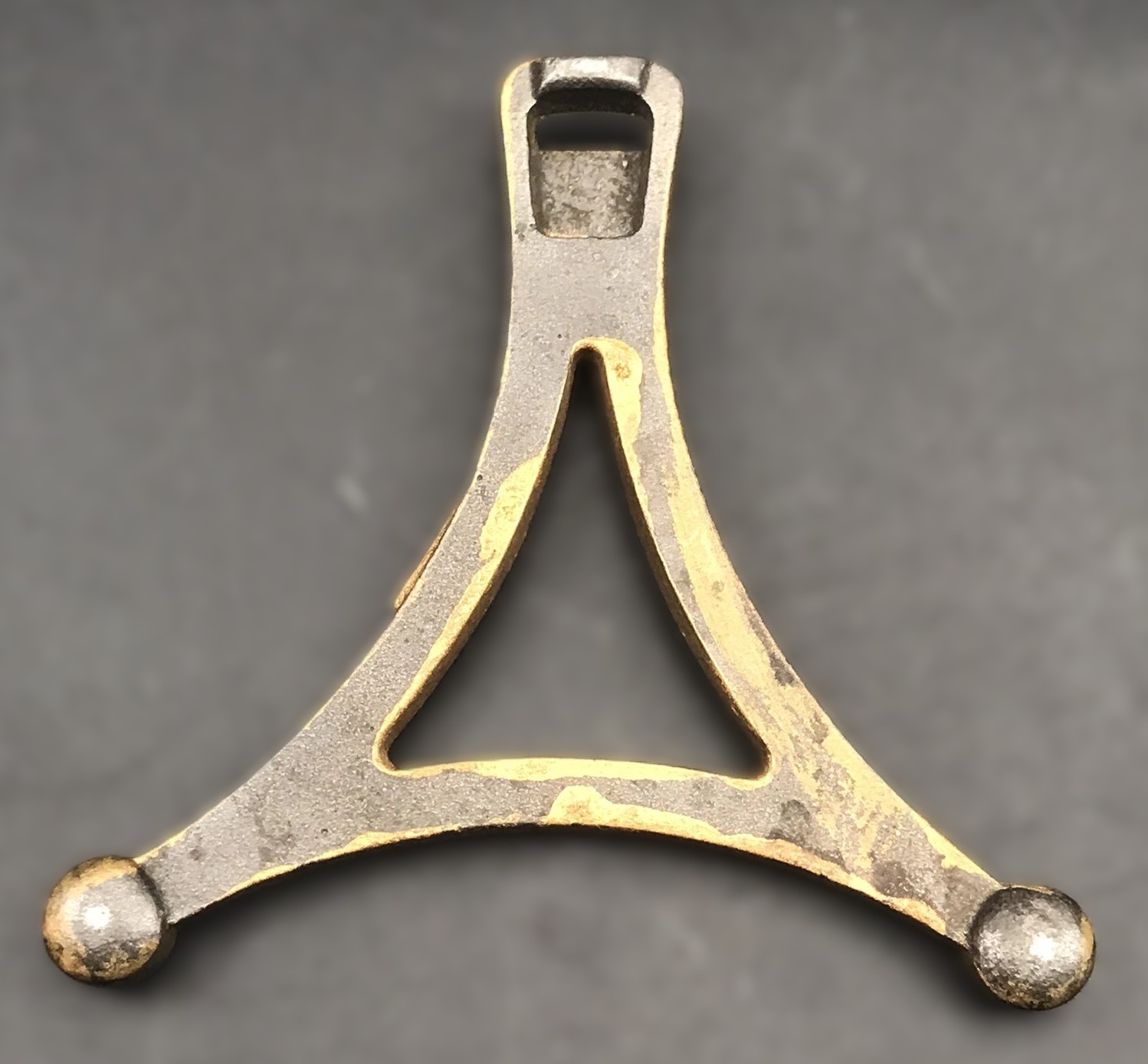
This piece is the revolving frame (or carriage), labeled as f in the patent drawings.
Its function is as follows:
- Central Pivot: The center hole fits over the vertical spindle/axis of the stand.
- Structural Support: The three “arms” of this triangular piece provide the skeletal support for the rings that hold the glass inkwells.
- Balance: The knobbed ends act as the points where the weight of the glass is distributed.
Without this piece, the inkwells would have nothing to sit on to facilitate the rotation.
The “Desktop” vs. “Rolltop” Version
While Cutler is famous for the rolltop desk, there is a standalone version. Figure 4 of the patent shows the version that “clips” into the desk’s internal structure. The desktop model, with its weighted-looking base and decorative metalwork, was intended to sit proudly on top of a flat-top desk or the writing surface of a rolltop, serving as a functional piece of desk utility.
Sold for $87 in October 2024
Desktop version sold for $100 in February 2026
Content disclaimer. The information posted is the owner’s best knowledge and may not have been vetted by the SOIC. We welcome comments, corrections, and additions, working to make our website information comprehensive and accurate.
Join the Society of Inkwell Collectors (SOIC) – it’s free!
Founded in 1981 as a non-profit organization,
we are documenting inkwells (and accessories).
We’re here to help and inform!