

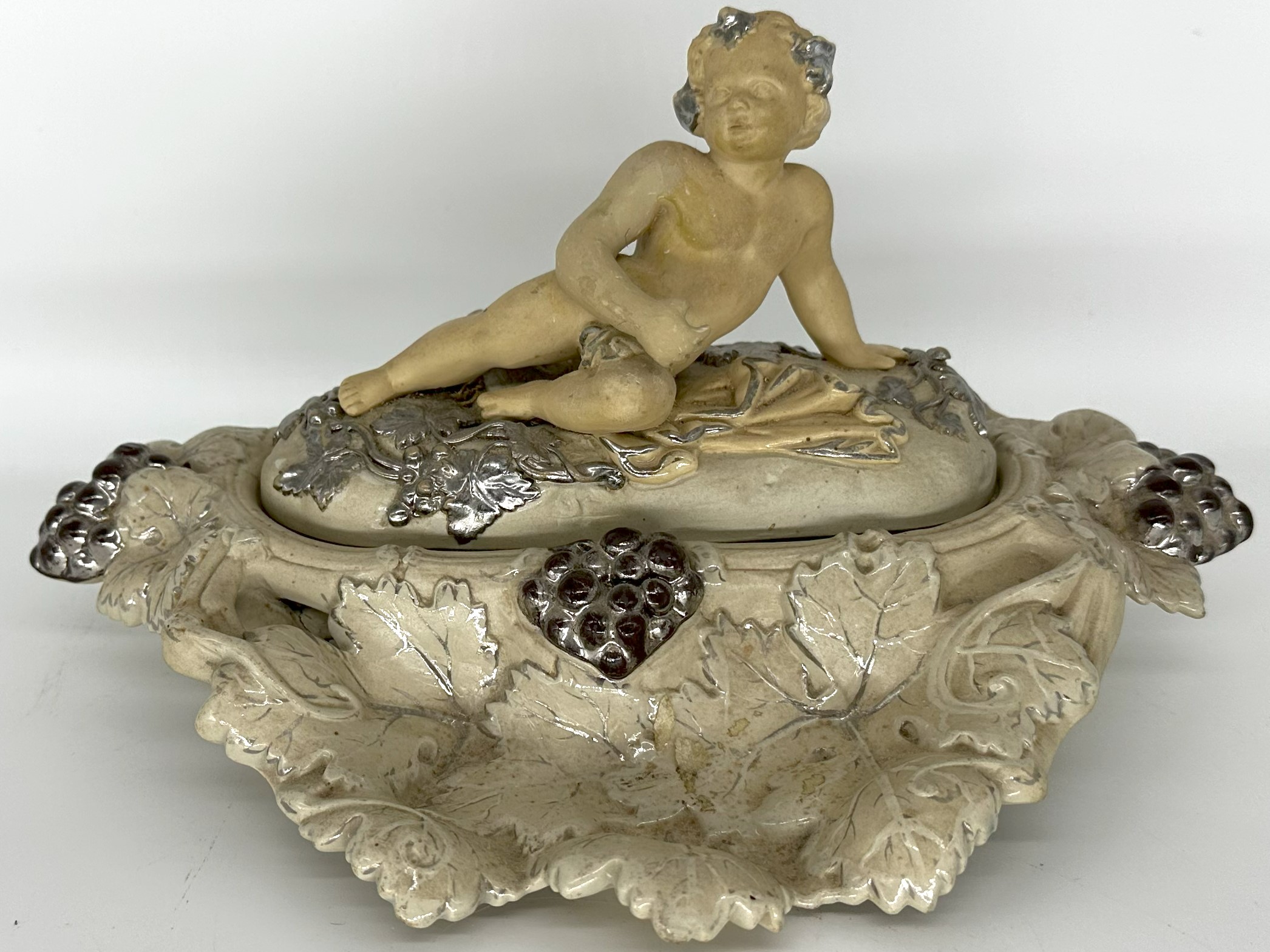
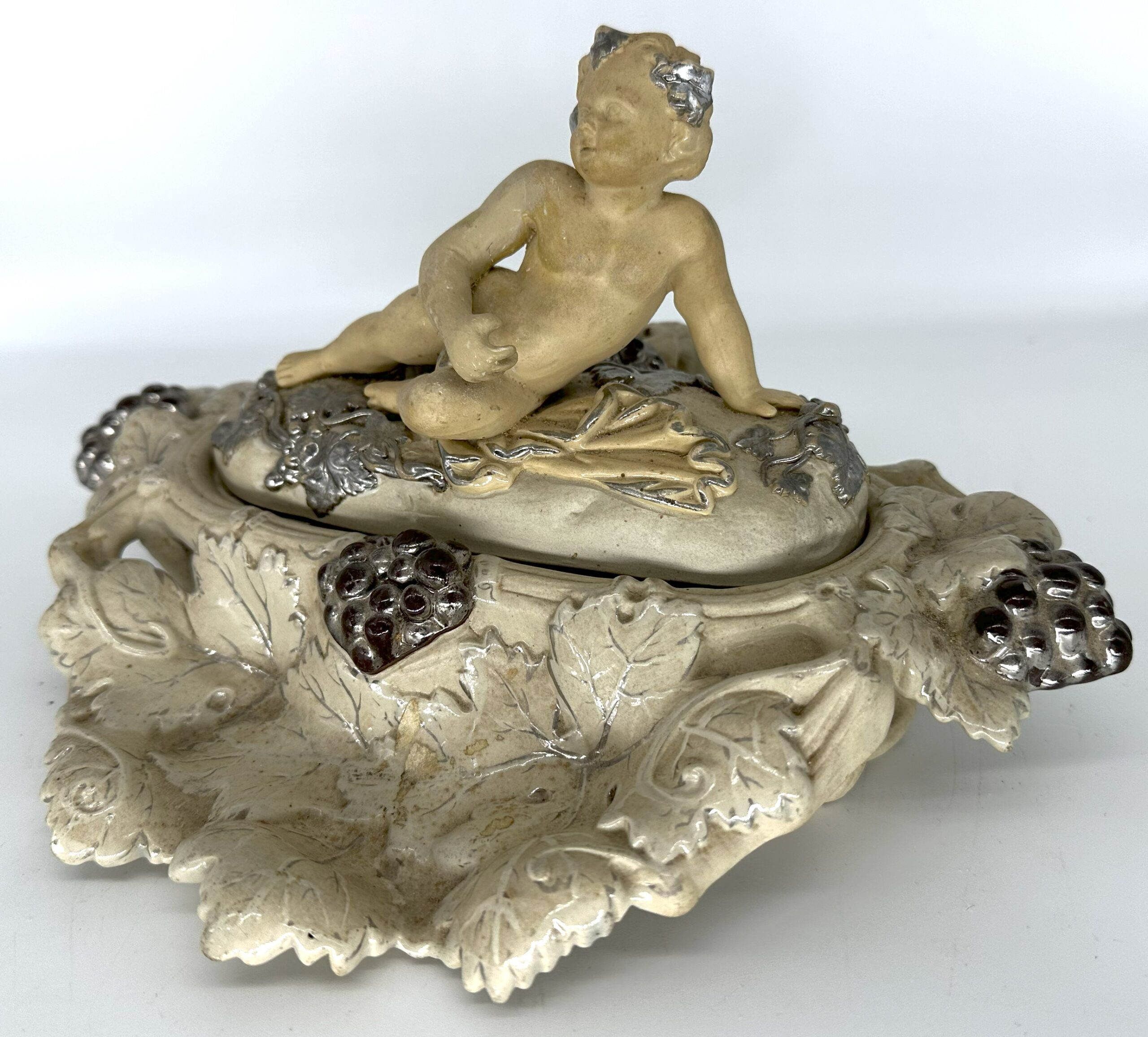


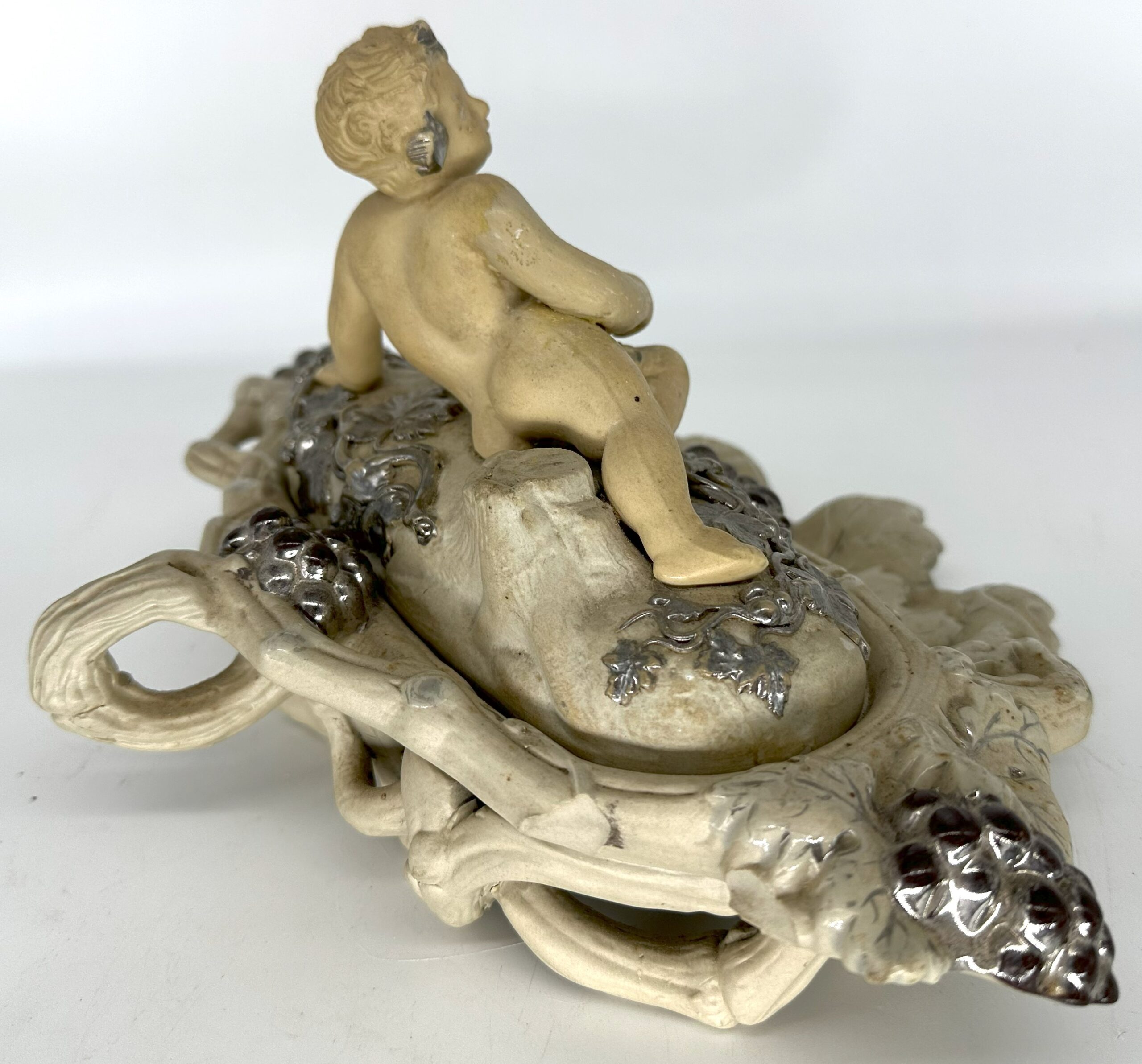
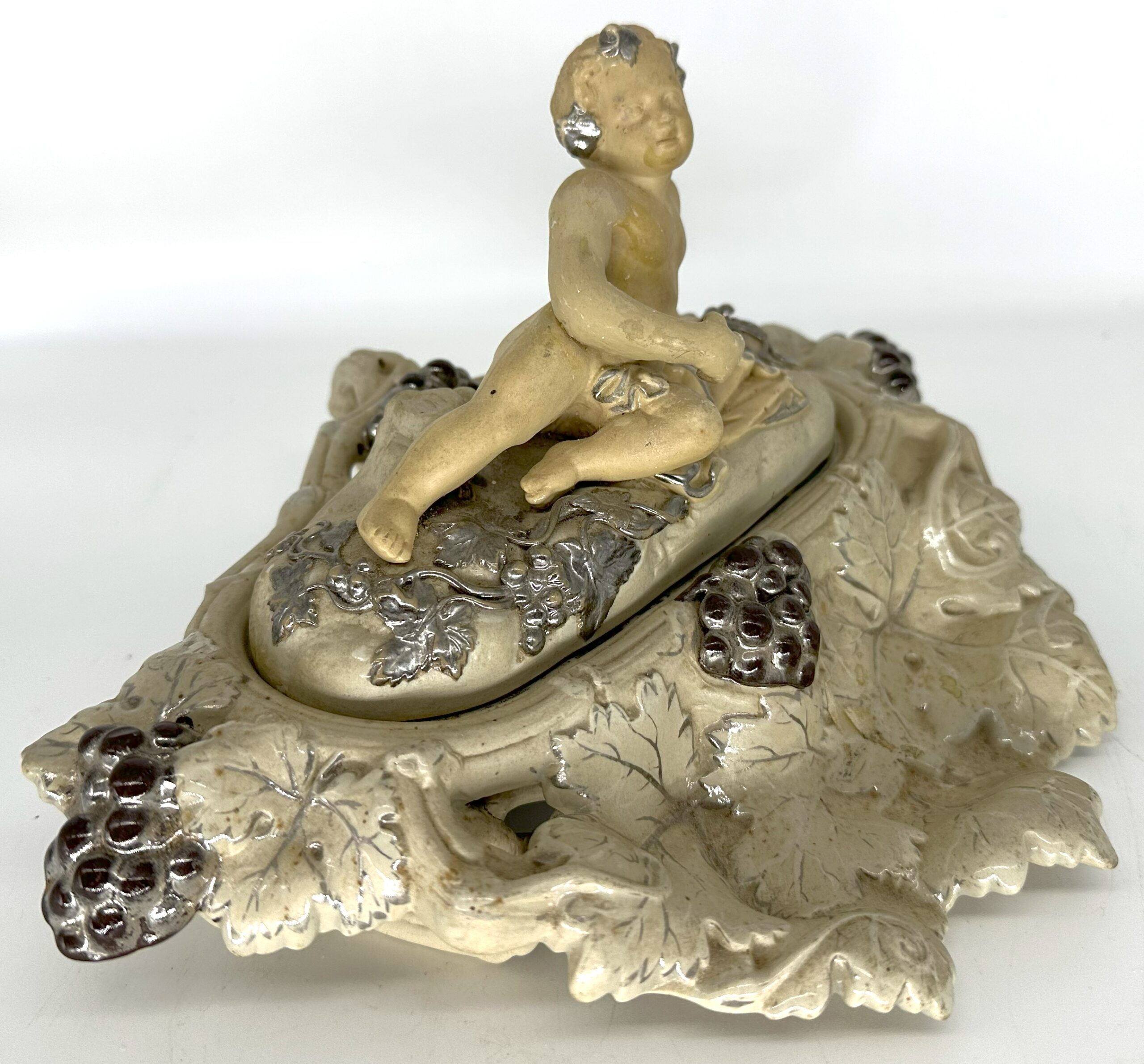


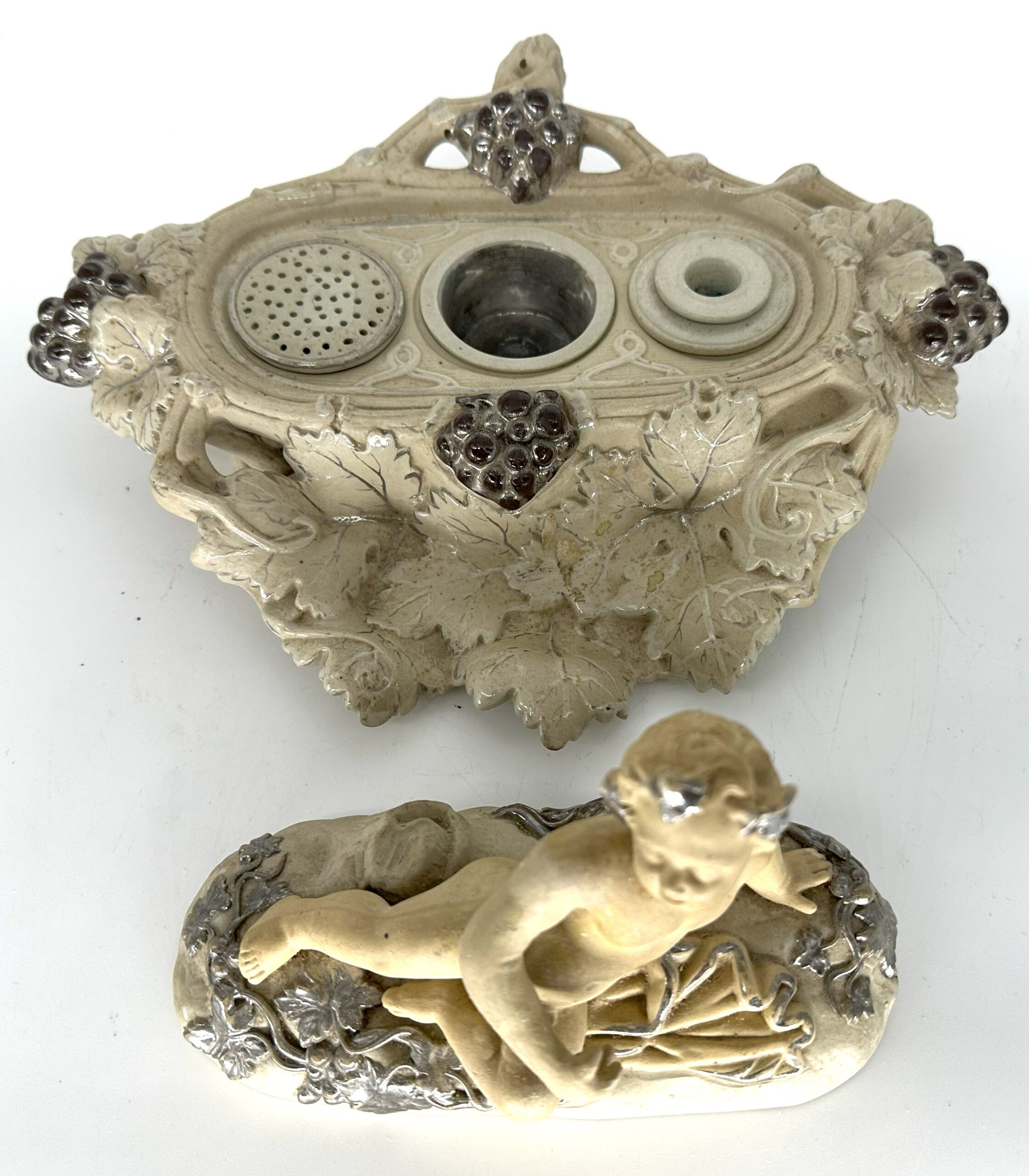


Villeroy and Boch Stoneware Reclining Cherub
| Categories | Ceramics/Porcelain "Named" Makers |
| Material | Stoneware |
| Markings | Unmarked |
| Manufacturer | Villeroy & Boch |
| Origin | Germany |
| Date or Era | circa 1860 |
| Measuring | 10 ¾” x 9” x 6” high |
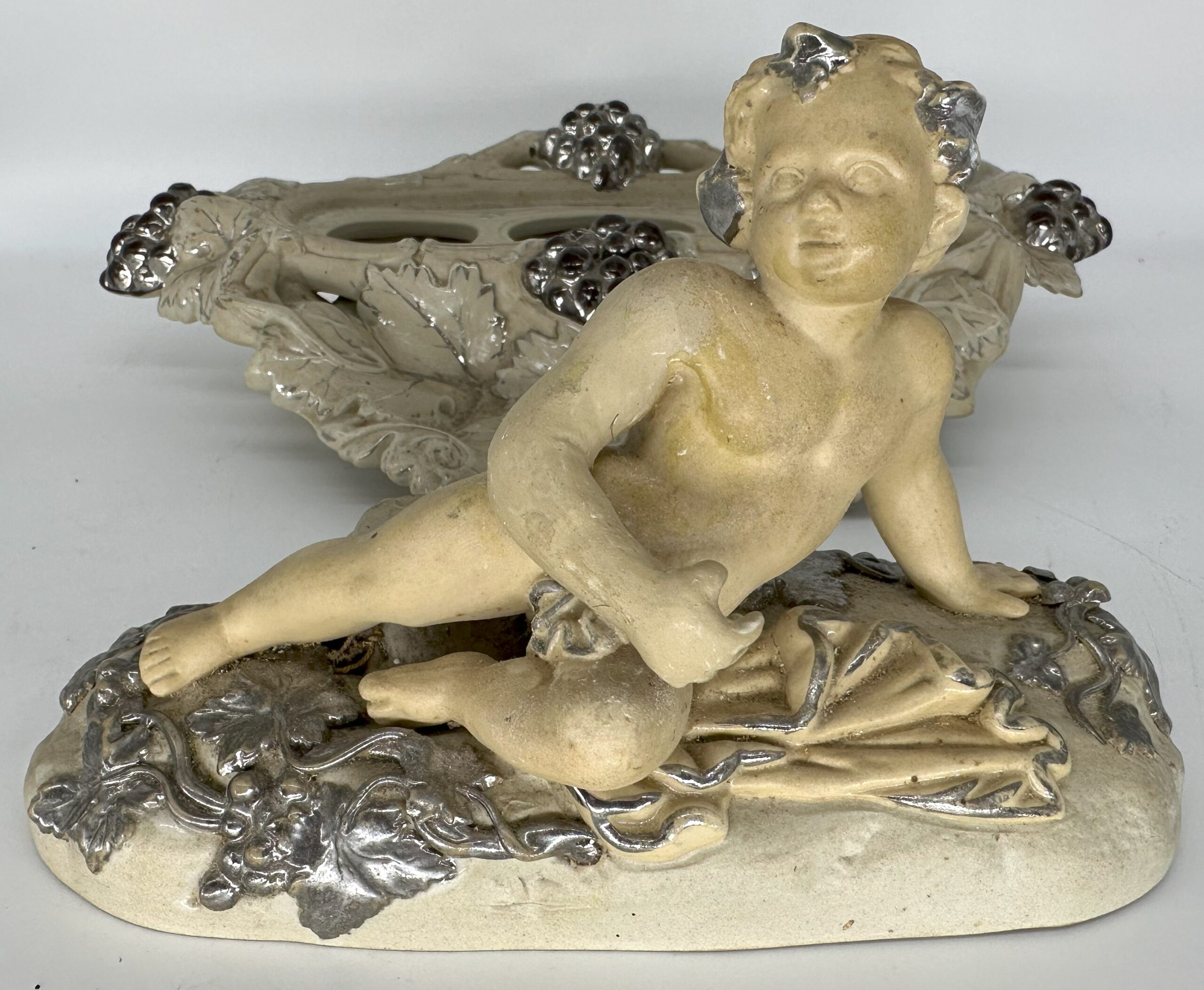
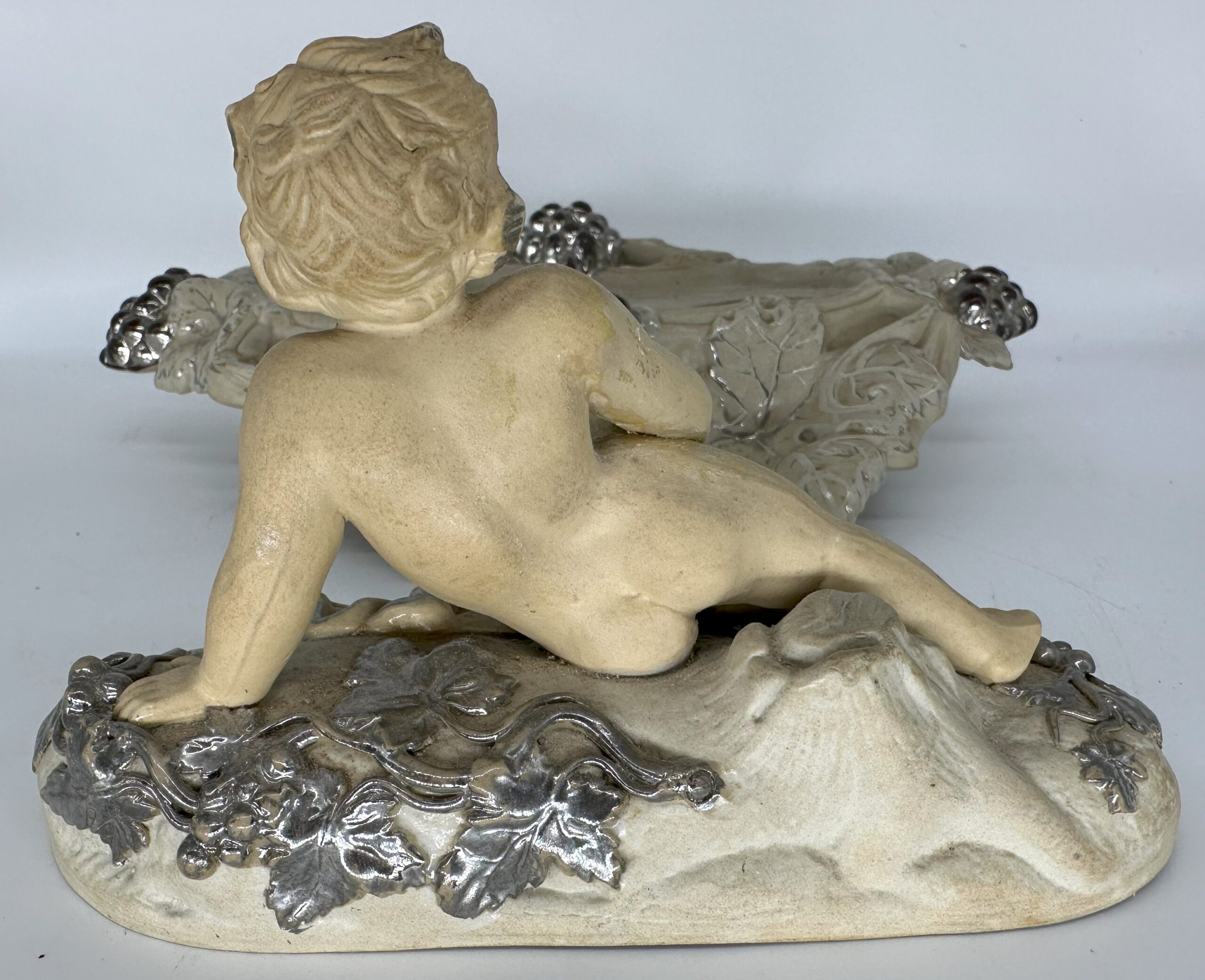
This ceramic inkstand features a sculptural, naturalistic Bacchic theme executed in glazed fine earthenware/stoneware with metallic silver-luster highlights.
Description
- Lid / Figural Finial: The top cover serves as a handle and decorative centerpiece, modeled in the round as a reclining, unglazed bisque-finish cherub (putto/infant Bacchus) resting upon a draped cloth, surrounded by molded grape leaves and vine tendrils detailed in silver luster.
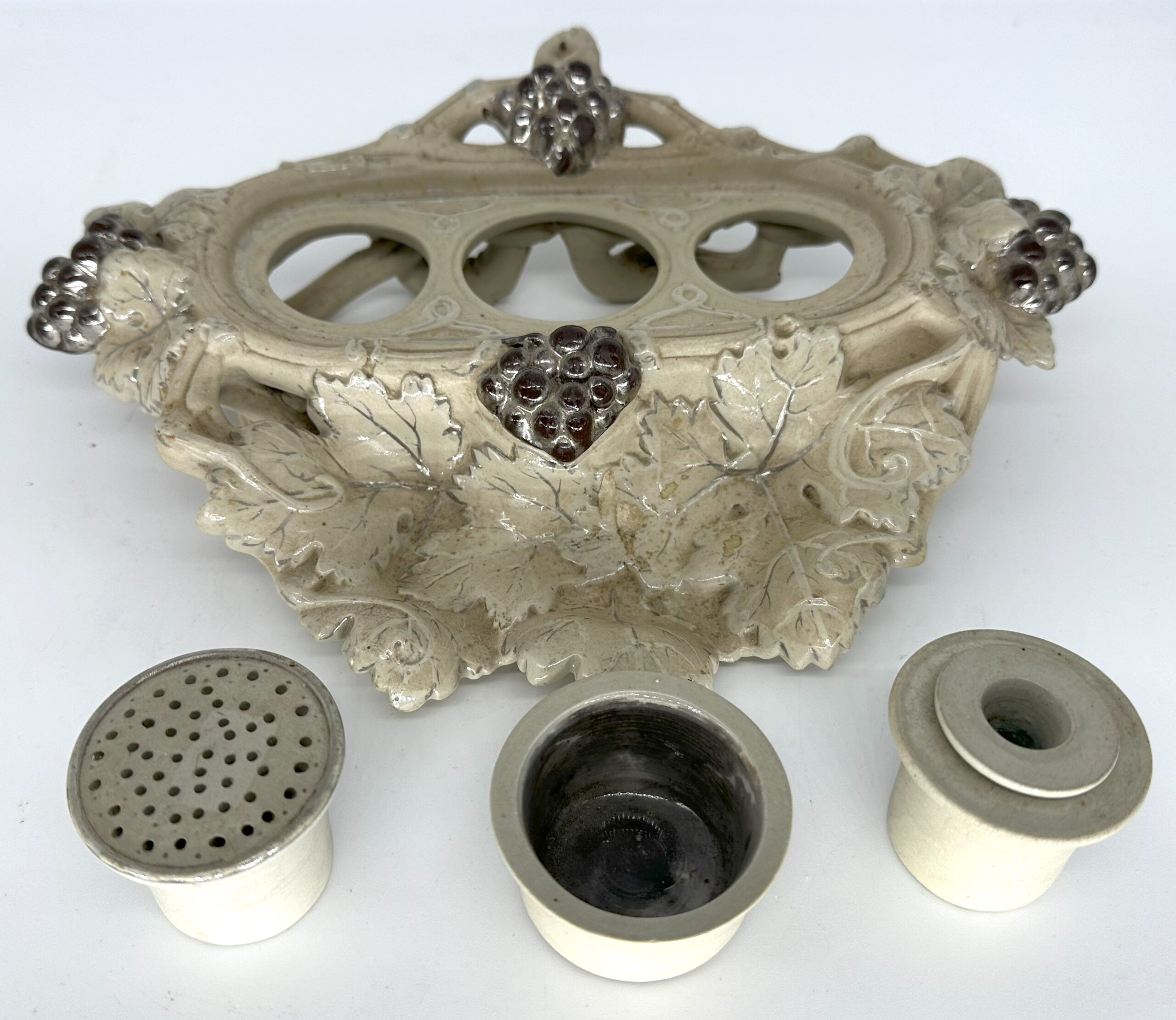
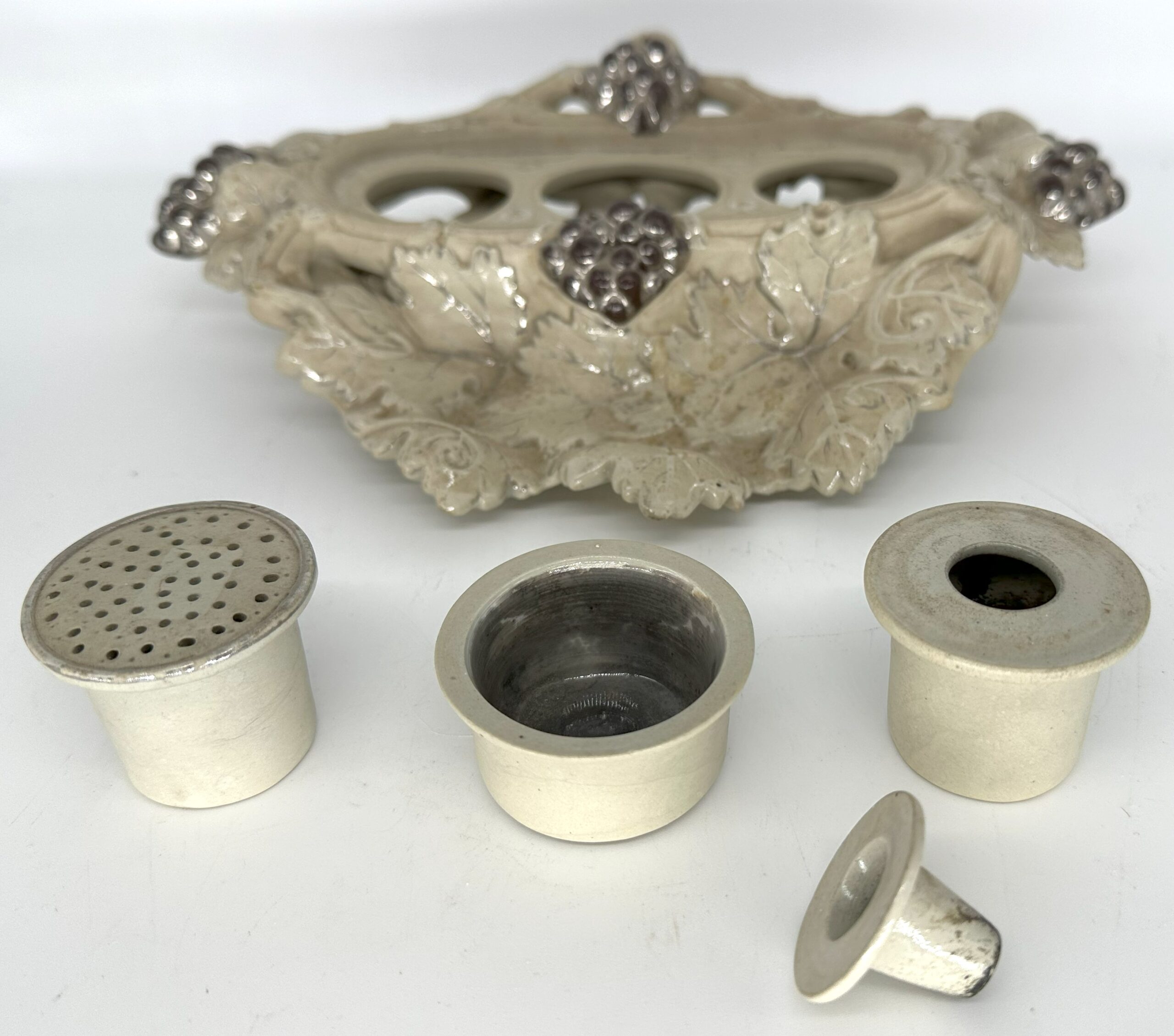
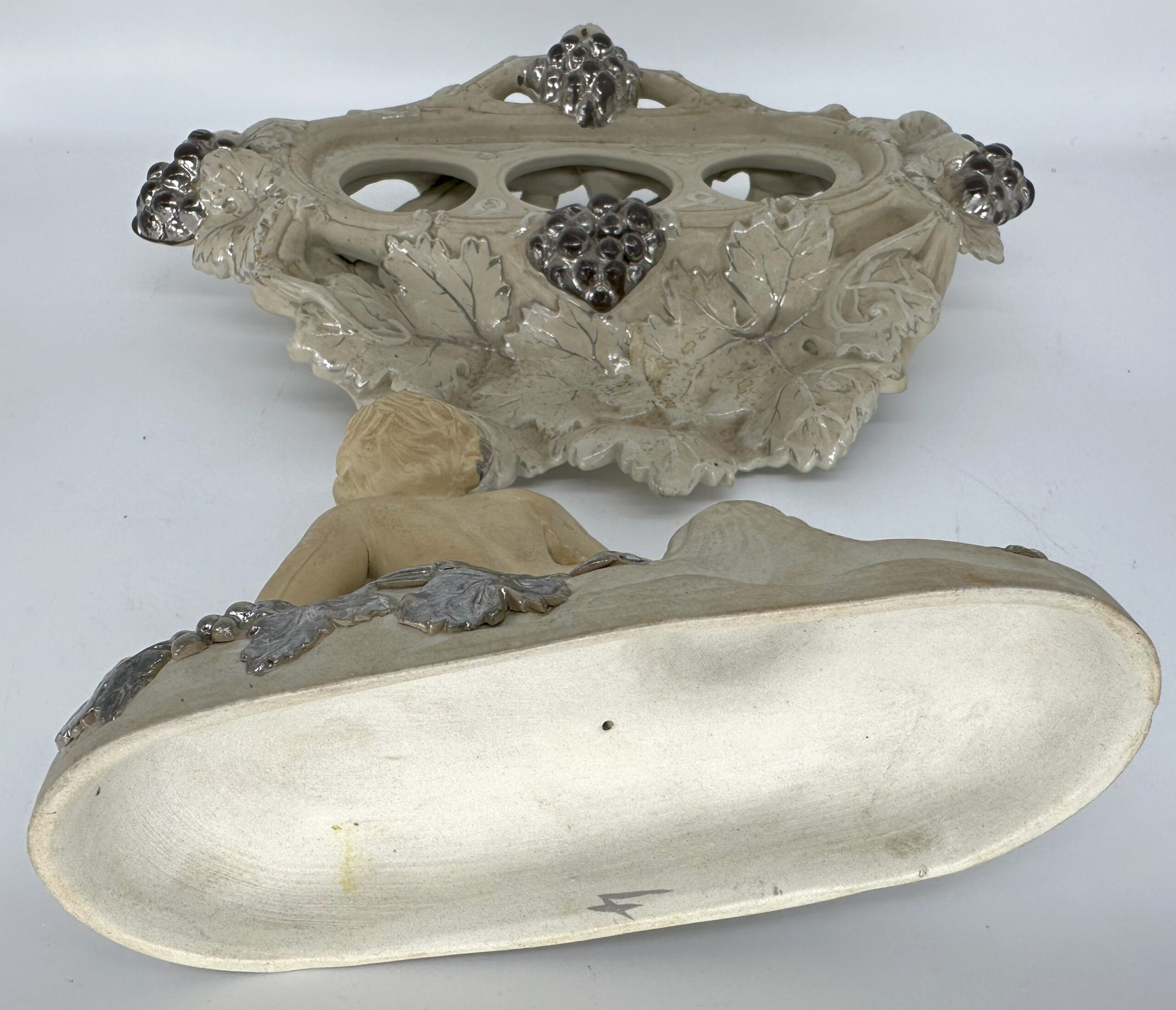
- Internal Compartments: Lifting the lid reveals a three-well platform holding three original ceramic inserts:
- A pounce pot / sander with a perforated sifter top (used to sprinkle gum sandarac powder or pounce onto parchment/paper, or drying sand before the widespread adoption of blotting paper).
- A central open well / wash well (for holding water or sponge to clean nibs, or spare nibs/accessories).
- An inkwell fitted with an internal stepped neck/rim designed to guide a dip pen and minimize evaporation and spills.
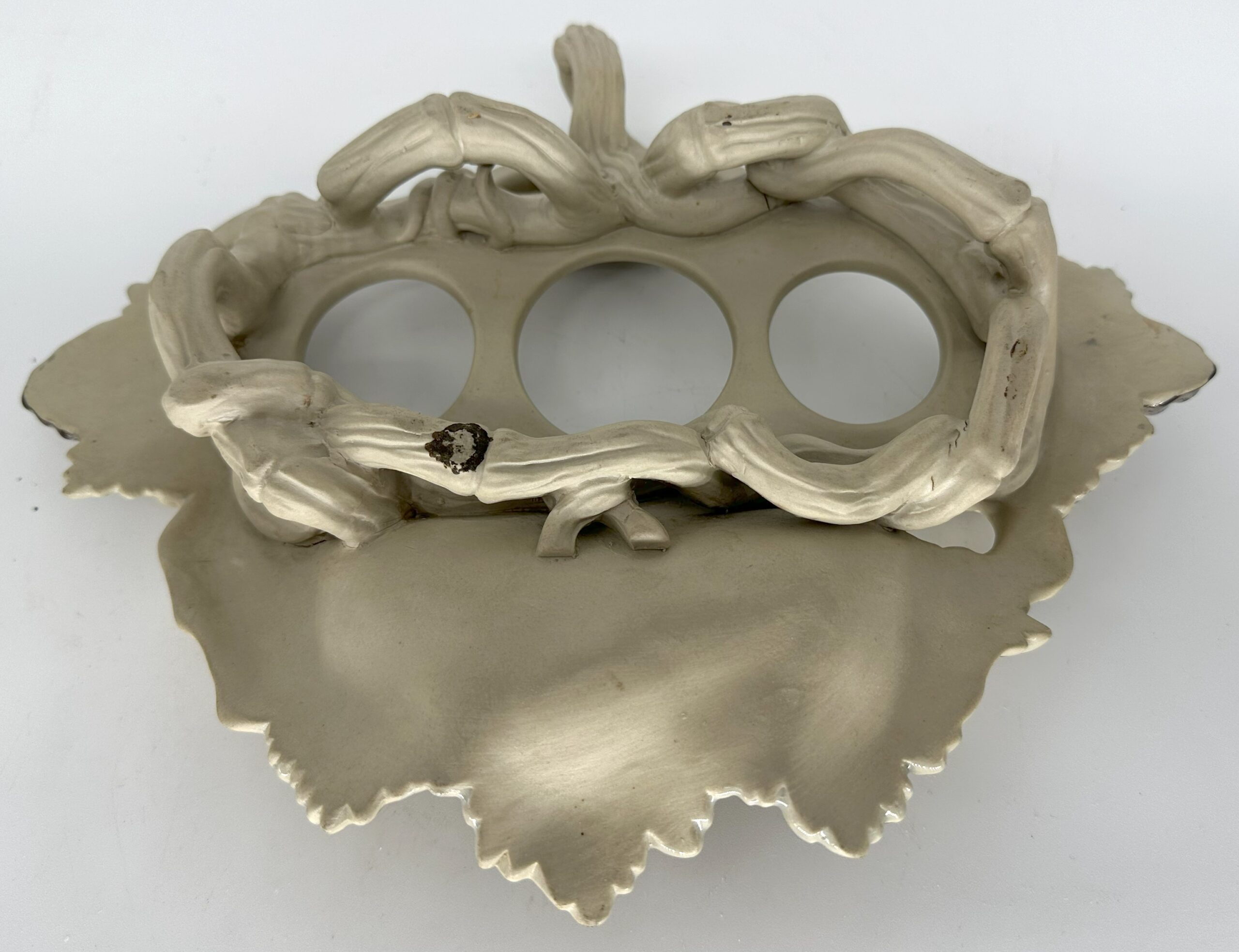
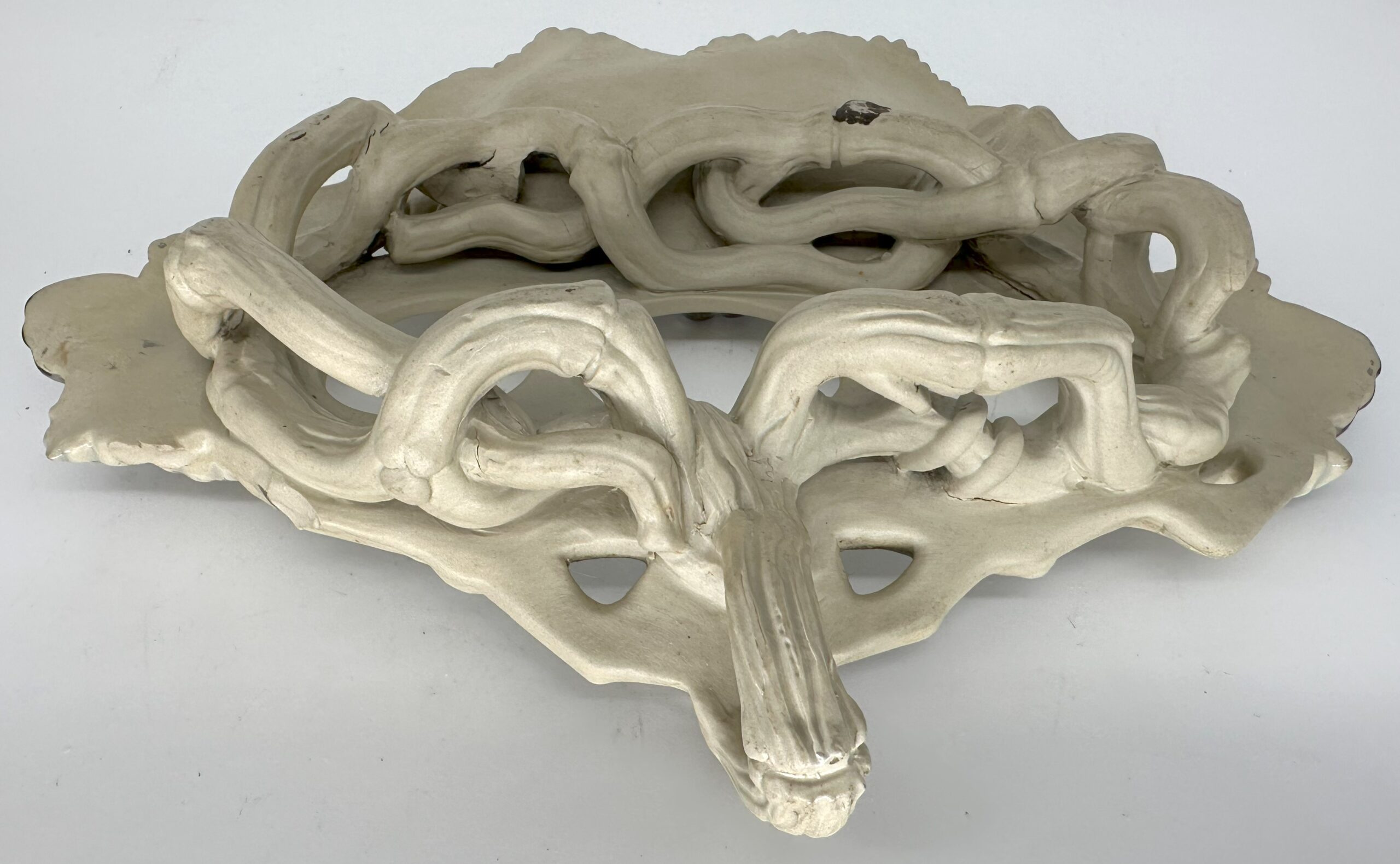
- Stand & Base: The tray is intricately molded as entwined, reticulated grapevine branches, sprawling fan-like vine leaves that form an integrated pen tray/rest, and clusters of high-relief grapes finished in dark luster glaze. The underside reveals an openwork trellis of faux-bois gnarled vine roots.
Maker & Age Estimation
- Estimated Age: Circa 1850–1880 (Mid-to-late 19th Century).
- Maker Identification: The piece is consistent with mid-19th-century German fine earthenware (Steingut) and stoneware from the Villeroy & Boch factory at Mettlach.
- Early to mid-19th-century Mettlach production extensively featured relief-molded botanical, Bacchic, and naturalistic vine motifs.
- The handwritten/incised number visible on the inside underside of the lid (looks like a script model or mold number) is characteristic of mid-19th-century workshop marks prior to the standardized stamped Mercury or Abbey-tower marks.
Historical Background: Villeroy & Boch (Mettlach)
- Founding & Merger (1748–1836): François Boch began producing ceramic tableware in Lorraine in 1748, later expanding to Septfontaines, Luxembourg. In 1791, Nicolas Villeroy established an earthenware factory at Vaudrevange (Wallerfangen). In 1836, the two rival ceramic innovators merged their businesses into Villeroy & Boch to consolidate expertise and compete against English Staffordshire imports.
- The Mettlach Abbey: In 1809, Jean-François Boch acquired the secularized Benedictine Abbey of St. Peter and St. Paul in Mettlach on the Saar River, transforming it into the company’s flagship production headquarters and artistic laboratory.
- Innovation & Technical Mastery: Mettlach became world-renowned during the 19th century for its pioneering ceramic techniques, notably fine stoneware (Feinsteinzeug), inlaid chromatic clay (Phanolith and Chromolith), and lustred earthenware that bridged Rococo revival, Historicism, and early Art Nouveau.
Here is a link to an article about cherubs, cupids, and other angels in art:
Cherubs, Cupids, and Artistic Depictions of Angels of Love (learnreligions.com)
Estimated value: $200
Content disclaimer. The information posted is the owner’s best knowledge and may not have been vetted by the SOIC. We welcome comments, corrections, and additions, working to make our website information comprehensive and accurate.
Join the Society of Inkwell Collectors (SOIC) – it’s free!
Founded in 1981 as a non-profit organization,
we are documenting inkwells (and accessories).
We’re here to help and inform!